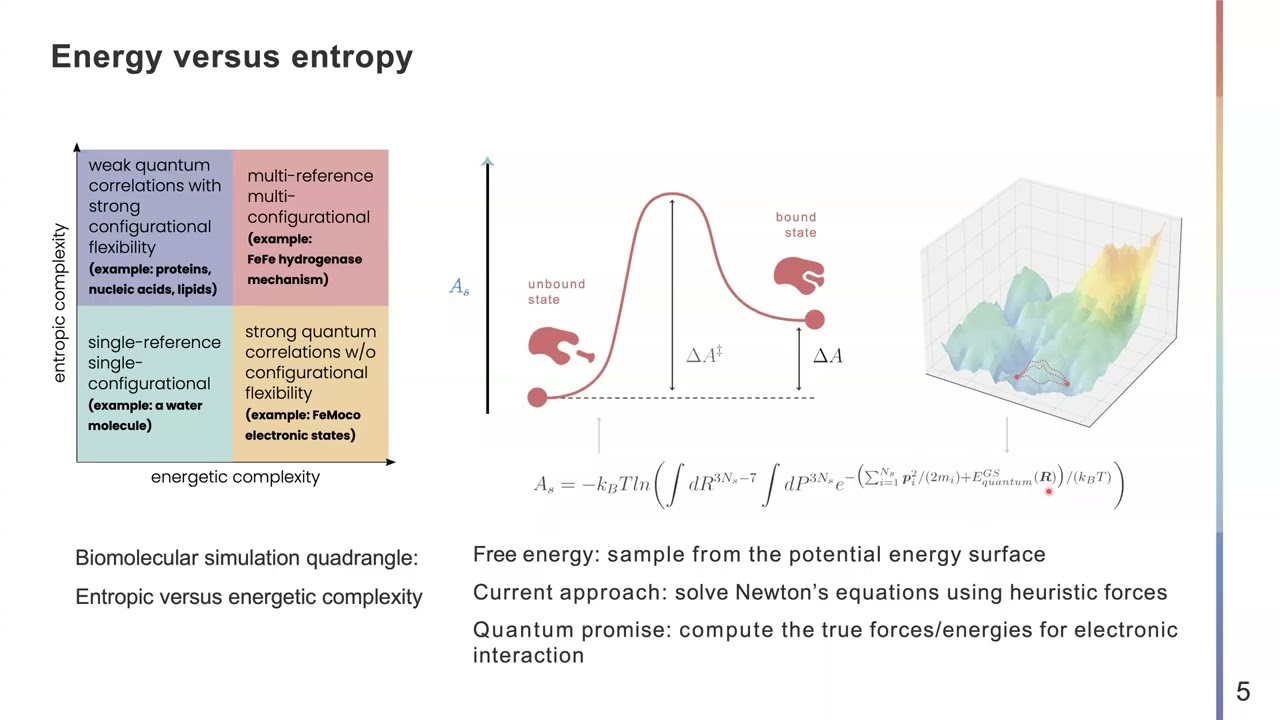
How to use quantum computers for biomolecular free energies
Keywords
Summary
177 words
Critical Evaluation
Value of the Information & Strength of the Argument
The talk provides a comprehensive overview of a complex, interdisciplinary project. It clearly explains the scientific motivation and the methodological approach. The argumentation is solid, with a logical progression from the problem statement to the proposed solution. The speaker acknowledges limitations and uncertainties, which enhances the credibility. The value lies in the detailed description of the workflow and the integration of quantum computing into a practical application.
Scientific Rigor, Source Quality, Title Accuracy
The talk is based on a collaborative research project, and the speaker mentions that details are available in a paper (likely on arXiv). However, no specific references are provided in the talk itself. The title accurately reflects the content. The speaker is a recognized expert in quantum information, and the project involves reputable institutions. The lack of explicit citations within the talk is a minor weakness, but the overall rigor appears high.
154 words
Title / Content Match
The title accurately reflects the content, which focuses on using quantum computers for biomolecular free energy calculations.
Quality & Reliability
8/10
The speaker is a professor at the University of Copenhagen, and the talk presents a collaborative project with ETH Zurich, MIT, and Novo Nordisk. The content is technical and detailed, but it is a seminar presentation rather than a peer-reviewed publication. The speaker acknowledges limitations and areas of uncertainty, which adds credibility.
Key Moments
Markers derived by PSI from the transcript: the creator did not define chapters.
- Introduction of the team and project overview.
- Explanation of the biomolecular simulation quadrangle.
- Discussion of free energy and the partition function.
- Overview of the FreeQuantum workflow.
- Details on free energy perturbation and alchemical methods.
- Explanation of machine learning force fields and active learning.
- Discussion of quantum computing integration and challenges.
Cited Sources
- arXiv paper (likely) — The speaker mentions a link to the archive in the bottom right, but it is not visible in the transcript.
Concurring Sources
- Quantum computing for chemistry — General background on quantum computing applications in chemistry.
Contribution & Novelties
The talk presents a novel, integrated workflow for using quantum computers in biomolecular free energy calculations, combining classical molecular dynamics, quantum chemistry, and machine learning. The approach addresses the challenge of sampling by using free energy perturbation and alchemical methods, and it proposes a hierarchical refinement strategy. The project is a collaborative effort involving academia and industry, which is notable.
Pour aller plus loin :
- Free energy perturbation — A key method for computing free energy differences.
- Alchemical free energy methods — Used to handle solvation effects.
- Quantum computing for quantum chemistry — Background on quantum algorithms for chemistry.
- Machine learning force fields — Relevant to the ML1 and ML2 force fields mentioned.
113 words
Radar Profile
The radar profile shows high scores in information quantity, quality, technical level, and reliability, indicating a dense, expert-level presentation. The talk is highly technical and assumes prior knowledge, which may limit its accessibility to a broader audience.
💬 No comments were provided for analysis.