QTML 2025: Modern techniques in quantum algorithms
Keywords
Summary
147 words
Critical Evaluation
Value of the Information & Strength of the Argument
The talk provides a comprehensive and well-structured overview of QSP and QSVT, explaining both the theoretical foundations and practical numerical aspects. The argumentation is clear, building from simple single-qubit examples to the general framework of QSVT. The speaker effectively motivates the techniques by showing their unifying power and wide applicability. He also addresses limitations and open questions, demonstrating a balanced perspective. The presentation is rigorous, with references to key papers and a clear logical flow.
Scientific Rigor, Source Quality, Title Accuracy
The talk is scientifically rigorous, referencing foundational papers such as those by Low and Chuang, and Gilyén et al. The speaker is a postdoctoral researcher with relevant expertise. The title accurately reflects the content. The talk does not include a public comments section, so no analysis of viewer feedback is possible.
141 words
Title / Content Match
The title accurately reflects the content, which focuses on modern techniques in quantum algorithms, specifically QSP and QSVT.
Quality & Reliability
8/10
The talk is a technical tutorial by a postdoctoral researcher at the University of Tokyo, presenting established and recent results in quantum algorithms. The content is well-structured, references key papers, and includes numerical stability considerations. However, as a conference talk, it does not provide full proofs or peer-reviewed validation of all claims.
Key Moments
Markers derived by PSI from the transcript: the creator did not define chapters.
- Introduction and overview of the talk's structure
- Historical background: NMR and composite pulse sequences
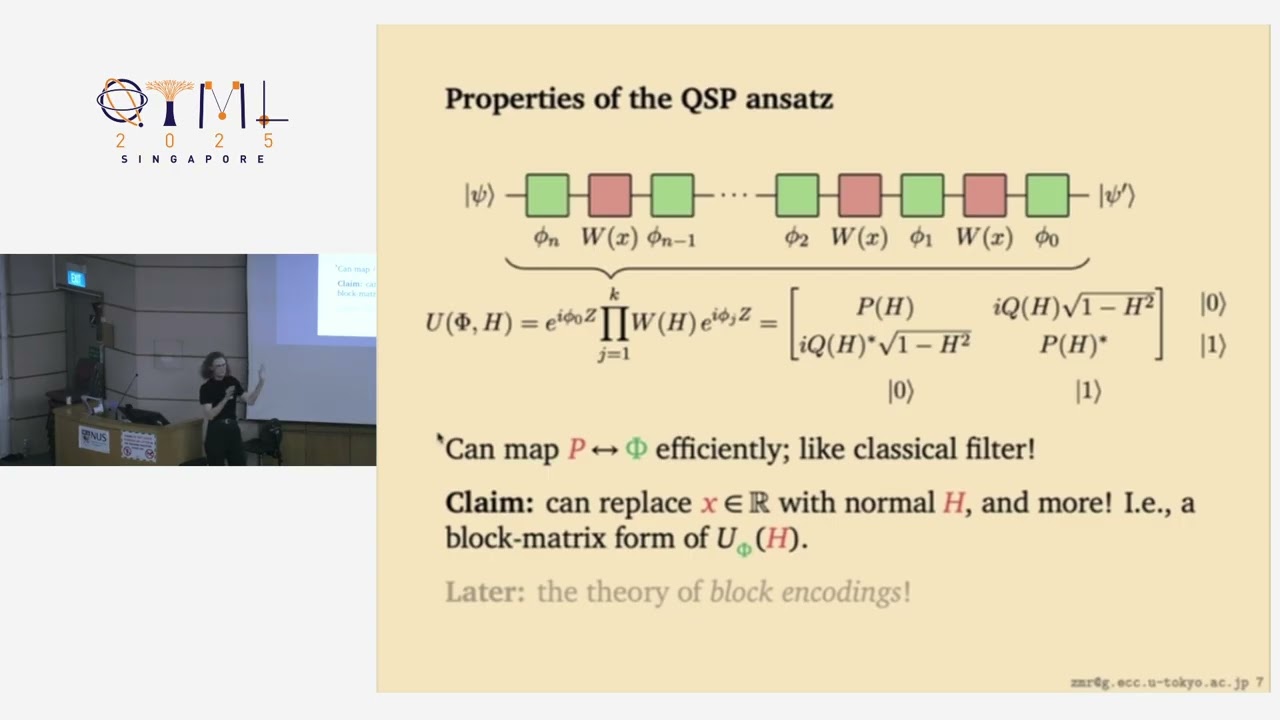
- Definition of quantum signal processing (QSP) and its circuit
- Achievable polynomials in QSP and constraints
- Numerical methods for computing QSP phases
- Introduction to block encodings and qubitization
- Quantum singular value transformation (QSVT) and its applications
- Applications: Hamiltonian simulation, amplitude estimation
- Limitations and open questions in QSVT
- Alternative approaches and concluding remarks
Cited Sources
- Quantum signal processing and its applications — Foundational paper on QSP by Low and Chuang
- Quantum singular value transformation and beyond — Paper by Gilyén et al. introducing QSVT
- QSPPACK — Software package for QSP phase computation
- PIQSP — Software package for QSP phase computation
Concurring Sources
- Quantum signal processing and its applications — The talk's content aligns with this foundational paper.
- Quantum singular value transformation and beyond — The talk's content aligns with this foundational paper.
Contribution & Novelties
The talk provides a clear and accessible introduction to QSP and QSVT, highlighting their role as unifying frameworks for quantum algorithms. It emphasizes the numerical aspects and practical implementation, which are often overlooked. The speaker also discusses limitations and open questions, offering a balanced view.
Pour aller plus loin :
- Quantum signal processing — Wikipedia article providing an overview.
- Quantum singular value transformation — Wikipedia article on QSVT.
- Block encoding — Wikipedia article on block encodings.
76 words
Radar Profile
The radar profile shows high scores in technical level and information quality, indicating a dense and rigorous presentation. The moderate scores in quantity and reliability suggest a focused tutorial rather than a comprehensive review.