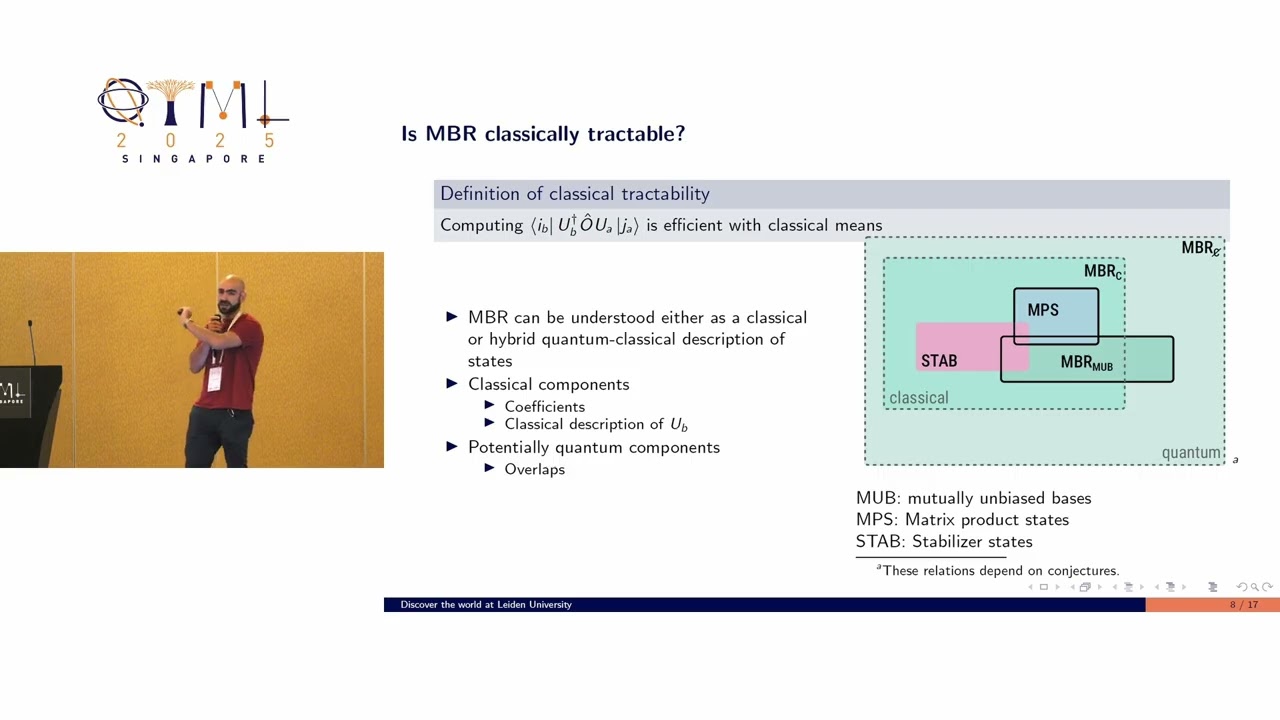
QTML 2025: Multiple-Basis Representation Of Quantum States
Keywords
Summary
132 words
Critical Evaluation
Value of the Information & Strength of the Argument
The talk presents a novel theoretical framework with potential practical implications for near-term quantum computing. The argumentation is logically structured, starting from the limitations of classical simulation and motivating the need for hybrid approaches. The speaker provides a formal definition of MBR and discusses its properties, including its relationship to existing methods. However, the presentation is concise and lacks detailed proofs or numerical results, which are presumably in the associated paper. The claims are plausible and supported by the abstract, but the talk itself does not provide extensive evidence.
98 words
Title / Content Match
The title accurately reflects the content, which focuses on the multiple-basis representation of quantum states.
Quality & Reliability
7/10
The talk presents original research with a clear theoretical framework, but the presentation is concise and lacks detailed derivations. The claims are supported by the abstract and references to the paper, but no external sources are cited in the video itself.
Key Moments
Markers derived by PSI from the transcript: the creator did not define chapters.
- Introduction and motivation for multiple-basis representation
- Definition of multiple-basis representation and its components
- Example illustrating the power of using multiple bases
- Discussion on classical extractability and relation to MPS and stabilizer states
- Role of mutually unbiased bases in the representation
- Application to finding ground states of Hamiltonians
- Conclusion and future directions
Cited Sources
- Multiple-Basis Representation Of Quantum States — The paper associated with this talk, referenced in the abstract.
Concurring Sources
- Quantum Techniques in Machine Learning (QTML) 2025 — The conference where this talk was presented, indicating peer review and relevance.
Contribution & Novelties
The talk introduces a new representation for quantum states that combines multiple bases, potentially offering a more efficient hybrid quantum-classical simulation method. It generalizes existing classical simulation techniques and may enable new applications for near-term quantum devices. The work is original and opens avenues for further research.
Pour aller plus loin :
- Matrix product states — MPS are a key classical simulation method that MBR generalizes.
- Stabilizer formalism — Stabilizer states are another class included in MBR.
- Mutually unbiased bases — MUBs play a central role in the representation’s expressivity.
90 words
Radar Profile
The radar profile shows high scores in technical level and information quality, with moderate scores in quantity and reliability. This indicates a technically dense presentation with solid content, but limited in breadth and external verification.
💬 No comments were provided for analysis.