QTML 2025: An efficient approach to realize Quantum Random Features
Keywords
Summary
107 words
Critical Evaluation
Value of the Information & Strength of the Argument
The talk provides a novel approach to generating random features using quantum circuits, with a clear theoretical motivation and numerical validation. The argumentation is solid, comparing against classical RFF and showing convergence. The speaker acknowledges limitations and discusses computational advantages. However, the presentation is concise and some details are omitted due to time constraints.
Scientific Rigor, Source Quality, Title Accuracy
The talk is based on original research, with references to prior work on RFF and quantum machine learning. The title accurately reflects the content. The speaker mentions related works but does not provide specific citations in the talk. The description includes the abstract and author list, but no external links. The methodology appears sound, but the lack of peer-reviewed publication and detailed derivations limits the assessment of rigor.
137 words
Title / Content Match
The title accurately reflects the content, focusing on an efficient quantum random features approach.
Quality & Reliability
7/10
The talk presents original research with a clear methodology, numerical experiments, and comparisons to classical baselines. However, it is a conference presentation with limited peer-reviewed validation, and the speaker acknowledges simplifications (e.g., permutation circuits).
Key Moments
Markers derived by PSI from the transcript: the creator did not define chapters.
- Introduction and outline of the talk.
- Explanation of classical two-layer neural networks and inspiration for quantum random features.
- Discussion of limitations of previous models and introduction to Random Fourier Features.
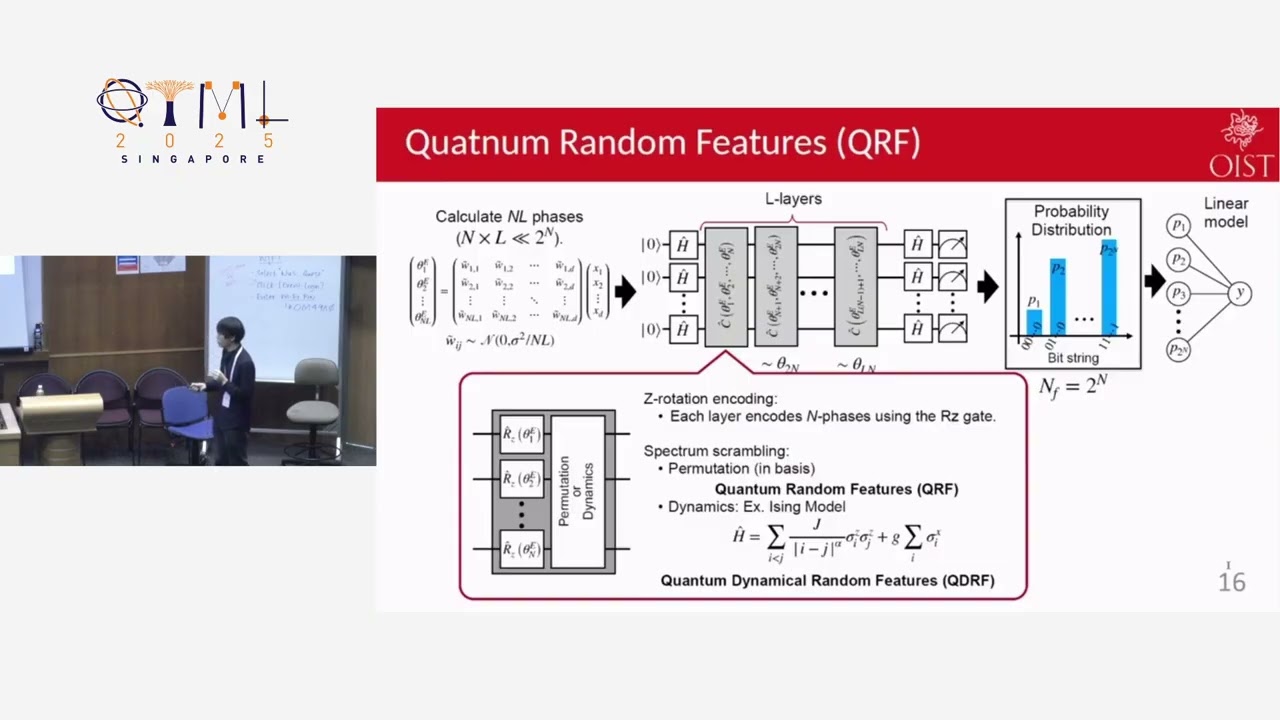
- Proposed quantum random features model with layered circuits and Z-rotation encoders.
- Theoretical analysis of frequency orthogonality and variance.
- Numerical experiments on Fashion MNIST comparing QRF, QDRF, and classical RFF.
- Finite-shot effects and scaling behavior.
- Comparison with related works and conclusion.
Cited Sources
- Quantum Techniques in Machine Learning (QTML) 2025 — Conference where the talk was presented.
Concurring Sources
- Quantum machine learning — General context for QML models.
Contribution & Novelties
The talk introduces a novel quantum random features model that reduces preprocessing cost and demonstrates applicability to image classification. It provides design principles for QML models.
Pour aller plus loin :
- Random Fourier Features — Background on classical RFF.
- Quantum machine learning — Overview of QML.
- Fashion MNIST — Dataset used for benchmarking.
53 words
Radar Profile
The radar profile shows high scores in technical level and information quality, with moderate scores in quantity and reliability, indicating a technically strong but not yet fully validated presentation.