QTML 2025: Accelerating Inference for Multilayer Convolutional Neural Networks
Keywords
Summary
156 words
Critical Evaluation
Value of the Information & Strength of the Argument
The talk provides a rigorous theoretical framework for quantum acceleration of CNN inference, with clear problem statements and formal complexity bounds. The argumentation is solid, building on established quantum computing primitives and carefully analyzing different QRAM assumptions. The speaker explains the key ideas behind the complexity results, such as the role of residual connections in norm preservation. The presentation is well-structured, moving from motivation to technical details and comparisons with prior work. However, the talk is dense and may require prior knowledge of quantum computing and complexity theory to fully appreciate.
Scientific Rigor, Source Quality, Title Accuracy
The talk is scientifically rigorous, presenting original results with formal proofs (though not fully detailed in the video). The speaker references prior work and techniques, but specific citations are not explicitly given in the talk. The title accurately reflects the content. The description provides the abstract and author list, which adds credibility. The talk is part of a reputable conference (QTML 2025).
168 words
Title / Content Match
The title accurately reflects the content, which focuses on accelerating inference for multilayer convolutional neural networks using quantum algorithms.
Quality & Reliability
8/10
The talk presents original theoretical results with formal complexity bounds, based on established quantum computing techniques (block encodings, vector encodings). The speaker is a PhD student at Oxford, and the work is co-authored with researchers from reputable institutions. The presentation is clear and technical, but the lack of a full paper or peer-review details in the video limits verification.
Key Moments
Markers derived by PSI from the transcript: the creator did not define chapters.
- Introduction and motivation: using quantum computers as linear algebra accelerators for neural networks.
- Problem statement: given a pre-trained neural network, speed up inference using quantum algorithms.
- Overview of three QRAM regimes and network architectures based on ResNet.
- Key idea: residual connections allow lower bounding the norm of vectors, enabling complexity proofs.
- Definitions of block encodings and vector encodings, and their properties.
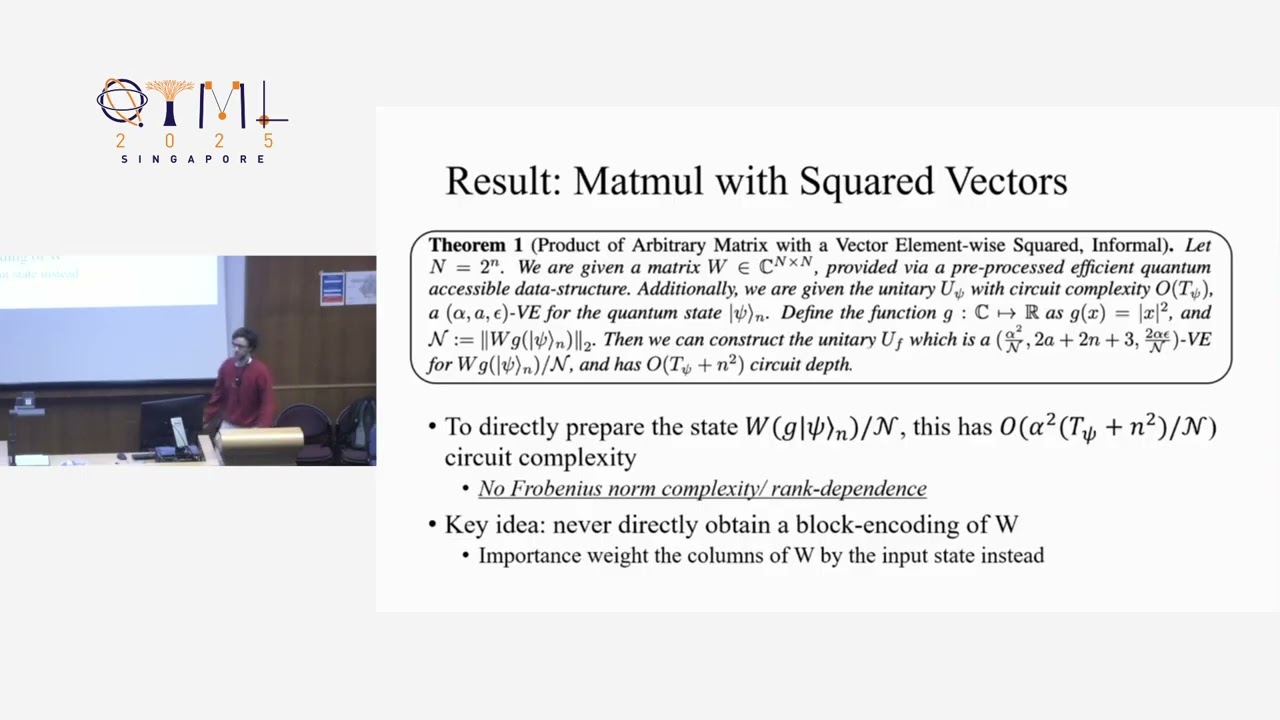
- First result: applying a full-rank matrix to the element-wise square of a vector without Frobenius norm complexity.
- QRAM-free block encoding for multifilter 2D convolutions.
- Residual skip norm block implementation and complexity analysis.
- Main complexity theorem for regime 1 (full QRAM) and regime 2 (weights only).
- Regime 3 (no QRAM) and comparison with prior work.
Cited Sources
- QTML 2025 conference — The talk was presented at this conference.
Concurring Sources
- Quantum singular value transformation — The talk uses block encodings, which are a key component of quantum singular value transformation.
Contribution & Novelties
The talk presents novel quantum algorithms for accelerating inference in CNNs, with provable complexity bounds under different QRAM assumptions. The key contributions include a QRAM-free block encoding for convolutions, a method to apply full-rank matrices without Frobenius norm cost, and end-to-end complexity statements for multi-layer networks. The work addresses a gap in integrating quantum computers into classical deep learning pipelines.
Pour aller plus loin :
- Quantum Random Access Memory — Background on QRAM, a key assumption in the talk.
- Block encoding — The technique used for encoding matrices in quantum circuits.
- ResNet — The classical architecture that the quantum algorithms aim to accelerate.
103 words
Radar Profile
The radar profile shows high scores in information quantity, quality, and technical level, with a slightly lower but still high reliability score. This indicates a technically dense and well-presented talk, but with some limitations in verifiability due to the lack of a full paper.