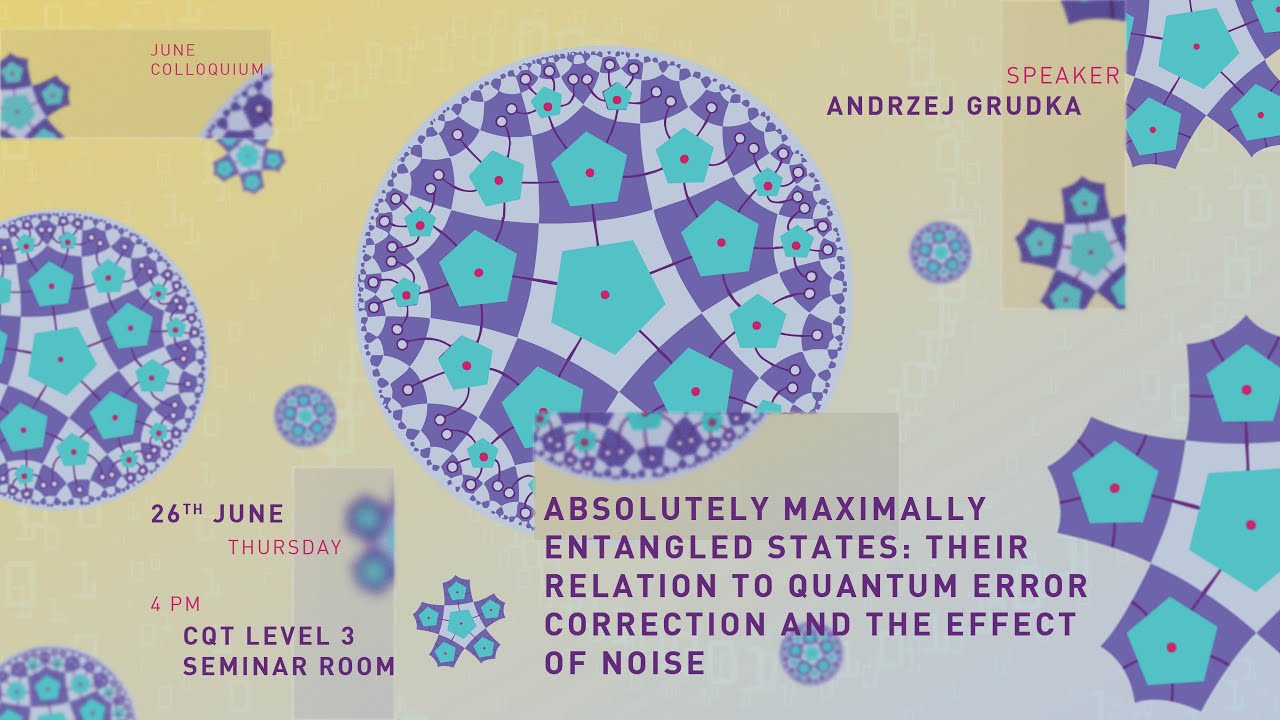
Absolutely Maximally Entangled States
Keywords
Summary
130 words
Critical Evaluation
Value of the Information & Strength of the Argument
The talk provides valuable insights into the connection between AME states and quantum error correction, offering a concrete algorithm to derive codes from graph states. The argumentation is logical and builds from basic definitions to advanced applications, with clear examples. However, the presentation is somewhat informal and lacks rigorous proofs, relying on established results. The connection to AdS/CFT is illustrative but not deeply explored.
Scientific Rigor, Source Quality, Title Accuracy
The speaker references known results (e.g., discovery of AME states in 2012, perfect tensors in 2015) but does not provide explicit citations. The title accurately reflects the content. The talk is a colloquium, so it is not a peer-reviewed source, but the speaker is an expert in the field. The description mentions applications in quantum communication and holographic codes, which are covered.
141 words
Title / Content Match
The title accurately reflects the content, which focuses on absolutely maximally entangled states and their applications.
Quality & Reliability
8/10
The talk is given by an expert researcher, presents formal definitions and algorithms, and references known results (e.g., existence of AME states, connection to error correction). However, it is a colloquium talk without peer-reviewed citations or detailed derivations, and some parts are informal.
Key Moments
Markers derived by PSI from the transcript: the creator did not define chapters.
Cited Sources
- Absolutely maximally entangled states — Mentioned as discovered in 2012, but no specific reference given.
- Perfect tensors and holographic codes — Mentioned as work by 'these guys in 2015', but no specific reference given.
Concurring Sources
- Absolutely maximally entangled states — Original paper introducing AME states.
- Holographic quantum error-correcting codes — Paper by Pastawski et al. on perfect tensors and holographic codes.
Contribution & Novelties
The talk offers a systematic method to derive quantum error-correcting codes from AME states, which is a novel perspective. It also illustrates how concatenated codes can be obtained via entanglement swapping, and connects these ideas to holographic principles.
Pour aller plus loin :
- Quantum error correction — Overview of quantum error correction.
- Stabilizer code — Formal definition of stabilizer codes.
- AdS/CFT correspondence — Background on the holographic principle.
68 words
Radar Profile
The radar profile shows high scores in information quantity, quality, technical level, and reliability, indicating a dense and expert-level presentation. The talk is highly technical and well-structured, with a strong emphasis on formal methods.
💬 No comments provided.