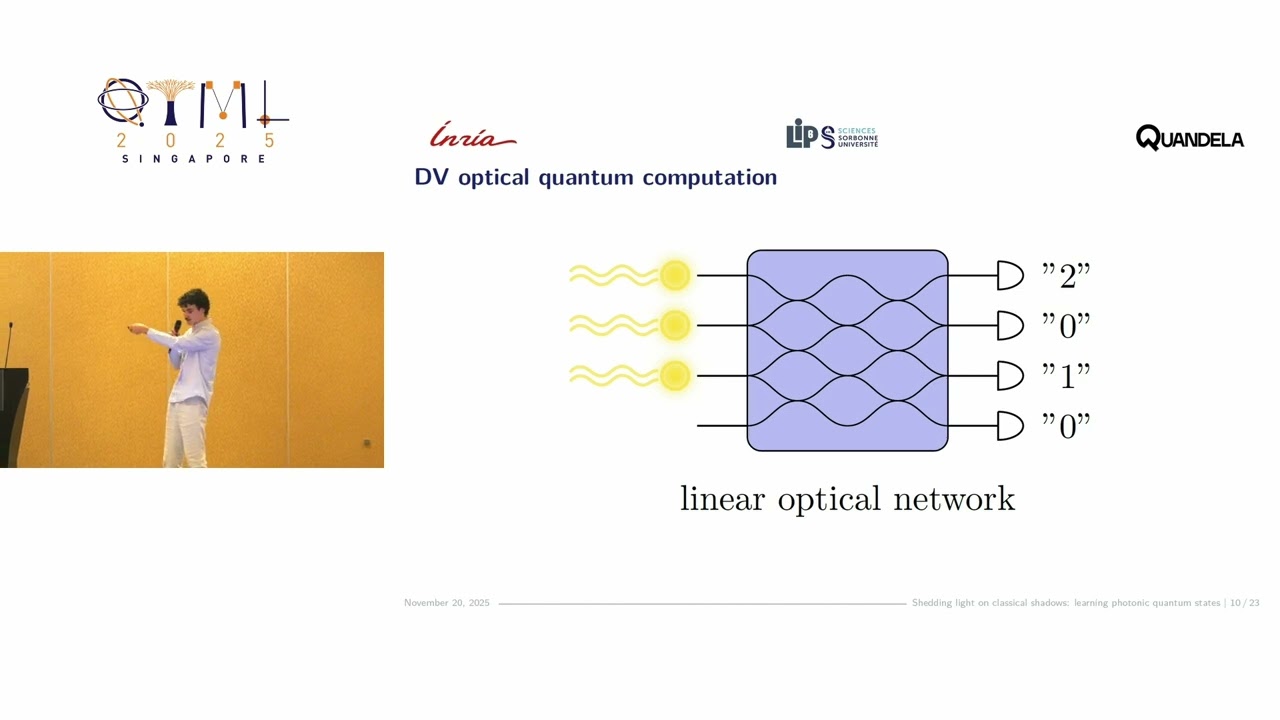
QTML 2025: Shedding light on classical shadows: learning photonic quantum states
Keywords
Summary
98 words
Critical Evaluation
Value of the Information & Strength of the Argument
The talk provides a novel extension of classical shadows to photonic systems, with rigorous theoretical guarantees and experimental validation. The argumentation is clear and well-structured, building on established concepts and addressing the specific challenges of linear optics. The experimental results strengthen the practical relevance of the protocol, and the discussion of complexity bounds is thorough.
Scientific Rigor, Source Quality, Title Accuracy
The talk is based on original research, with theoretical proofs and experimental data. The sources cited are the authors’ own paper and the experimental hardware from Quandela. The title accurately reflects the content. The presentation is scientifically rigorous, with clear methodology and results.
113 words
Title / Content Match
The title accurately reflects the content, which focuses on extending classical shadows to photonic quantum states.
Quality & Reliability
8/10
The talk presents original research with rigorous theoretical proofs and experimental validation on a real photonic processor. The methodology is sound, and the results are published. Minor limitations include the lack of peer-review details in the video and the narrow scope of the experimental validation.
Key Moments
Markers derived by PSI from the transcript: the creator did not define chapters.
Cited Sources
- Paper on classical shadows for photonic states — Mentioned as available, but no URL provided in the video description.
Concurring Sources
- Classical shadows with Pauli measurements — Original classical shadows paper, providing the foundation for this work.
Contribution & Novelties
This work introduces a classical shadow protocol for photonic quantum states, which is a significant extension of the original classical shadows framework to a different physical platform. The protocol is tailored to linear optical systems and provides efficient estimation of low-degree observables, with experimental validation. This opens new avenues for quantum state characterization in photonic quantum computing.
Pour aller plus loin :
- Classical shadows — Overview of the original classical shadows protocol.
- Boson sampling — Related computational problem in photonics.
- Linear optical quantum computing — Background on the hardware used.
90 words
Radar Profile
The radar profile shows high scores in all dimensions, indicating a well-rounded and rigorous presentation. The talk is technically deep, with strong theoretical and experimental components, making it suitable for a specialized audience.