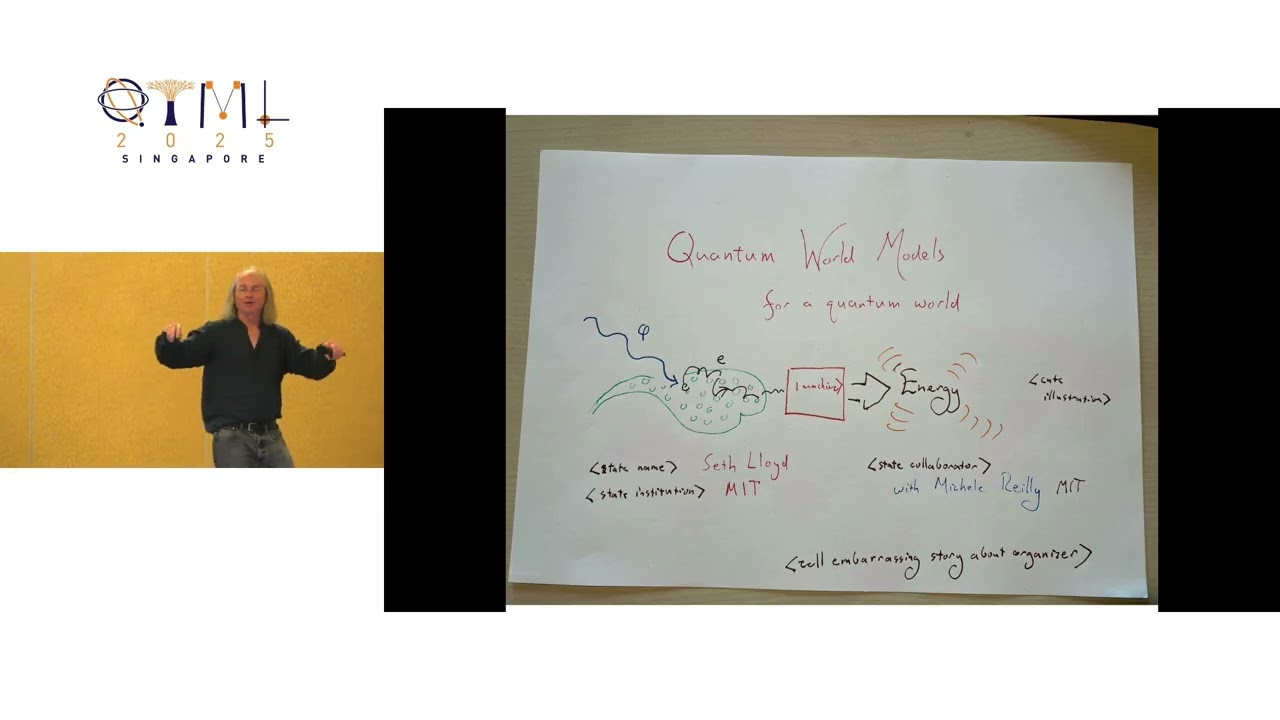
QTML 2025: Quantum world models for a quantum world
Keywords
Summary
180 words
Critical Evaluation
Value of the Information & Strength of the Argument
The talk provides a novel theoretical framework connecting quantum mechanics, thermodynamics, and evolutionary biology. The argumentation is logically structured, starting with a concrete example (photosynthesis) and building up to a general mathematical proof. The proof that populations converge to optimal quantum world models via Bayesian inference is a significant contribution, though it relies on assumptions that are clearly stated. The discussion of the quantum polar decomposition algorithm adds practical value, showing potential applications in quantum machine learning. The argument that quantum world models outperform classical ones for quantum worlds is compelling but not fully detailed in the talk.
Scientific Rigor, Source Quality, Title Accuracy
The talk is scientifically rigorous, with clear mathematical derivations and references to prior work, such as the FMO complex studies and the work of Michelle Ryley. However, few specific sources are cited in the talk itself, and the description only provides the abstract. The title accurately reflects the content, focusing on quantum world models. The talk is well-structured and the claims are presented with appropriate caveats. The lack of detailed citations in the video description limits the ability to verify all claims, but the speaker’s expertise and the mathematical nature of the presentation lend credibility.
208 words
Title / Content Match
The title accurately reflects the content: the talk introduces quantum world models and their application to a quantum world.
Quality & Reliability
8/10
Talk by a leading expert (Seth Lloyd) presenting original theoretical work with mathematical proofs, but limited peer-reviewed sources cited and no direct verification of claims.
Key Moments
Markers derived by PSI from the transcript: the creator did not define chapters.
- Introduction and thanks to organizers, mention of previous QTML conferences.
- Story about meeting Patrick and working on quantum coherence in photosynthesis.
- Explanation of exciton transport and Anderson localization in photosynthesis.
- Introduction of quantum world models and contrast with classical world models.
- Discussion of large language models lacking world models, and the need for physical intelligence.
- Presentation of quantum polar decomposition algorithm and its applications.
- Definition of quantum world models and quantum cybernetics.
- Detailed description of ATP synthesis and its efficiency.
- Introduction of thermodynamic complexity and its role in quantum processes.
- Conclusion: populations perform quantum Bayesian inference, and quantum world models are optimal.
Cited Sources
- Quantum Techniques in Machine Learning (QTML) 2025 — Conference where this talk was presented.
Concurring Sources
- Quantum Techniques in Machine Learning (QTML) 2025 — The talk itself is the primary source.
Contribution & Novelties
The talk introduces the concept of quantum world models and provides a mathematical proof that populations of quantum systems converge to optimal quantum world models via Bayesian inference. This is a novel contribution linking quantum thermodynamics, evolutionary biology, and machine learning. The quantum polar decomposition algorithm is also presented as a useful tool for quantum machine learning.
Pour aller plus loin :
- Quantum Bayesian inference — Relevant to the proof that populations perform quantum Bayesian inference.
- Anderson localization — Key concept in the photosynthesis example.
- FMO complex — Specific photosynthetic complex studied in the talk.
95 words
Radar Profile
The radar profile shows high scores in information quantity, quality, and technical level, with a slightly lower reliability score. This indicates a technically dense and informative talk, but with some limitations in verifiability due to lack of detailed citations.