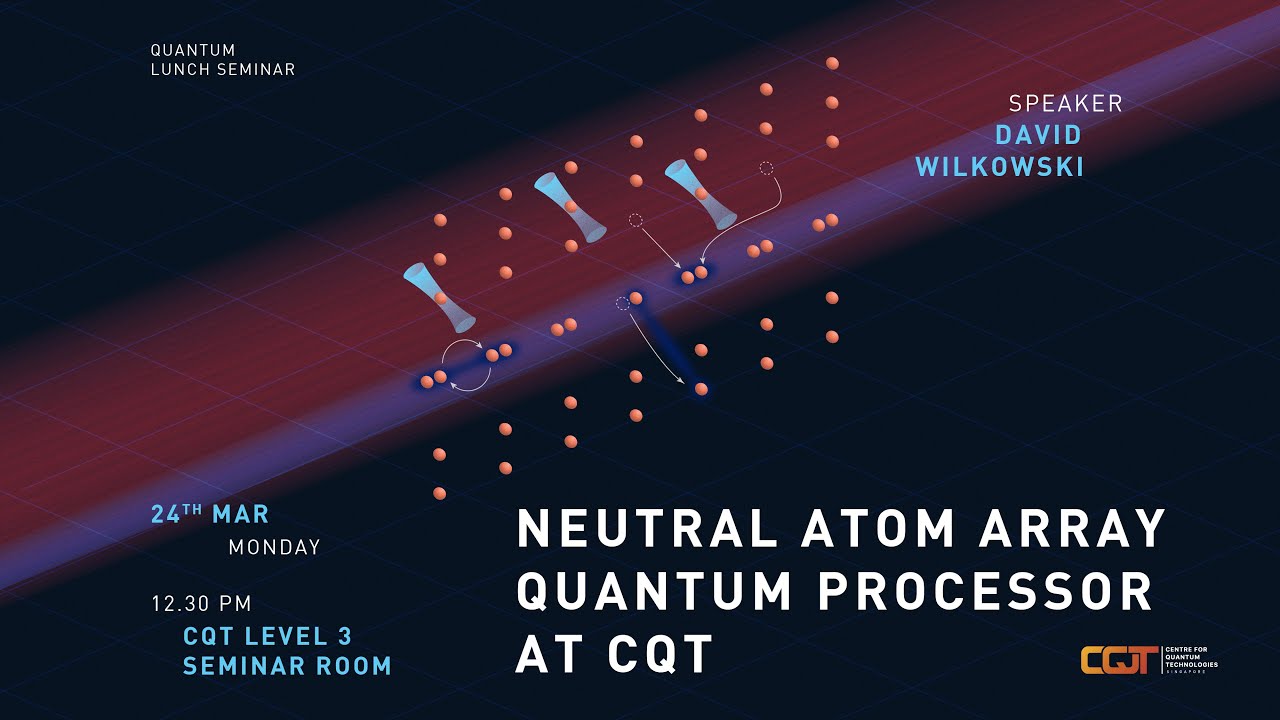
Neutral atom array quantum processor at CQT
Keywords
Summary
184 words
Critical Evaluation
Value of the Information & Strength of the Argument
The talk provides valuable insights into the design considerations and challenges of building a neutral atom quantum processor. The speaker argues for the advantages of cesium atoms, such as lower sensitivity to magnetic fields and better hyperfine optical pumping, and presents simulations showing promising gate fidelities. The argumentation is logical and grounded in technical details, though it lacks experimental validation. The speaker also discusses the potential of using all-to-all connectivity for more efficient error correction codes, which is a forward-looking perspective.
Scientific Rigor, Source Quality, Title Accuracy
The talk is scientifically rigorous in its technical explanations, but it is a project overview rather than a peer-reviewed study. The speaker references several works, including those by the Lukin group and the Endres group, but does not provide specific citations. The title accurately reflects the content. The talk is not a formal publication, so the sources are not systematically cited. The speaker’s expertise adds credibility, but the lack of experimental data limits the scientific rigor.
172 words
Title / Content Match
The title accurately reflects the content, which focuses on the design and objectives of a neutral atom array quantum processor.
Quality & Reliability
7/10
The talk is an expert presentation of a new research project, with technical details and some preliminary simulations. It is not peer-reviewed and lacks experimental data, but the speaker is a recognized researcher and the content is plausible.
Key Moments
Markers derived by PSI from the transcript: the creator did not define chapters.
- Introduction and overview of the project, including logos and support.
- Comparison of neutral atom arrays with superconducting and ion platforms.
- Discussion of quantum volume and error correction codes.
- Explanation of the neutral atom array technique and rearrangement.
- Choice of cesium and its advantages.
- Laser systems and optical tweezer design.
- Simulations of single-qubit gate fidelities and error sources.
- Magnetic field control and its importance.
- Rydberg excitation and two-qubit gate implementation.
- Conclusion and future directions.
Cited Sources
- Lukin group — Mentioned as the source for the CZ gate implementation.
- Endres group — Mentioned for the neutral atom array technique.
Concurring Sources
- Quantum computing with neutral atoms — Review of neutral atom quantum computing.
Contribution & Novelties
The talk presents a new project at CQT, with a focus on cesium atoms and a dual-site approach (digital and analog). It discusses specific design choices and simulations, providing insights into the practical challenges of building such a processor. The discussion of using all-to-all connectivity for error correction codes is a novel angle.
Pour aller plus loin :
- Neutral atom quantum computing — Overview of the technology.
- Rydberg atom — Basis for two-qubit gates.
- Surface code — Error correction code mentioned.
81 words
Radar Profile
The radar profile shows high scores in technical level and information quality, but slightly lower in information quantity and reliability, reflecting the early-stage nature of the project and lack of experimental data.