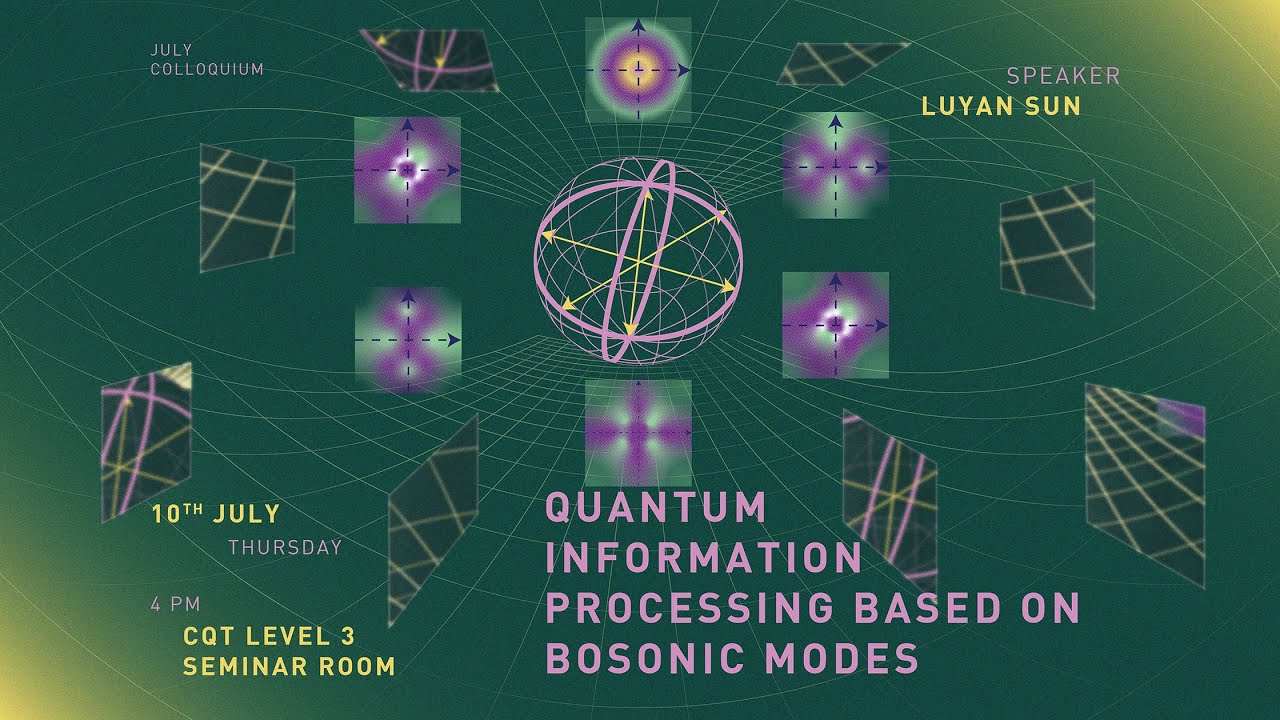
Quantum information processing based on bosonic modes
Keywords
Summary
171 words
Critical Evaluation
Value of the Information & Strength of the Argument
The talk provides a comprehensive overview of the state of the art in bosonic quantum error correction, with a focus on the speaker’s own experimental achievements. The argumentation is solid, grounded in published results and clear physical reasoning. The speaker effectively explains the advantages of bosonic codes, such as reduced hardware overhead and fewer error syndromes, and supports claims with experimental data, including surpassing the break-even point and protecting entanglement. The presentation is well-structured, moving from basic concepts to recent advances, and includes critical analysis of limitations and future directions.
Scientific Rigor, Source Quality, Title Accuracy
The speaker references several key papers, including the original binomial code proposal by Michael et al. (2016) and the GKP code, as well as their own publications. The sources are appropriate and credible. The title accurately reflects the content, which is a focused presentation on bosonic modes for quantum information processing. The talk is rigorous, with clear explanations of experimental protocols and results. The speaker also mentions a review paper they co-authored, providing further context. Overall, the scientific rigor is high, and the title-content alignment is excellent.
192 words
Title / Content Match
The title accurately reflects the content, which focuses on quantum information processing using bosonic modes, covering error correction, control, and scaling.
Quality & Reliability
9/10
The talk is given by a leading experimentalist in the field, presenting peer-reviewed results from their group, with clear methodology and references to published work. The content is technical and specific, indicating high reliability.
Key Moments
Markers derived by PSI from the transcript: the creator did not define chapters.
- Introduction to quantum error correction and the two approaches: multi-qubit codes vs bosonic codes.
- Explanation of bosonic codes and their advantages, including hardware efficiency.
- Introduction to the binomial code and its properties.
- Description of the circuit QED architecture and universal control techniques.
- First demonstration of the binomial code in 2019 and the path to surpassing break-even.
- Development of error-transparent gates and autonomous quantum error correction.
- Surpassing the break-even point for QEC with the binomial code.
- Protecting entanglement between two logical qubits using simultaneous error correction.
- Autonomous QEC using dissipation and reset without feedback.
- Scaling towards distributed quantum computation and new quantum state transfer scheme.
Cited Sources
- New class of quantum error-correcting codes for a bosonic mode — Original proposal of the binomial code by Michael et al. (2016).
- Encoding a qubit in a cavity — Review paper on bosonic codes and applications.
- Quantum error correction of a qubit encoded in grid states of an oscillator — Experimental demonstration of GKP code surpassing break-even.
Concurring Sources
- Quantum error correction of a qubit encoded in grid states of an oscillator — Independent demonstration of GKP code surpassing break-even, supporting the feasibility of bosonic QEC.
Contribution & Novelties
The talk provides an overview of recent experimental progress in bosonic quantum error correction, particularly highlighting the speaker’s group’s achievements in surpassing the break-even point and protecting entanglement. It also introduces novel techniques like error-transparent gates and autonomous QEC. The presentation offers a clear roadmap for scaling bosonic systems towards distributed quantum computation.
Pour aller plus loin :
- Bosonic codes — Overview of bosonic codes and their applications.
- GKP code — Description of the GKP code, a major bosonic code.
- Circuit quantum electrodynamics — Background on the architecture used in the experiments.
92 words
Radar Profile
The radar profile shows high scores across all dimensions, indicating a technically deep, reliable, and information-rich presentation. The talk is particularly strong in technical level and information quality, reflecting its expert audience and detailed experimental content.