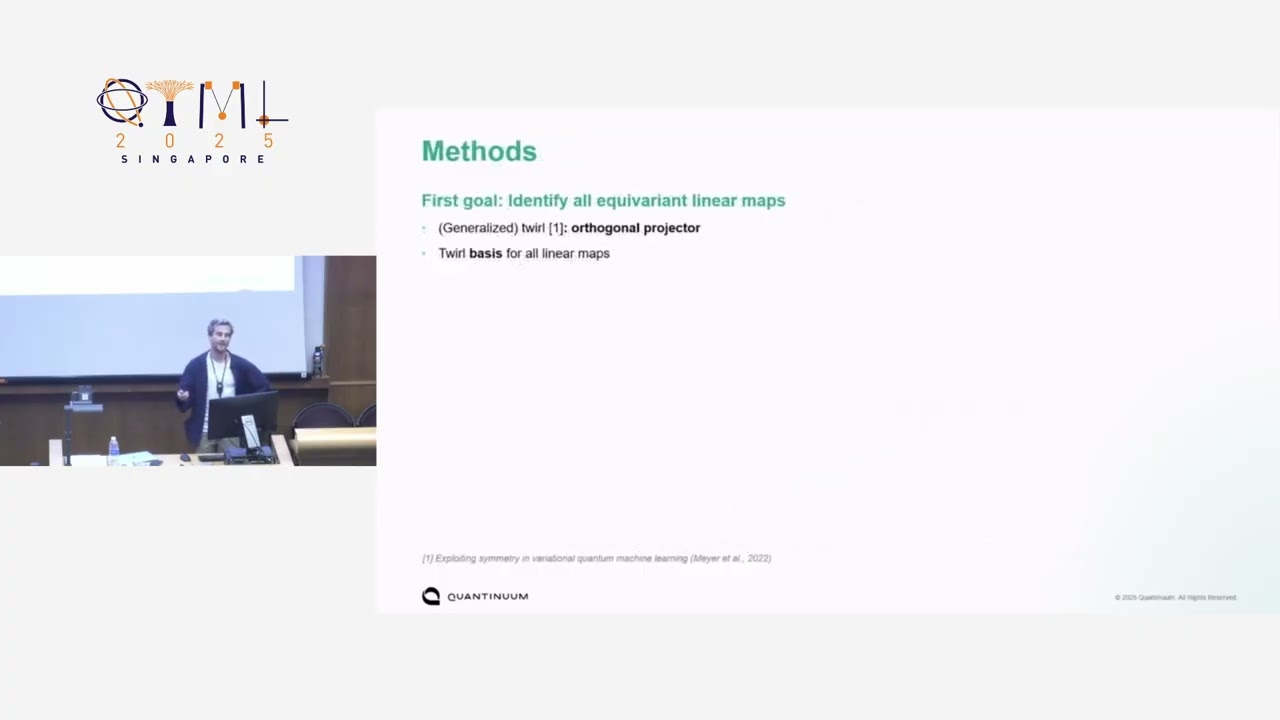
QTML 2025: Designing Quantum Machine Learning Models for Graphs
Keywords
Summary
95 words
Critical Evaluation
Value of the Information & Strength of the Argument
The talk provides a rigorous theoretical foundation for designing equivariant QML models, offering a unifying perspective that generalizes existing approaches. The argumentation is well-structured, moving from background to the main results and numerical demonstrations. The numerical experiments, though small-scale, support the claims of improved distinguishability and pre-training benefits. The presentation is clear and logically coherent, making a strong case for the utility of the proposed toolbox.
Scientific Rigor, Source Quality, Title Accuracy
The talk is based on original research, but no specific references are cited in the video or description. The title accurately reflects the content. The methodology appears sound, but the lack of detailed derivations and peer-reviewed publication limits immediate verification. The talk is presented at a scientific conference, indicating a level of scrutiny, but the absence of citations in the description reduces the ability to cross-check sources.
148 words
Title / Content Match
The title accurately reflects the content, focusing on the design of quantum machine learning models for graph data.
Quality & Reliability
8/10
The talk presents original research with a clear theoretical framework and numerical experiments, but lacks peer-reviewed publication details and detailed methodology in the talk.
Key Moments
Markers derived by PSI from the transcript: the creator did not define chapters.
- Introduction and motivation for QML models for graphs
- Background on graph classification and symmetries
- Definition of equivariance and invariance
- Twirl operation and identification of equivariant maps
- Generalization of existing models and numerical experiments
- Pre-training strategy and barren plateaus mitigation
- Summary and future directions
Contribution & Novelties
The talk provides a comprehensive toolbox for designing equivariant QML models for graphs, unifying and generalizing existing approaches. It offers a complete characterization of equivariant maps and demonstrates practical benefits such as improved distinguishability and pre-training strategies.
Pour aller plus loin :
- Geometric Deep Learning — Relevant for understanding the classical foundations of equivariant models.
- Quantum Machine Learning — Provides context on the broader field.
- Barren Plateaus in Quantum Neural Networks — Discusses the issue of barren plateaus, relevant to the pre-training discussion.
83 words
Radar Profile
The radar profile shows high scores in technical level and information quality, indicating a technically dense and well-founded presentation. The lower score in information quantity suggests the talk is concise, focusing on key results rather than exhaustive detail.