QTML 2025: Interactive proofs for verifying (quantum) learning and testing
Keywords
Summary
97 words
Critical Evaluation
Value of the Information & Strength of the Argument
The talk provides a clear and rigorous presentation of original research. The argumentation is well-structured, starting with motivation, formal framework, negative results, positive results, and open questions. The value lies in addressing a timely problem in quantum computing: how to delegate learning tasks to untrusted parties with more resources. The negative results are significant, showing limitations of classical interaction, while the positive results with quantum communication and VBQC offer practical pathways. The argumentation is solid, based on formal theorems and proofs, and the speaker effectively explains complex concepts.
Scientific Rigor, Source Quality, Title Accuracy
The talk is based on a paper by the speaker and collaborators, which is a credible source. The presentation is rigorous, with formal statements and references to prior work (e.g., by Sitan Chen and others). The title accurately reflects the content. The talk does not include external sources beyond the paper, but the methodology is sound. The adequacy between title and content is high.
167 words
Title / Content Match
The title accurately reflects the content, focusing on interactive proofs for verifying quantum learning and testing.
Quality & Reliability
8/10
Presentation of original research with formal theorems and proofs, based on a paper by recognized researchers in quantum computing. The talk is technical and assumes background in quantum information, but the content is rigorous and well-structured.
Key Moments
Markers derived by PSI from the transcript: the creator did not define chapters.
- Introduction and motivation for outsourcing quantum data processing
- Purity testing example and resource constraints
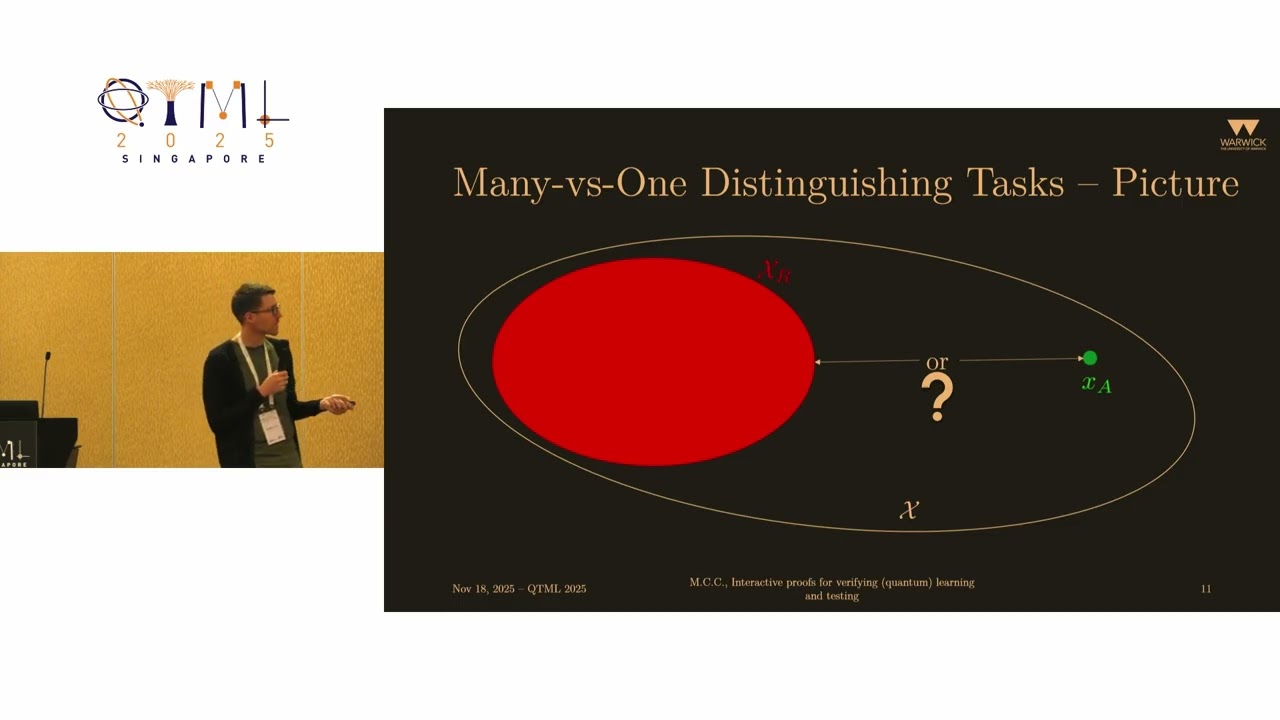
- Formal framework: many-versus-one distinguishing tasks and interactive proofs
- Negative results: classical communication does not help
- Positive results with quantum communication and VBQC
- Blackbox interactive proofs and leveraging prover's data access
- Applications: state tomography and stabilizer state learning
- Conclusion and open questions
Cited Sources
- Paper: Interactive proofs for verifying (quantum) learning and testing — The talk is based on this paper by the speaker and collaborators.
Concurring Sources
- Sitan Chen et al. - Exponential separations between learning with and without quantum memory — Prior work showing hardness of purity testing with limited quantum memory, which the talk builds upon.
Contribution & Novelties
The talk presents novel results on interactive proofs for quantum learning and testing, showing both limitations and advantages. It introduces blackbox interactive proofs and demonstrates benefits in specific tasks. The work extends classical interactive proofs to quantum settings and provides a framework for resource-constrained verifiers.
Pour aller plus loin :
- Verified blind quantum computing — Relevant for understanding VBQC techniques used in the talk.
- Quantum state tomography — Relevant for the application of interactive proofs to state tomography.
- Stabilizer states — Relevant for the stabilizer state learning task mentioned.
89 words
Radar Profile
The radar profile shows high scores in information quality and technical level, with slightly lower but still strong scores in quantity and reliability. This indicates a technically dense and reliable presentation, though the quantity of information is moderate due to the talk's length.
💬 Sur les 0 commentaires analysés, aucune tendance n'est disponible.