QTML 2025: The State Hidden Subgroup Problem (SHSP): Learning stabilizer groups and beyond
Keywords
Summary
131 words
Critical Evaluation
Value of the Information & Strength of the Argument
The talk provides a clear and valuable contribution by unifying several quantum learning tasks under the SHSP framework. The argumentation is solid, building on established results in HSP and representation theory. The speaker motivates the problem well and demonstrates the efficiency of the proposed algorithm through concrete examples. The discussion of open problems adds depth and shows the limitations of the current approach.
Scientific Rigor, Source Quality, Title Accuracy
The talk is scientifically rigorous, with precise definitions and references to prior work, including the work by Bolan et al. on entanglement location. The title accurately reflects the content. The speaker does not provide detailed citations during the talk, but the abstract and description mention the authors and the conference. The presentation is concise but technically sound.
135 words
Title / Content Match
The title accurately reflects the content, focusing on the State Hidden Subgroup Problem and its applications to learning stabilizer groups.
Quality & Reliability
8/10
The talk presents original research from a reputable group, with clear mathematical definitions and references to prior work. The speaker is knowledgeable and the content is technically sound, though the presentation is concise and lacks detailed proofs.
Key Moments
Markers derived by PSI from the transcript: the creator did not define chapters.
- Introduction to the talk and motivation for the State Hidden Subgroup Problem.
- Definition of the classical Hidden Subgroup Problem and its quantum solution.
- Introduction to the State Hidden Subgroup Problem and its formal definition.
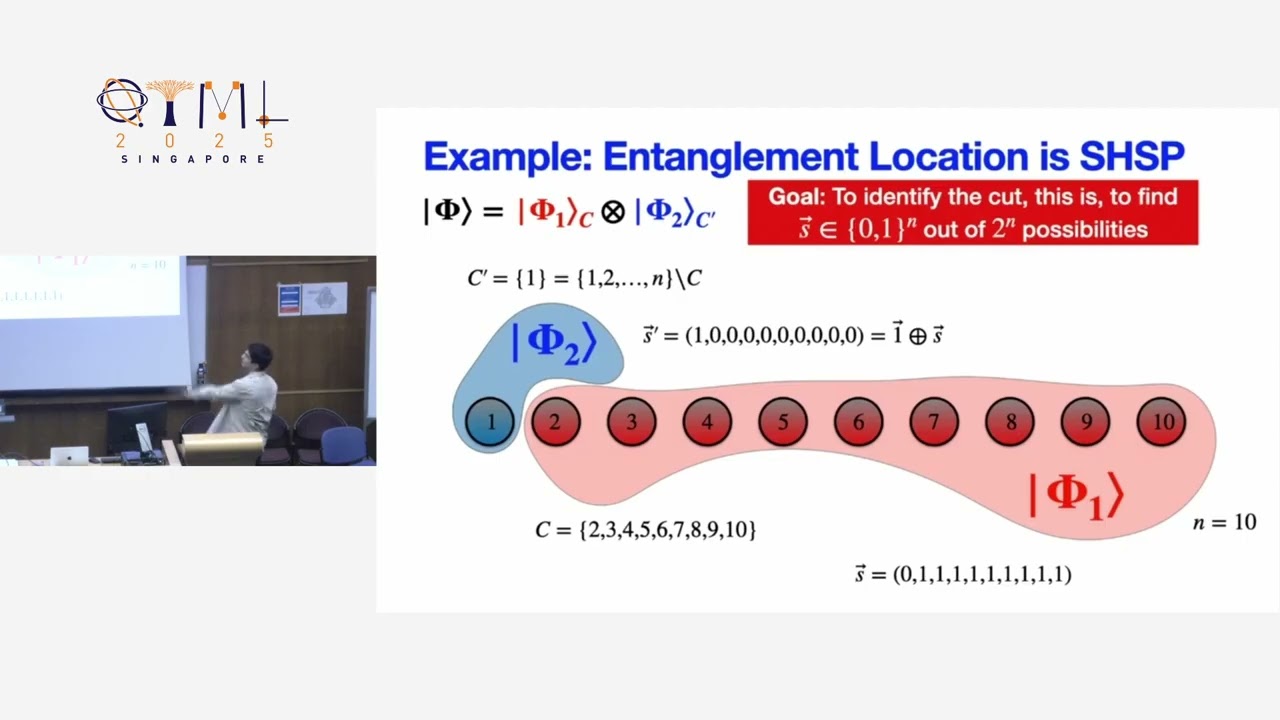
- Example of entanglement location as an instance of SHSP.
- Presentation of the main contribution: efficient algorithm for abelian groups using character POVM.
- Applications to learning stabilizer groups and hidden translation symmetries.
- Discussion of open problems, including robustness and hardness of rank-two case.
- Conclusion and summary of the talk.
Cited Sources
- QTML 2025 conference — The talk was presented at this conference.
- Centre for Quantum Technologies — The speaker is affiliated with this institution.
Concurring Sources
- Bollan et al. (2024) on entanglement location — The speaker references this work as motivation and comparison.
Contribution & Novelties
The talk presents a novel unified framework for quantum learning of symmetries, extending the Hidden Subgroup Problem to the quantum state setting. The proposed algorithm for abelian groups is efficient and requires only low-depth circuits, improving upon previous approaches. The applications to stabilizer learning and entanglement location demonstrate the practical relevance.
Pour aller plus loin :
- Hidden subgroup problem — Background on the classical problem.
- Quantum Fourier transform — Key tool in the algorithm.
- Stabilizer code — Related to stabilizer states and groups.
83 words
Radar Profile
The radar profile shows high scores in technical level and information quality, with slightly lower scores in information quantity and global reliability, reflecting the concise nature of a conference talk.