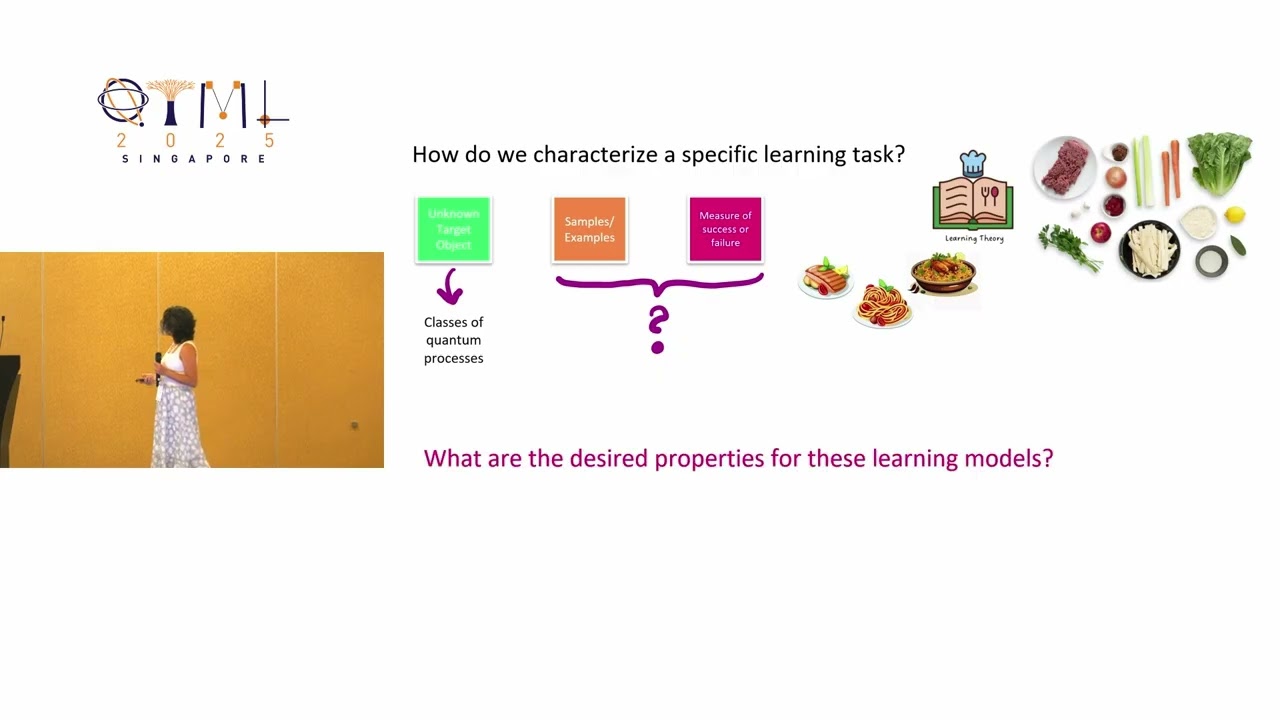
QTML 2025: Models of Learning for Quantum Processes: with noise, limitations and adversaries!
Keywords
Summary
134 words
Critical Evaluation
Value of the Information & Strength of the Argument
The talk provides valuable insights into quantum learning theory, particularly the two models of statistical query and agnostic learning. The speaker argues convincingly for the relevance of these models in realistic settings, using examples from her own research and connections to existing literature. The argumentation is solid, as she explains the motivations, definitions, and potential applications, while acknowledging limitations. The talk is well-structured, moving from personal experience to formal definitions and implications.
Scientific Rigor, Source Quality, Title Accuracy
The talk demonstrates scientific rigor by referencing specific papers and authors, such as the survey on quantum learning theory and works on statistical queries and agnostic learning. The sources are relevant and up-to-date, though not all are explicitly cited with URLs. The title accurately reflects the content, focusing on learning models for quantum processes with noise and adversaries. The talk is a conference presentation, so it is not peer-reviewed, but the content aligns with established research.
163 words
Title / Content Match
The title accurately reflects the content: the talk focuses on models for learning quantum processes, addressing noise and adversarial scenarios.
Quality & Reliability
7/10
The talk is given by a researcher in quantum learning theory, presenting recent work and known results. It is a conference talk, not peer-reviewed, but the content aligns with established literature. The speaker cites specific papers and authors, and the abstract is coherent. However, the talk is informal and lacks detailed technical proofs, which limits its standalone reliability.
Key Moments
Markers derived by PSI from the transcript: the creator did not define chapters.
- Introduction and personal academic background
- Explanation of the universal quantum emulator and its role in learning theory
- Definition of statistical query learning for quantum processes
- Discussion on noise tolerance and connection to shadow tomography
- Introduction to agnostic process tomography and its definition
- Comparison between conventional and agnostic tomography
- Applications in quantum machine learning and error mitigation
- Open questions and limitations of the discussed models
Cited Sources
- Quantum learning theory: a tutorial — Mentioned as a survey paper on quantum learning theory by Srinivasan Arunachalam and Ronald de Wolf.
- Universal quantum emulator — Referenced as the paper that inspired the speaker's interest in learning theory.
- Statistical query learning for quantum processes — Work by the speaker and her student, referenced as [WD24,WD25].
- Agnostic process learning — Work by the speaker and collaborators, referenced as [WLKD24].
- Classical shadow tomography for quantum processes — Mentioned as a related work by Robert Huang, Sitan Chen, and John Preskill.
- Barren plateaus and statistical query hardness — Referenced as a paper by Alex Nitner et al., which the speaker recommends.
Concurring Sources
- Quantum learning theory: a tutorial — The survey paper mentioned aligns with the talk's content on learning quantum objects.
- Classical shadow tomography for quantum processes — The connection to statistical queries is consistent with existing literature.
Contribution & Novelties
The talk presents recent research on learning quantum processes under realistic conditions, specifically statistical query learning and agnostic process tomography. It highlights the importance of these models for handling noise and adversarial scenarios, and connects them to broader quantum machine learning applications. The speaker shares personal insights and open questions, contributing to the field’s understanding.
Pour aller plus loin :
- Quantum learning theory — Overview of the field.
- Statistical query learning — Classical model extended to quantum.
- Quantum process tomography — Standard approach to characterizing quantum processes.
87 words
Radar Profile
The radar profile shows high scores in information quality and technical level, indicating a technically rich talk with solid content. The quantity of information is moderate, and the global reliability is good but not perfect due to the informal nature of a conference talk.
💬 No comments were provided for analysis.