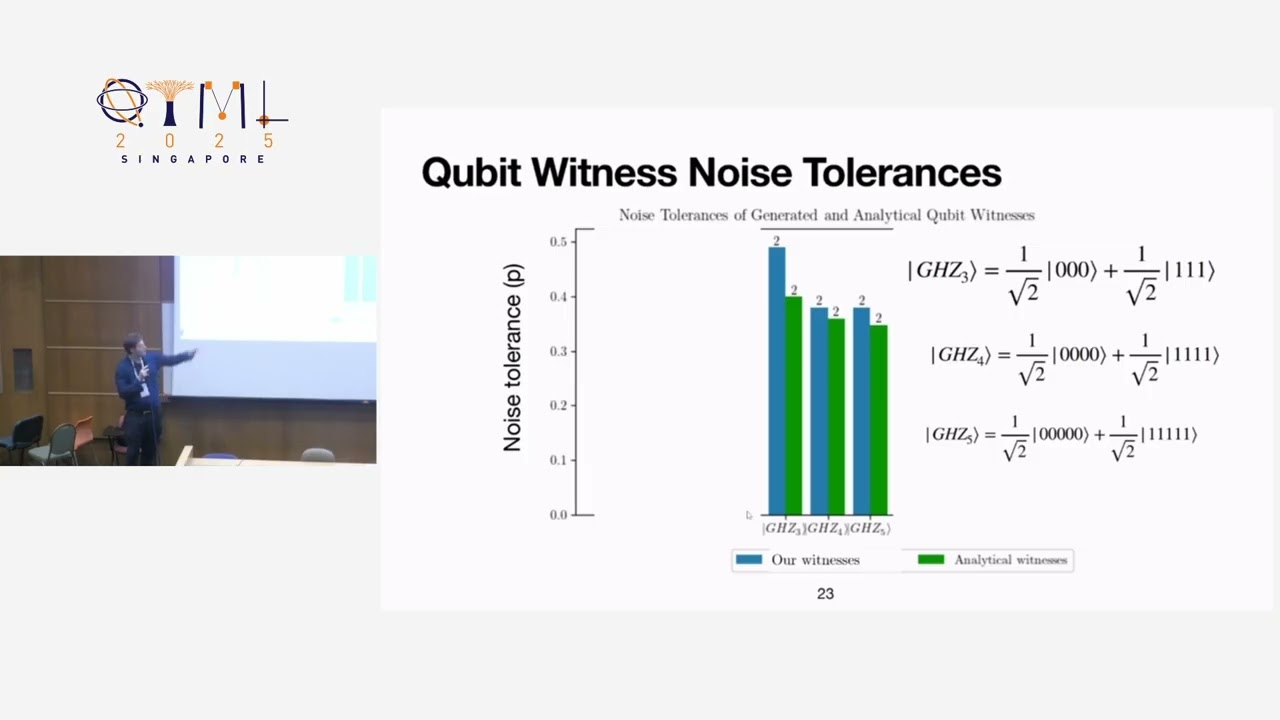
QTML 2025: A Universal Script for Machine Learning Derived Entanglement Witnesses
Keywords
Summary
128 words
Critical Evaluation
Value of the Information & Strength of the Argument
The value of the information is high, presenting a novel and practical method for generating entanglement witnesses with improved performance. The argumentation is solid, supported by numerical simulations and physical experiments. The speaker clearly explains the motivation, methodology, and results, making a compelling case for the method’s advantages. The adversarial training approach is particularly innovative, allowing for better noise tolerance without requiring prior training data. The validation process is thorough, including both numerical and experimental verification, which strengthens the credibility of the claims.
Scientific Rigor, Source Quality, Title Accuracy
The scientific rigor is good, with the method being tested on various states and systems. The sources are not explicitly cited in the talk, but the description mentions the authors and the conference. The title accurately reflects the content, focusing on a universal script for machine learning derived entanglement witnesses. The talk is well-structured and presents original research, though it lacks detailed references to prior work. The adequacy between title and content is high, as the talk indeed presents a universal script for generating entanglement witnesses.
184 words
Title / Content Match
The title accurately reflects the content, focusing on a universal script for machine learning derived entanglement witnesses.
Quality & Reliability
8/10
Presentation of original research with numerical verification and physical experiments, but limited peer review and no detailed methodology.
Key Moments
Markers derived by PSI from the transcript: the creator did not define chapters.
- Introduction and motivation for entanglement detection
- Background on entanglement witnesses and their limitations
- Introduction of the trainable measurements approach
- Results for W states and GHZ states
- Results for hypergraph states and qudit states
- Numerical verification of witnesses
- Physical experiments with photonic and superconducting qubits
- Conclusion and summary of advantages
Cited Sources
- QTML 2025 conference — The talk was presented at this conference.
Concurring Sources
- Entanglement witness — General concept of entanglement witnesses.
Contribution & Novelties
The talk presents a novel machine learning method for generating entanglement witnesses with user-defined measurement settings, improving noise tolerance and reducing measurement complexity. The method is universal, handling various qubit and qudit systems, and is validated both numerically and experimentally.
Pour aller plus loin :
- Entanglement witness — Background on entanglement witnesses.
- Quantum entanglement — Fundamental concept.
- Machine learning — Overview of machine learning techniques.
65 words
Radar Profile
The radar profile shows high scores across all dimensions, indicating a well-rounded presentation with strong technical depth, reliable information, and good quantity of content. The method's novelty and validation contribute to its high quality.