QTML 2025: Verifiable End-to-End Delegated Variational Quantum Algorithms
Keywords
Summary
212 words
Critical Evaluation
Value of the Information & Strength of the Argument
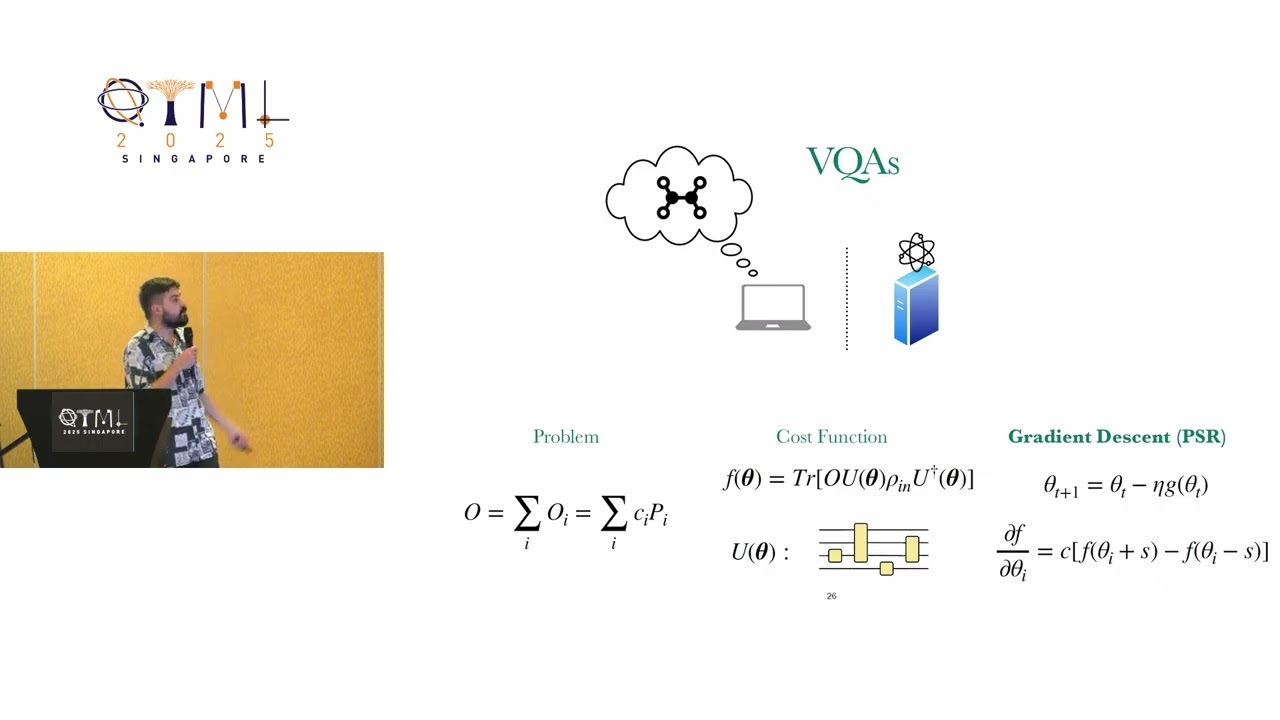
The talk provides a valuable contribution by addressing a gap in delegated quantum computing: previous works focused on BQP computations, while this work extends verification to variational quantum algorithms, which are more relevant for near-term devices. The argumentation is solid: the speaker clearly motivates the need for end-to-end verifiability, explains the limitations of shot-level verification, and presents a protocol with formal theorems. The step-level verification approach is more robust than previous methods, as it tolerates some corrupted shots without aborting, which is a practical advantage. The simulations, although simple, demonstrate the effectiveness of the protocol in preventing divergence under attacks. The speaker also discusses potential extensions, showing the generality of the approach. However, the talk is highly technical and assumes familiarity with quantum computing concepts, which may limit its accessibility to a broader audience.
Scientific Rigor, Source Quality, Title Accuracy
The talk demonstrates scientific rigor by building on established frameworks (UBQC, VBQC) and providing formal proofs for the new protocol. The speaker references previous works, such as the UBQC protocol and a recent verification protocol, but does not provide specific citations or URLs in the talk. The description includes the abstract and author names, but no links to papers. The title accurately reflects the content, and the talk is well-structured. The lack of explicit source citations in the talk itself is a minor weakness, but the technical depth and formal approach indicate a high level of rigor. The speaker also acknowledges the limitations and suggests future improvements, which adds to the credibility.
261 words
Title / Content Match
The title accurately reflects the content: the talk introduces a framework for delegated variational quantum algorithms with end-to-end verifiability.
Quality & Reliability
8/10
The talk presents a novel protocol with formal proofs and simulations, grounded in established frameworks (UBQC, VBQC). The speaker is a PhD student, and the work is co-authored with recognized researchers. The presentation is clear and technical, but the lack of peer-reviewed publication details and the limited visibility (22 views) slightly reduce the score.
Key Moments
Markers derived by PSI from the transcript: the creator did not define chapters.
- Introduction and motivation for delegated quantum computing
- Explanation of blindness and verifiability in delegation
- Overview of measurement-based quantum computing (MBQC)
- Introduction to Universal Blind Quantum Computing (UBQC)
- Verification via interactive proofs and trap qubits
- Challenges in extending verification to VQAs
- Step-level protocol for secure gradient estimation
- Lemma connecting gradient error to corrupted shots
- End-to-end verifiability via geometric convergence
- Simulations on TFIM model showing robustness
- Extensions to other optimizers and future work
Cited Sources
- Universal Blind Quantum Computing — Mentioned as the basis for blindness in delegated quantum computing.
- Verifiable Blind Quantum Computing — Referenced as a follow-up work providing verification via test rounds.
Concurring Sources
- Universal Blind Quantum Computing — The protocol builds on this foundational work for blindness.
- Verifiable Blind Quantum Computing — The verification scheme is inspired by this work, which uses test rounds.
Contribution & Novelties
The talk introduces a novel framework for delegated variational quantum algorithms (DVQAs) with end-to-end verifiability. The key innovation is a step-level verification protocol that verifies the gradient estimation in VQAs, tolerating some corrupted shots without aborting, which is more robust than previous shot-level verification. This is achieved by connecting the error in gradient estimation to the number of corrupted shots and setting a threshold. The protocol is integrated into a custom optimizer with geometric convergence guarantees. This work extends delegated quantum computing from BQP computations to VQAs, which are more relevant for near-term devices.
Pour aller plus loin :
- Variational Quantum Algorithms — Overview of VQAs, the context of this work.
- Measurement-Based Quantum Computation — Background on MBQC, the underlying model.
- Blind Quantum Computing — General concept of blind quantum computing, including UBQC.
133 words
Radar Profile
The radar profile shows high scores in technical level and information quality, indicating a specialized and rigorous presentation. The moderate scores in quantity and reliability suggest that while the content is dense, the limited visibility and lack of peer-reviewed publication details slightly reduce the overall reliability. The profile is typical for a conference talk presenting original research.