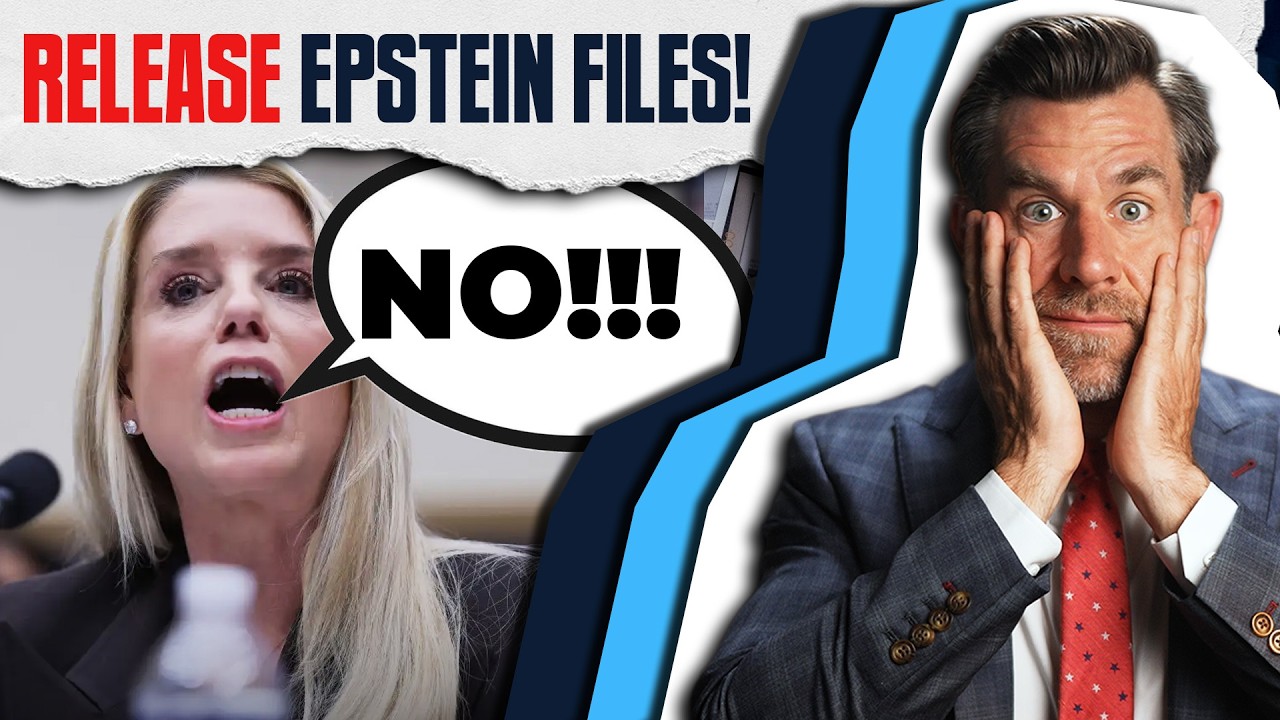
DOJ In Contempt of Congress?
Keywords
Summary
161 words
Critical Evaluation
Value of the Information & Strength of the Argument
The video provides valuable legal analysis of the DOJ’s obligations under the EFTA and the validity of its privilege claims. The argumentation is well-structured, citing specific statutory language and case law to support the conclusion that the DOJ is likely in violation of the law. The host effectively explains complex legal concepts in an accessible manner, making the information useful for viewers interested in the legal aspects of the Epstein files controversy.
Scientific Rigor, Source Quality, Title Accuracy
The video demonstrates high rigor in its legal analysis, referencing the EFTA, FOIA, and relevant court cases such as Nixon v. Administrator of General Services. The sources cited are appropriate and support the arguments made. The title accurately reflects the content, and the video stays on topic throughout. The host’s expertise in law is evident, and the analysis is thorough and well-supported.
149 words
Title / Content Match
The title accurately reflects the content, which examines whether the DOJ is in contempt of Congress for failing to release all Epstein files.
Quality & Reliability
8/10
The video provides a detailed legal analysis of the DOJ's withholding of Epstein files, citing specific statutes, case law, and congressional testimony. The arguments are well-structured and grounded in legal principles, though the presentation is partisan and relies on the host's interpretation.
Key Moments
Markers derived by PSI from the transcript: the creator did not define chapters.
- Introduction: DOJ claims to have released all Epstein files but withholds millions.
- Explanation of EFTA and its requirements.
- Discussion of DOJ's privilege claims and why they are invalid.
- Analysis of deliberative process privilege and its limitations.
- Examination of work product and attorney-client privileges.
- Discussion of separation of powers and Nixon v. Administrator of General Services.
- Potential congressional actions: Vaughn index, lawsuits, contempt.
- Sponsored segment for Chime.
- Promotion of LegalEagle's law firm and conclusion.
Cited Sources
- Epstein Files Transparency Act — The law requiring the DOJ to release Epstein-related documents.
- Nixon v. Administrator of General Services — Supreme Court case cited to argue that Congress can override executive privilege.
- Committee on Oversight and Government Reform v. Lynch — District Court case cited to show that deliberative process privilege can be overcome by congressional need.
Concurring Sources
- Congressman Jamie Raskin's statement — Raskin's comments in the video support the argument that the DOJ's privilege claims are invalid.
Dissenting Sources
- DOJ's Valentine's Day letter — The DOJ claims it has fulfilled its obligations and that privileges justify withholding documents, contradicting the video's argument.
External References
Contribution & Novelties
The video provides a clear and detailed legal analysis of the DOJ’s obligations under the EFTA, explaining why the asserted privileges are not valid. It offers a practical overview of potential congressional responses, including the use of Vaughn indexes and contempt proceedings. The analysis is grounded in statutory text and case law, making it a valuable resource for understanding the legal dimensions of the Epstein files controversy.
Pour aller plus loin :
- Epstein Files Transparency Act — The full text of the law.
- Nixon v. Administrator of General Services — Supreme Court decision on executive privilege.
- Freedom of Information Act (FOIA) — Official FOIA portal explaining exemptions and procedures.
109 words
Radar Profile
The radar profile shows high scores in information quantity, quality, and reliability, with a slightly lower technical level, indicating a well-researched and accessible legal analysis.
💬 Négatif - Sur les 30 commentaires analysés, la majorité exprime frustration et colère envers l'administration, critiquant le manque de transparence et l'impunité perçue.