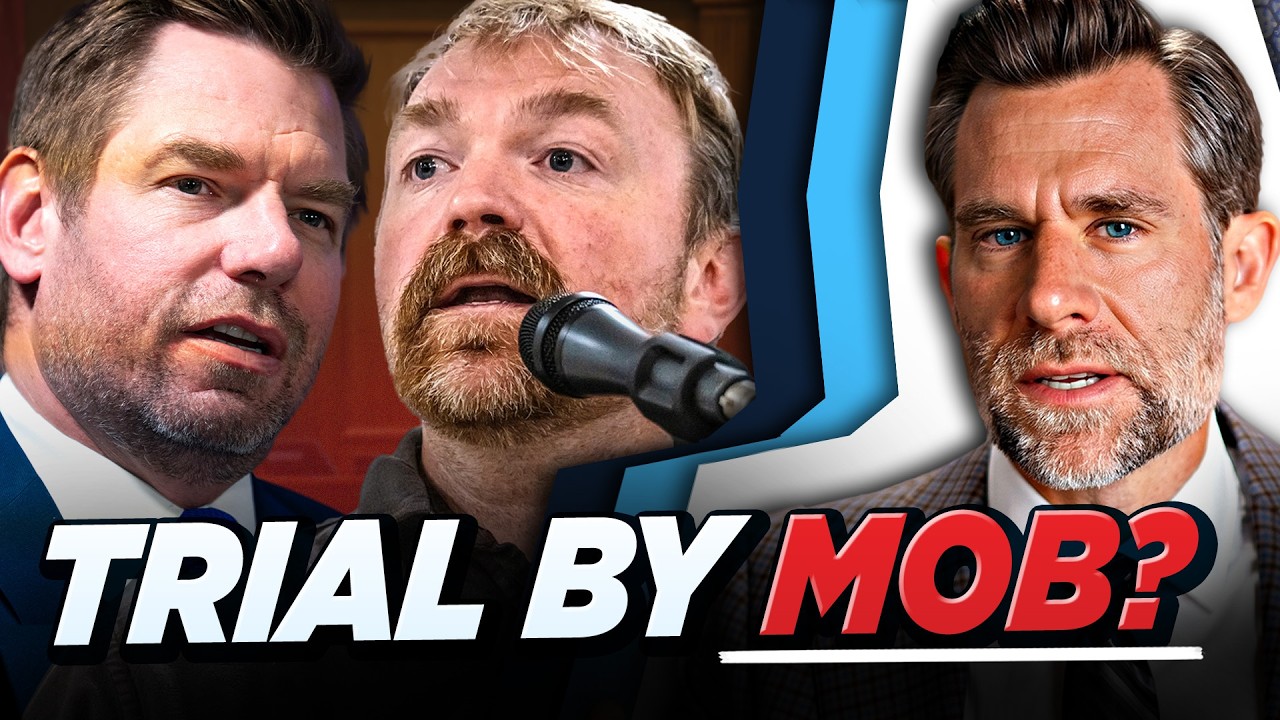
She Said IS Evidence
Keywords
Summary
131 words
Critical Evaluation
Value of the Information & Strength of the Argument
The video provides valuable information by clarifying common legal misconceptions and explaining how evidence works in court. The argumentation is solid, as the host uses legal principles and examples to support his points. He effectively distinguishes between legal standards and public judgment, and he addresses counterarguments by citing specific commentators and their flawed reasoning. The use of concrete cases (Platner and Swalwell) grounds the discussion in real-world events, making the argument more compelling.
Scientific Rigor, Source Quality, Title Accuracy
The video demonstrates scientific rigor by referencing specific legal rules (Federal Rules of Evidence) and cases (e.g., Brady v. Maryland). The sources cited in the description are mostly promotional or social media links, but the video itself references news articles from The New York Times, Politico, CNN, and the San Francisco Chronicle. The title accurately reflects the content, and the video does not misrepresent the facts. The host also acknowledges the limitations of the allegations and the importance of due process in criminal contexts.
172 words
Title / Content Match
The title accurately reflects the core argument that testimony is a form of evidence, which is central to the video's thesis.
Quality & Reliability
8/10
The video provides a clear, legally accurate explanation of evidence rules and applies them correctly to the public discourse surrounding allegations. The host, a lawyer, cites specific legal rules and cases, and uses credible sources. However, the video is opinionated and includes a sponsored segment, which slightly reduces its neutrality.
Key Moments
Markers derived by PSI from the transcript: the creator did not define chapters.
- Introduction to the cases of Grant Platner and Eric Swalwell, and the public debate over allegations.
- Summary of Platner's background and the allegations against him.
- Discussion of Swalwell's allegations and the media coverage.
- Explanation of how evidence is defined in law, including testimonial evidence.
- Distinction between direct and circumstantial evidence, and the weight of evidence.
- Discussion of admissibility rules, including relevance and hearsay.
- Explanation of character evidence and its exclusion in criminal trials.
- Critique of commentators who misuse legal terms, and the concept of 'he said, she said'.
- Discussion of corroboration and the evidence in the Platner case.
- Conclusion: political decisions are hiring decisions, and voters should weigh allegations.
Cited Sources
- Ground News — Sponsored tool for media bias comparison, used to illustrate how different outlets cover the same story.
- LegalEagle Law Guide — Promotional link for a law school guide.
- LegalEagle Copyright Course — Promotional link for a copyright course.
- LegalEagle Team — Link for legal representation inquiries.
Concurring Sources
- Federal Rules of Evidence — The video references these rules to explain admissibility and relevance.
Dissenting Sources
- Glenn Greenwald's commentary — Greenwald argues that due process is the best way to determine guilt, which the video criticizes as misapplying legal standards to public discourse.
External References
Contribution & Novelties
The video offers a clear, legally grounded explanation of why testimony is evidence, correcting a widespread misconception. It provides a framework for evaluating allegations outside the courtroom, emphasizing the difference between criminal guilt and fitness for office. The inclusion of media bias analysis adds a unique perspective.
Pour aller plus loin :
- Federal Rules of Evidence — Official text of the rules referenced in the video.
- Brady v. Maryland — Supreme Court case on prosecutorial disclosure obligations.
- Hearsay — Overview of the hearsay rule and its exceptions.
87 words
Radar Profile
The radar profile shows high scores in information quality and reliability, with slightly lower scores in technical depth and quantity, reflecting the video's focus on legal concepts and its concise length.
💬 Positive and supportive. On the 30 comments analyzed, viewers largely agree with the video's argument, praising the clear explanation of evidence law and the rejection of euphemisms. Many comments emphasize the distinction between legal guilt and political accountability.