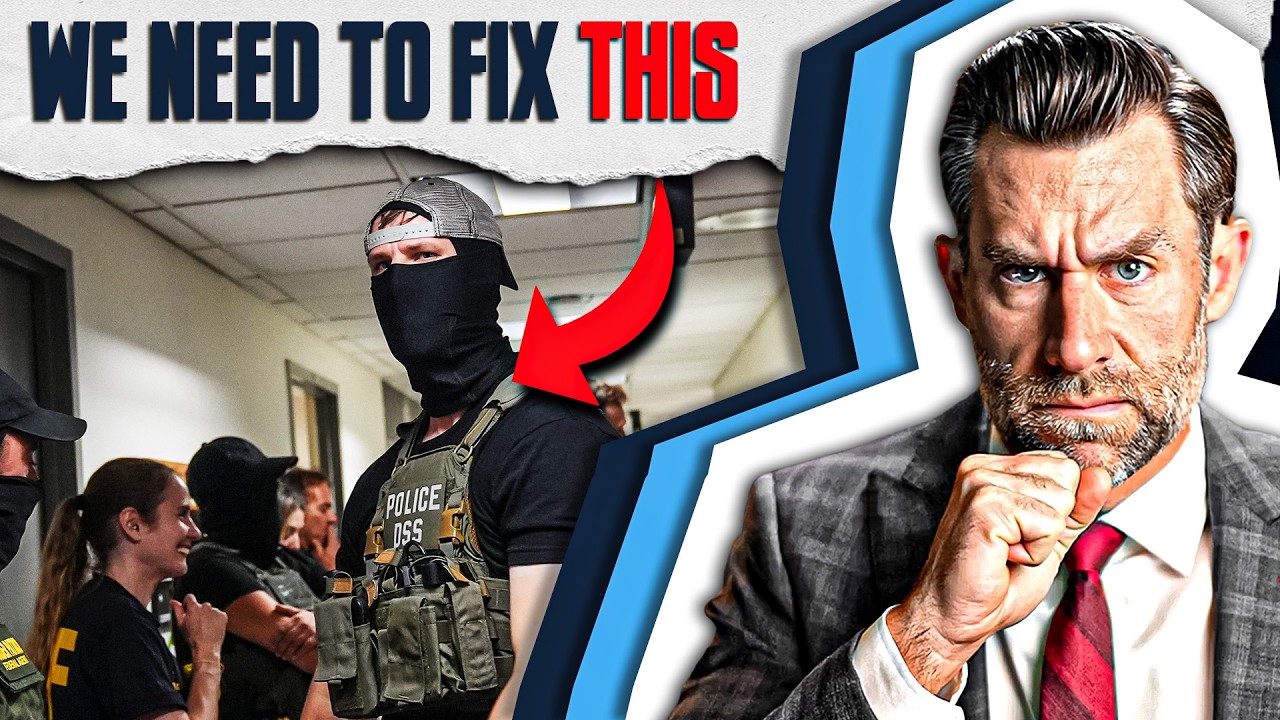
5 Words to Fix ICE
Keywords
Summary
158 words
Critical Evaluation
Value of the Information & Strength of the Argument
The video provides valuable legal analysis, clearly explaining complex doctrines like Bivens and Section 1983. The argumentation is well-structured, using historical context and case law to support the claim that ICE is effectively above the law. The inclusion of specific cases (Monroe, Bivens, Hernandez, Egbert) strengthens the argument. However, the presentation is advocacy-oriented, with a clear political stance, which may affect objectivity. The legal reasoning is sound, but the video does not present counterarguments in depth, such as national security justifications for limiting remedies.
Scientific Rigor, Source Quality, Title Accuracy
The video demonstrates high rigor in legal analysis, citing primary sources like Supreme Court decisions and statutes. The sources are credible and directly relevant. The title ‘5 Words to Fix ICE’ is catchy but accurately reflects the core proposal. The content is well-researched, though it is an opinion piece rather than a neutral review. The video includes a sponsored segment for Ground News, which is disclosed. The legal citations are accurate, and the explanation of the Bivens doctrine is precise.
179 words
Title / Content Match
The title '5 Words to Fix ICE' accurately reflects the core proposal: adding five words to Section 1983 to extend liability to federal officials. The content directly addresses this, though the title is somewhat catchy.
Quality & Reliability
8/10
The video provides a detailed legal analysis of the lack of remedies for constitutional violations by federal agents, citing key cases (Monroe v. Pape, Bivens v. Six Unknown Named Agents, Hernandez v. Mesa, Egbert v. Boule) and statutes (Section 1983, FTCA). The legal reasoning is sound and well-supported, though the presentation is opinionated and advocacy-oriented.
Key Moments
Markers derived by PSI from the transcript: the creator did not define chapters.
- Introduction: ICE raids in Chicago, the problem of ICE being above the law.
- Guest Christian Fus introduced; overview of ICE's recent behavior.
- Explanation of why ICE is above the law: no cause of action for federal officials.
- History of Section 1983 and Monroe v. Pape.
- The Bivens case and the creation of an implied cause of action.
- Erosion of Bivens: key cases like Hernandez v. Mesa and Egbert v. Boule.
- Discussion of the Federal Tort Claims Act as an inadequate alternative.
- The proposed Bivens Act: adding five words to Section 1983.
- Community resistance and legislative efforts; conclusion.
Cited Sources
- Ground News — Sponsor segment; used to illustrate media bias in covering ICE raids.
- LegalEagle's law school guide — Promoted as a resource for those interested in law school.
- LegalEagle's copyright course — Promoted as a resource for copyright issues.
Concurring Sources
- Monroe v. Pape — Cited in the video as the case that opened the door for Section 1983 suits against state officials.
- Hernandez v. Mesa — Cited as an example of the Supreme Court refusing to extend Bivens in a cross-border shooting case.
Dissenting Sources
- No direct discordant sources cited in the video. — The video presents a one-sided legal argument without addressing potential counterarguments, such as national security justifications for limiting remedies.
External References
Contribution & Novelties
The video offers a clear and accessible explanation of the legal loophole that allows ICE agents to evade accountability, and proposes a specific legislative fix (the Bivens Act). It synthesizes complex case law into a compelling narrative. The inclusion of recent events and community responses adds a timely perspective.
Pour aller plus loin :
- Bivens v. Six Unknown Named Agents — The foundational case establishing an implied cause of action for constitutional violations by federal officials.
- Section 1983 — The Reconstruction-era statute that allows suits against state officials, which the Bivens Act seeks to extend to federal officials.
- Egbert v. Boule — The 2022 Supreme Court case that severely limited Bivens remedies, particularly in immigration contexts.
116 words
Radar Profile
The radar profile shows high scores in information quantity, quality, and technical level, but slightly lower in global reliability due to the advocacy nature. The video is technically strong but may be perceived as biased.
💬 Très négatif: Sur les 30 commentaires analysés, la grande majorité exprime une forte opposition à ICE et soutient l'abolition de l'agence, avec des comparaisons à la Gestapo et des appels à la responsabilisation. Le ton est très critique envers le gouvernement et les actions de ICE.