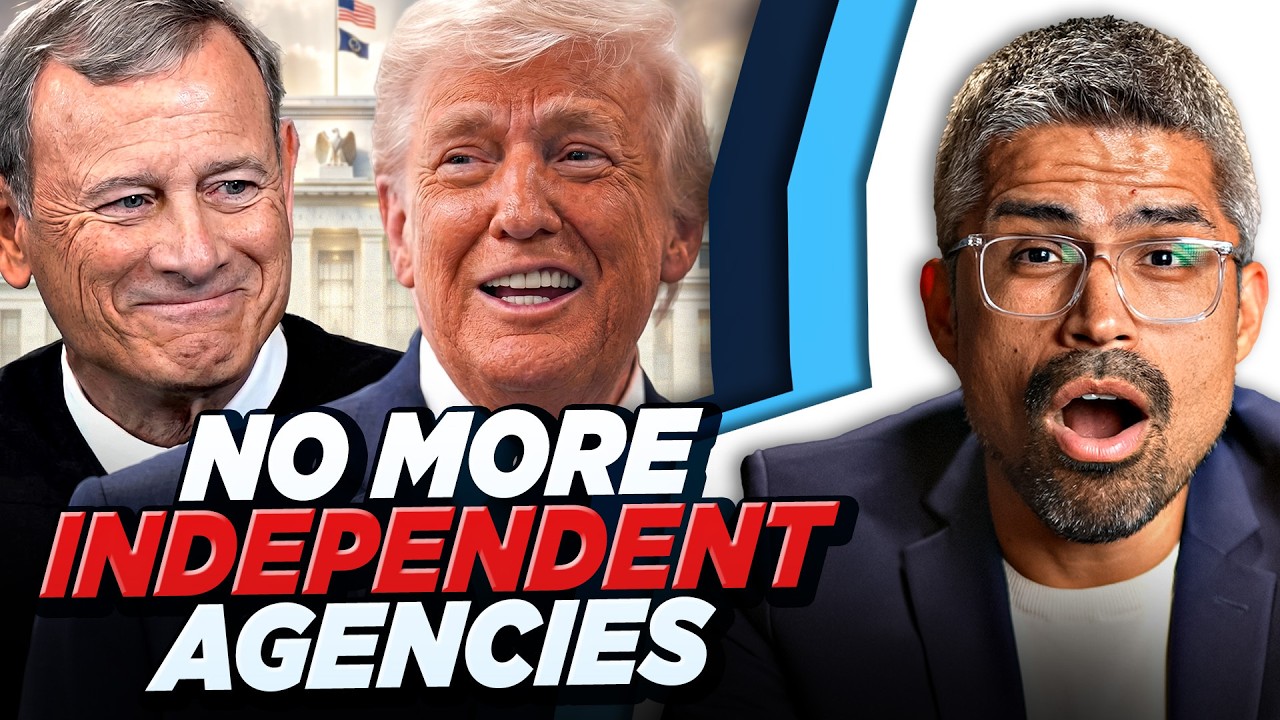
SCOTUS Says Trump Can Fire Everyone... Except the Fed
Keywords
Summary
137 words
Critical Evaluation
Value of the Information & Strength of the Argument
The video provides valuable legal analysis, explaining complex constitutional issues in an accessible manner. It effectively argues that the Slaughter decision undermines the independence of federal agencies, while the Cook decision creates an arbitrary exception for the Fed. The argumentation is persuasive, supported by references to legal precedents and the specific facts of the cases. However, the presentation is clearly opinionated, with strong criticism of the Court’s reasoning and potential political motivations.
Scientific Rigor, Source Quality, Title Accuracy
The video demonstrates high rigor in its legal analysis, accurately citing cases like Humphrey’s Executor and Myers v. United States, and explaining the statutory provisions involved. The sources cited in the description are mostly promotional links, but the video references legal documents and news reports. The title accurately reflects the content, and the video’s legal arguments are well-founded. The inclusion of promotional segments is clearly separated from the substantive content.
157 words
Title / Content Match
The title accurately reflects the content, focusing on the Supreme Court's rulings on presidential removal powers and the exception for the Federal Reserve.
Quality & Reliability
8/10
The video provides a detailed and accurate analysis of two Supreme Court decisions (Trump v. Slaughter and Trump v. Cook), citing specific legal precedents and statutes. The legal reasoning is sound and well-explained, though the presentation is opinionated and includes promotional segments.
Key Moments
Markers derived by PSI from the transcript: the creator did not define chapters.
- Introduction to the Supreme Court's double ruling on presidential removal power.
- Explanation of Trump v. Slaughter and the overruling of Humphrey's Executor.
- Discussion of the unitary executive theory and its implications.
- Background on the firing of FTC Commissioner Rebecca Slaughter.
- Analysis of the Federal Reserve exception in Trump v. Cook.
- Details of Lisa Cook's firing and the court's reasoning.
- Discussion of the dissenting opinions and potential consequences.
- Conclusion and commentary on the future of independent agencies.
Cited Sources
- LegalEagle's Copyright Course — Promotional link for a course on copyright law.
- LegalEagle's Law School Guide — Promotional link for a guide to law school.
- Nebula Streaming Service — Promotional link for Nebula, where extended content is available.
Concurring Sources
- SCOTUSblog — Provides comprehensive coverage of Supreme Court cases and decisions.
- Congressional Research Service Reports — Offers legal analysis of separation of powers and independent agencies.
Dissenting Sources
- The Federalist Society — A conservative legal organization that supports the unitary executive theory, which the video criticizes.
External References
Contribution & Novelties
The video provides a clear and engaging explanation of two significant Supreme Court decisions, highlighting the inconsistency in the Court’s approach to presidential removal power. It offers a critical perspective on the unitary executive theory and its potential impact on the separation of powers.
Pour aller plus loin :
- Unitary executive theory — Overview of the theory and its historical context.
- Humphrey’s Executor v. United States — The overruled precedent and its significance.
- Federal Reserve Independence — Official explanation of the Fed’s structure and independence.
85 words
Radar Profile
The radar profile shows high scores in quantity and quality of information, with a moderate technical level. The video is well-researched and provides a thorough analysis, but its opinionated nature may reduce its perceived objectivity.
💬 Très négatif. Sur les 30 commentaires analysés, la grande majorité exprime une forte opposition à la décision de la Cour suprême, la qualifiant de dangereuse et de partisane, avec des inquiétudes sur l'érosion de la séparation des pouvoirs et l'indépendance des agences.