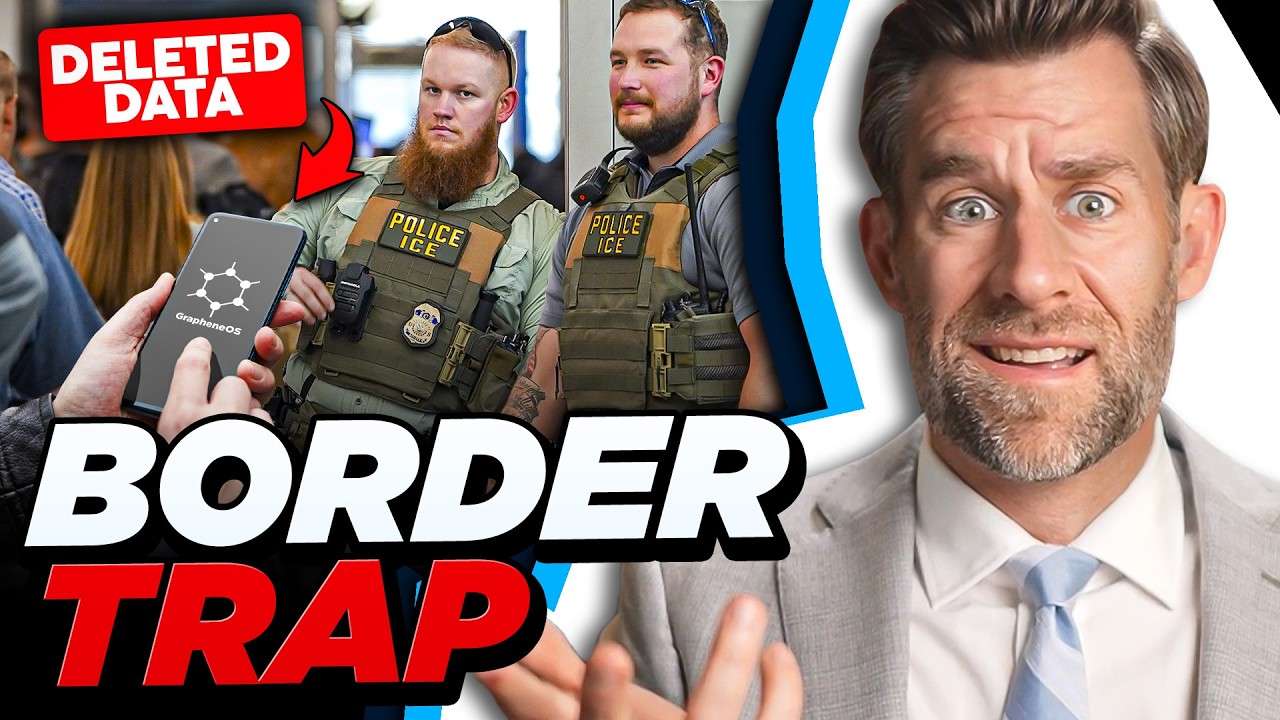
Police Demanded A Password; It Deleted The Phone
Keywords
Summary
165 words
Critical Evaluation
Value of the Information & Strength of the Argument
The video provides substantial value by explaining complex legal concepts in an accessible manner, using a real case to illustrate the interplay between border search authority, the Fifth Amendment, and obstruction statutes. The argumentation is solid, presenting both the government’s and defense’s perspectives, and acknowledging the challenges Tunick faces in the 11th Circuit. The presenter supports his analysis with specific case citations and statutory interpretation, making the reasoning persuasive. However, the video is not neutral; it clearly sympathizes with Tunick and criticizes the government’s actions, which may color the presentation of facts.
Scientific Rigor, Source Quality, Title Accuracy
The video demonstrates high rigor by citing specific court cases (Riley, Vergara, Tousaint, Pleito, Ramsey, Flores-Montano, Edmond, Wren, Blyth, Brown, Plavic) and statutes (18 U.S.C. § 2232A). The presenter is a lawyer, adding credibility. The title accurately reflects the content. The video includes a disclaimer that it is not legal advice. The sources are primarily legal precedents, which are appropriate for the analysis. The video does not cite external articles or reports, but relies on the court documents and legal reasoning. The title is catchy and relevant, though it slightly sensationalizes the incident.
200 words
Title / Content Match
The title accurately reflects the core incident: police demanded a password, and the phone deleted its data. It is catchy and relevant.
Quality & Reliability
8/10
The video provides a detailed legal analysis of a specific case, citing relevant statutes and case law. The presenter is a lawyer, and the analysis is nuanced, acknowledging circuit splits and potential weaknesses in the defense. However, the video includes promotional segments and relies on the defendant's motion, which is one-sided.
Key Moments
Markers derived by PSI from the transcript: the creator did not define chapters.
- Introduction to the case of Samuel Tunick and the duress password incident.
- Details of Tunick's detention at Atlanta airport, including the FBI's involvement and the questioning.
- Explanation of the border search exception and the 11th Circuit's permissive stance.
- Discussion of other circuits' approaches, including the 4th and 9th Circuits.
- Analysis of the Fifth Amendment and compelled decryption, citing relevant cases.
- Discussion of Miranda rights and whether the border questioning was custodial.
- Examination of Section 2232A and the requirement of lawful authority to seize property.
- Conclusion summarizing the legal issues and the potential outcome for Tunick.
Cited Sources
- LegalEagle website — Main website for the channel, providing additional resources.
- Copyright course — Course offered by LegalEagle on copyright law.
- Law school guide — Guide for law school applicants.
- Nebula — Video streaming platform where LegalEagle posts ad-free content.
- Patreon — Patreon page for supporting the channel.
- Podcast — Podcast feed for LegalEagle.
Concurring Sources
- Riley v. California — Supreme Court case recognizing the heightened privacy interest in cell phones.
- United States v. Vergara — 11th Circuit case allowing forensic border searches without suspicion.
- United States v. Tousaint — 11th Circuit case further extending border search authority.
Dissenting Sources
- United States v. Cano — 9th Circuit case requiring reasonable suspicion for forensic border searches, contrasting with the 11th Circuit.
- United States v. Ikay Bodden — 4th Circuit case requiring individualized suspicion and transnational nexus for forensic border searches.
External References
Contribution & Novelties
The video provides a novel analysis of a recent case that highlights the tension between border search authority and the Fifth Amendment, particularly regarding duress passwords. It synthesizes relevant case law and statutory interpretation, offering a clear explanation of the legal issues. The video also brings attention to the potential misuse of border search powers for domestic investigations.
Pour aller plus loin :
- Fourth Amendment to the United States Constitution — Overview of the Fourth Amendment and its protections.
- Fifth Amendment to the United States Constitution — Overview of the Fifth Amendment and its protections.
- Riley v. California — Supreme Court case on cell phone searches incident to arrest.
- Border search exception — Explanation of the border search exception to the warrant requirement.
- 18 U.S.C. § 2232A — Text of the statute on destruction of property to prevent seizure.
139 words
Radar Profile
The radar profile shows high scores in quantity of information and technical level, indicating a detailed and complex analysis. Quality and reliability are also strong, but slightly lower due to the presenter's advocacy perspective. The overall profile suggests a well-researched and informative video with a clear legal focus.
💬 The comments are overwhelmingly negative towards law enforcement and supportive of the defendant, with many expressing outrage at the violation of rights. The tone is critical of the government's actions, with some comments highlighting the absurdity of the situation. Overall, the sentiment is strongly negative towards the authorities and sympathetic to the individual.