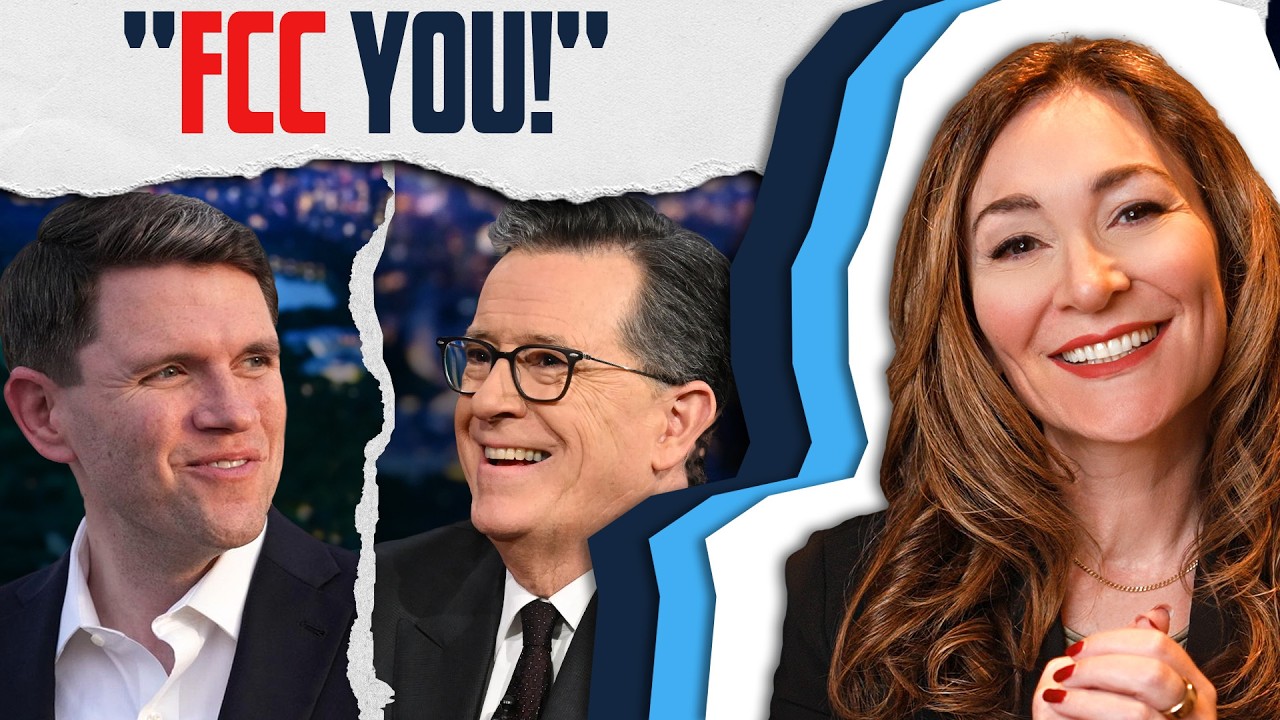
Trump's FCC Censorship Backfires
Keywords
Summary
125 words
Critical Evaluation
Value of the Information & Strength of the Argument
The video provides valuable legal analysis, explaining complex FCC regulations and their application. The argumentation is solid, grounded in statutory and case law, and effectively demonstrates the legal flaws in Carr’s actions. The host’s expertise adds credibility, and the use of examples (Kimmel, Colbert, The View) illustrates the practical implications.
Scientific Rigor, Source Quality, Title Accuracy
The video cites specific legal sources, including the Communications Act, FCC regulations, and Supreme Court cases. The title accurately reflects the content, and the analysis is rigorous. The host’s legal background enhances the reliability. The video also includes a disclaimer that it is not legal advice, which is appropriate.
114 words
Title / Content Match
The title accurately reflects the content, focusing on the FCC's actions under Trump and the backlash, particularly the Streisand effect.
Quality & Reliability
8/10
The video provides a detailed legal analysis of FCC regulations, citing specific statutes (Section 326, Section 315) and case law (Red Lion, Near v. Minnesota, Brandenburg, Pentagon Papers, NetChoice). The host is a lawyer, and the content is well-researched, though it includes opinion and commentary.
Key Moments
Markers derived by PSI from the transcript: the creator did not define chapters.
- Colbert announces that CBS lawyers prevented an interview with James Talarico.
- Explanation of the FCC's role and the Communications Act.
- Discussion of the Fairness Doctrine and its repeal.
- Analysis of the equal time rule and Carr's letter.
- Colbert airs the interview on YouTube, leading to the Streisand effect.
- Carr's push for patriotic content and LegalEagle's response.
Cited Sources
- Communications Act of 1934 — Referenced as the basis for FCC authority and Section 326.
- Red Lion Broadcasting Co. v. FCC — Cited as upholding the Fairness Doctrine.
- Near v. Minnesota — Cited for the principle against prior restraint.
- Brandenburg v. Ohio — Cited for the incitement standard.
- New York Times Co. v. United States (Pentagon Papers) — Cited for press freedom.
- NetChoice v. Paxton — Cited for social media content moderation.
Concurring Sources
- FCC's official page on the Equal Time Rule — Provides the official interpretation of the rule, supporting the video's explanation.
Dissenting Sources
- Brendan Carr's public statements — Carr argues that his actions are within the FCC's mandate to ensure public interest, which contrasts with the video's interpretation.
External References
Contribution & Novelties
The video provides a timely and detailed legal analysis of the FCC’s actions under the Trump administration, explaining the legal limits of FCC authority and the implications for press freedom. It highlights the Streisand effect as a counterproductive outcome of censorship attempts.
Pour aller plus loin :
- Fairness Doctrine — Historical context on the doctrine and its repeal.
- Equal Time Rule — Official FCC explanation of the rule.
- First Amendment to the United States Constitution — Foundational legal text.
79 words
Radar Profile
The radar profile shows high scores in information quantity and quality, with moderate technical level and reliability. This indicates a well-researched, informative video that is accessible to a general audience while maintaining legal rigor.
💬 Sur les 30 commentaires analysés, le climat est très positif, avec une majorité de commentaires soutenant la critique de la FCC et exprimant leur appréciation pour l'analyse juridique. Plusieurs commentaires soulignent l'ironie de la situation et le retour de bâton (Streisand effect).