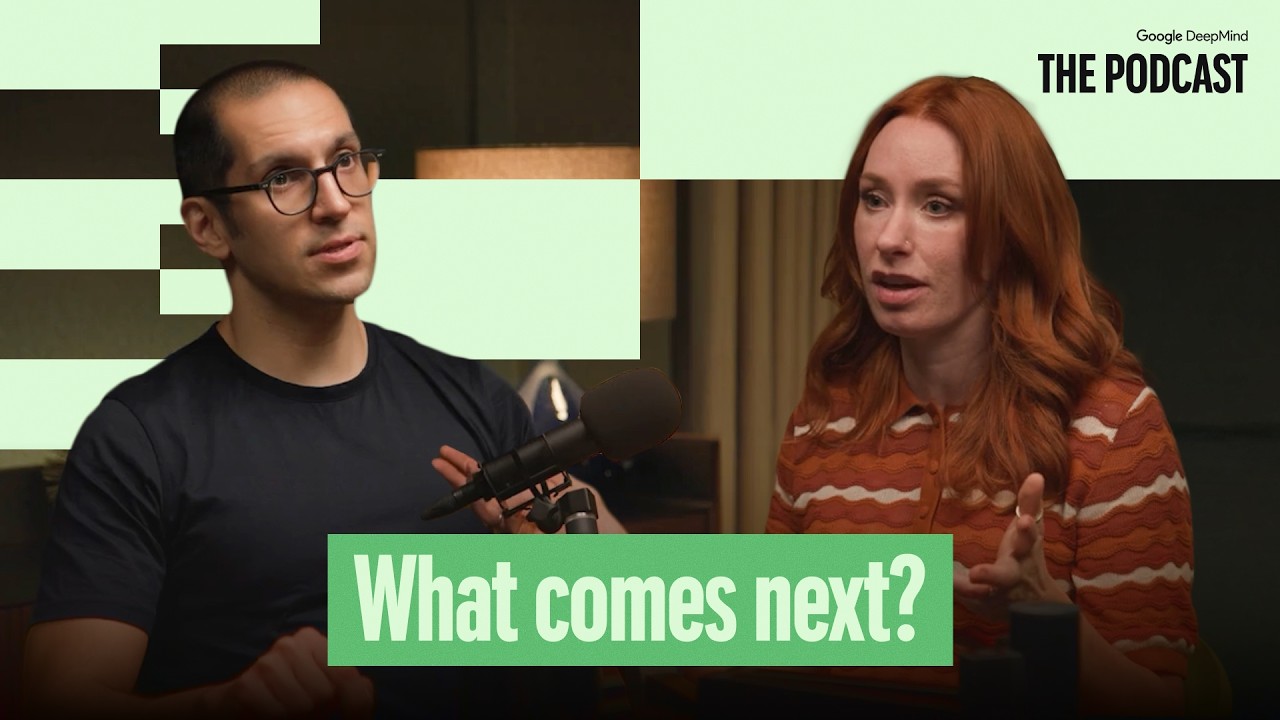
When millions of AI agents meet
Keywords
Summary
153 words
Critical Evaluation
The video provides a comprehensive and insightful overview of AI agents and their potential societal impact, delivered by an expert in the field. Tomašev’s explanations are clear and accessible, making complex concepts understandable without oversimplifying. He demonstrates intellectual honesty by acknowledging the limitations and failure rates of current agents, which adds credibility to the discussion. The argumentation is solid, with logical progression from defining agents to exploring their applications and risks. The discussion of automation bias is particularly valuable, as it highlights a psychological risk that is often overlooked. The sources cited, including the blog post on securing the future of AI agents, are relevant and authoritative, though the video itself does not delve into detailed empirical evidence. The title accurately reflects the content, and the conversation stays on topic throughout. The presence of a sponsor segment is noted but does not detract from the scientific value. Overall, the video is a high-quality contribution to the discourse on AI agents, offering both technical depth and broader societal considerations.
168 words
Title / Content Match
The title accurately reflects the core theme of the video, which explores the implications of large-scale AI agent interactions.
Quality & Reliability
8/10
The discussion is led by a senior research scientist at Google DeepMind, providing expert insights into AI agents and the agentic economy. The content is well-structured, references specific research papers, and includes honest discussion of limitations and risks. However, it is primarily an opinion piece without detailed empirical data or peer-reviewed citations in the video itself.
Chapters
Cited Sources
- Securing the future of AI agents — Referenced in the video description as part of the AGI control roadmap.
- Google DeepMind on LinkedIn — Official company page mentioned in the description.
Concurring Sources
- Securing the future of AI agents — Aligns with the video's discussion on AI safety and control.
Contribution & Novelties
The video offers a forward-looking perspective on the ‘agentic economy,’ where AI agents interact autonomously, and discusses novel concepts such as ‘society of specialists’ and ‘cognitive monoculture.’ It provides a balanced view of the benefits and risks, including cybersecurity challenges unique to multi-agent systems.
Pour aller plus loin :
- AI agent — Provides foundational definitions and context for understanding AI agents.
- Automation bias — Explains the psychological phenomenon discussed in the video.
- Multi-agent system — Offers an overview of the field of multi-agent systems, relevant to the ‘society of specialists’ concept.
91 words
Radar Profile
The radar profile shows high scores in quantity and quality of information, with a slightly lower score in technical level, indicating that the content is informative and reliable but not overly technical. The overall high scores suggest a well-balanced and credible presentation.
💬 Positif. Sur les 30 commentaires analysés, le public exprime une appréciation générale pour la qualité de l'interview et la clarté des explications, avec quelques demandes humoristiques et des remerciements personnels.