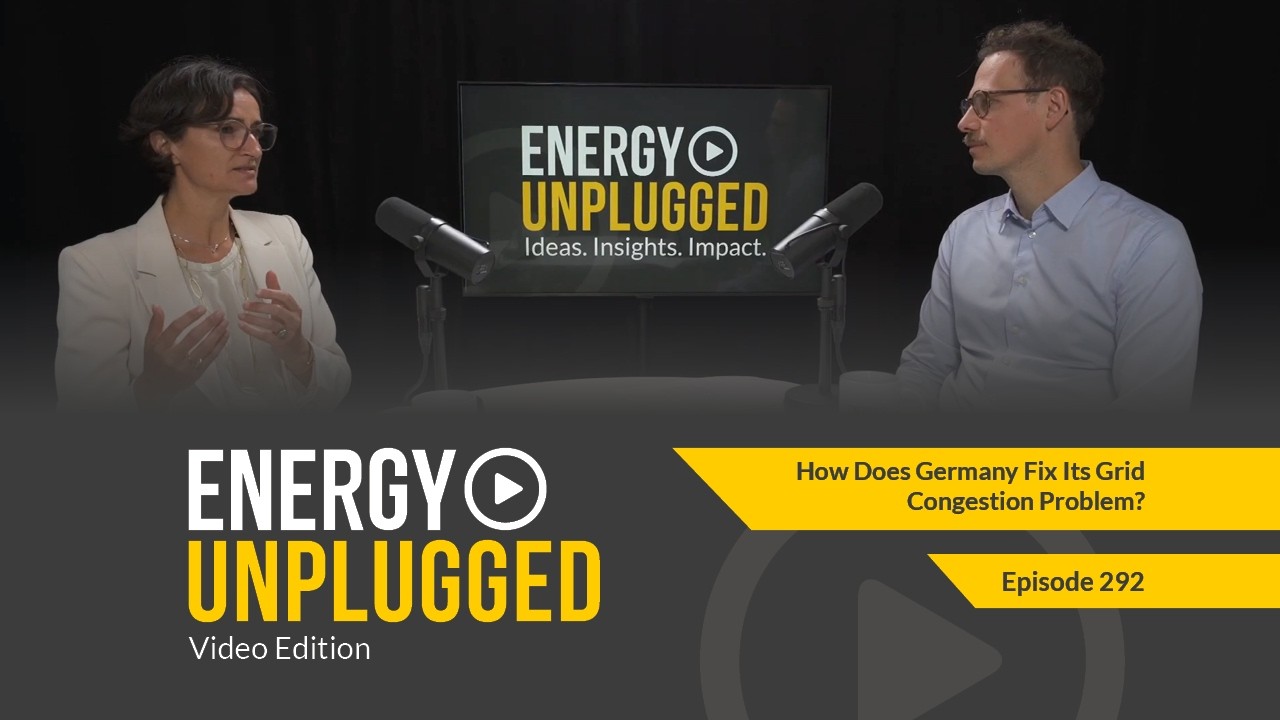
How Does Germany Fix Its Grid Congestion Problem? EP. 292
Keywords
Summary
133 words
Critical Evaluation
Value of the Information & Strength of the Argument
The value of the information lies in the practical perspective of a CEO managing both a distribution grid and renewable assets. Alemany provides nuanced arguments for market-based approaches, explaining the limitations of dynamic grid tariffs and the potential of nodal pricing. The argumentation is coherent, though it relies on anecdotal evidence and personal experience rather than rigorous data. The discussion offers valuable insights into the real-world challenges of grid congestion and market design.
Scientific Rigor, Source Quality, Title Accuracy
The scientific rigor is moderate; the conversation is based on expert opinion without formal citations. The title accurately reflects the content. The podcast is produced by Aurora Energy Research, a reputable energy consultancy, adding credibility. However, the lack of specific data sources and the reliance on personal views limit the scientific robustness.
140 words
Title / Content Match
The title accurately reflects the content, which focuses on Germany's grid congestion challenges and potential solutions.
Quality & Reliability
7/10
The discussion features a senior energy executive with practical experience, providing credible insights. However, it is primarily opinion-based with limited quantitative data and no formal citations.
Key Moments
Markers derived by PSI from the transcript: the creator did not define chapters.
- Introduction to the topic and guests.
- Discussion on the scale of grid congestion in Germany.
- Alemany explains enercity's dual role as grid operator and renewable producer.
- Comparison of single price zone with dynamic grid fees and regional pricing.
- Discussion on the benefits and challenges of nodal pricing.
- Barriers to market reform: political, structural, and technical.
- The role of flexibility and battery storage in solving congestion.
- Alemany's vision for the future and the need for pilot projects.
Contribution & Novelties
The podcast provides a unique insider perspective on Germany’s grid congestion problem, highlighting the practical challenges and potential solutions from a utility CEO’s viewpoint. It emphasizes the need for market-based mechanisms and the importance of flexibility and digitalization.
Pour aller plus loin :
- Nodal pricing — Overview of nodal pricing as a market mechanism.
- Dynamic grid tariffs — General concept of dynamic pricing applied to electricity.
- German energy transition (Energiewende) — Background on Germany’s energy policy.
76 words
Radar Profile
The radar profile shows a balanced performance across all dimensions, with slightly higher scores in information quantity and quality, reflecting the expert discussion. The technical level is moderate, suitable for a general audience interested in energy markets.