LEC 10 Gauss's law applied to symmetrical charge distribution | Gauss's law
Keywords
Summary
149 words
Critical Evaluation
Value of the Information & Strength of the Argument
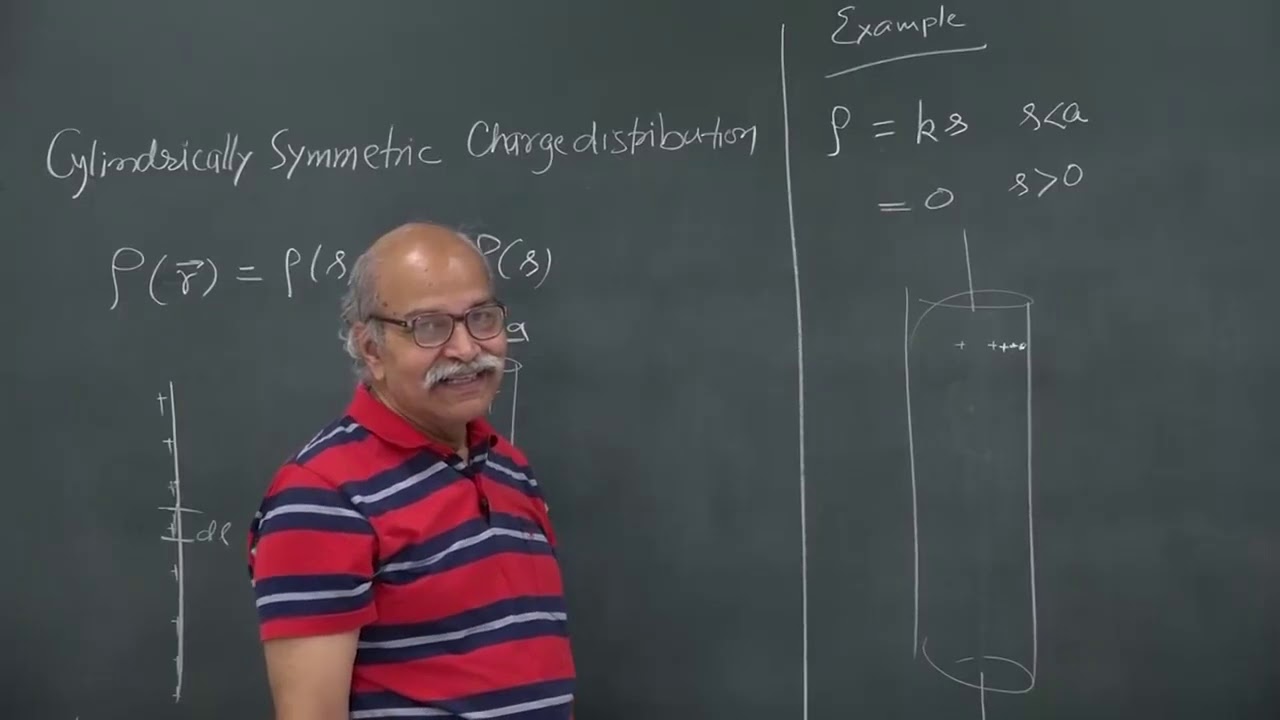
The lecture provides a thorough and rigorous derivation of the electric field for a cylindrically symmetric charge distribution. The argumentation is solid, building from the fundamental principles of Gauss’s law and symmetry considerations. The instructor carefully explains each step, from setting up the Gaussian surface to evaluating the flux and enclosed charge. The use of a non-uniform charge density adds depth, demonstrating how to handle more complex distributions. The value lies in the clear pedagogical approach, making the method accessible and applicable to a wide range of problems.
Scientific Rigor, Source Quality, Title Accuracy
The scientific rigor is high, as the lecture follows standard derivations consistent with classical electrostatics. The instructor is a well-known physicist, and the content is accurate. The title accurately describes the content, focusing on Gauss’s law applied to symmetric charge distributions. No external sources are cited, but the lecture is part of a structured course, and the playlist link is provided. The presentation is self-contained and relies on established physics principles.
174 words
Title / Content Match
The title accurately reflects the content: the lecture focuses on applying Gauss's law to symmetric charge distributions, specifically cylindrical symmetry.
Quality & Reliability
8/10
The lecture is delivered by a renowned physicist, Prof. H.C. Verma, known for his clarity and rigorous approach. The content is mathematically sound and follows standard derivations of Gauss's law applications. The presentation is well-structured, with logical steps and clear explanations. However, the video is a recording of a live lecture, which may include minor digressions and informal language, but the scientific content remains accurate.
Key Moments
Markers derived by PSI from the transcript: the creator did not define chapters.
- Introduction to cylindrical coordinates and symmetry.
- Definition of cylindrical symmetry and its implications.
- General method for applying Gauss's law to cylindrical distributions.
- Example: infinitely long cylinder with non-uniform charge density.
- Setting up the Gaussian surface and evaluating flux.
- Integration of charge density to find enclosed charge.
- Deriving the electric field inside the cylinder.
- Deriving the electric field outside and concluding remarks.
Cited Sources
- Classical Electromagnetism-1 (Electrostatics) Playlist — Complete lecture series by Prof. H.C. Verma on electrostatics.
Concurring Sources
- Gauss's law - Wikipedia — Standard formulation and applications of Gauss's law.
Contribution & Novelties
This lecture provides a clear and systematic approach to applying Gauss’s law to cylindrically symmetric charge distributions, including a worked example with a non-uniform charge density. The pedagogical value is high, as it emphasizes the importance of symmetry in simplifying complex problems. The lecture is part of a comprehensive course, offering a solid foundation for students.
Pour aller plus loin :
- Gauss’s law - Wikipedia — General statement and applications.
- Cylindrical coordinate system - Wikipedia — Mathematical background for the coordinates used.
- Electric field - Wikipedia — Fundamental concept underlying the lecture.
92 words
Radar Profile
The radar profile shows high scores in information quantity, quality, and reliability, with a slightly lower technical level, indicating a lecture that is comprehensive and accurate but may require some background knowledge. The overall balance suggests a solid educational resource.
💬 Sur les 0 commentaires analysés, aucune tendance n'est disponible.