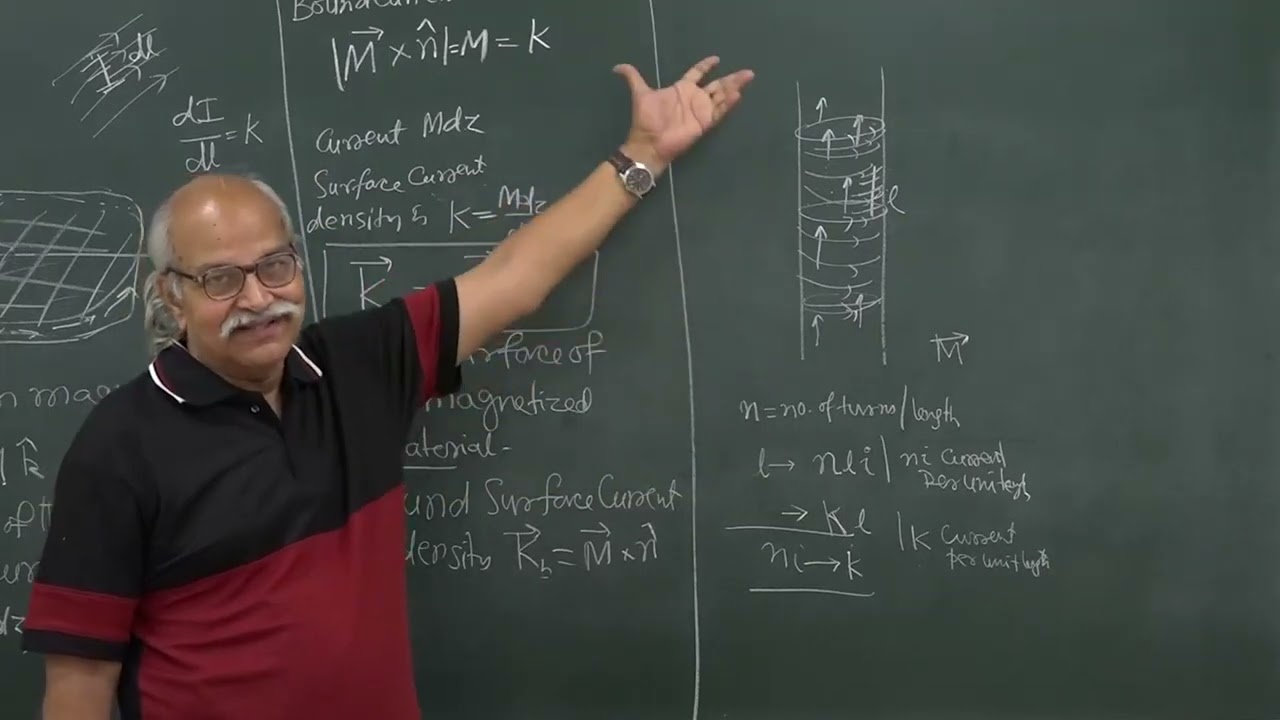
LEC 37 - Bound Volume Current
Keywords
Summary
166 words
Critical Evaluation
Value of the Information & Strength of the Argument
The lecture provides a clear and rigorous explanation of bound currents in magnetized materials. The argumentation is solid, starting from the known surface current for uniform magnetization and extending to the volume current for non-uniform cases. The derivation of J_b = ∇ × M is well-structured, using a differential block and Taylor expansion, making the mathematics accessible. The physical interpretation is emphasized, such as the equivalence to a solenoid and the explanation of magnetic attraction. The lecture effectively builds on previous material and sets the stage for future topics.
Scientific Rigor, Source Quality, Title Accuracy
The lecture is scientifically rigorous, with logical derivations and correct use of vector calculus. No external sources are cited, but the content is standard in electromagnetism textbooks. The title accurately reflects the content, focusing on bound volume current. The lecture is well-structured and pedagogically sound.
149 words
Title / Content Match
The title accurately reflects the main topic: the derivation and explanation of bound volume current in magnetized materials.
Quality & Reliability
8/10
The lecture provides a rigorous derivation of bound volume current density from non-uniform magnetization, using calculus and vector identities. The reasoning is clear and mathematically sound, with appropriate physical interpretations. No external sources are cited, but the content is standard textbook material.
Key Moments
Markers derived by PSI from the transcript: the creator did not define chapters.
- Recap of bound surface current for uniform magnetization
- Explanation of bar magnet as solenoid and why it attracts at ends
- Discussion on magnetic field lines and poles
- Explanation of attraction/repulsion using parallel and anti-parallel currents
- Introduction to non-uniform magnetization and derivation of bound volume current
- Derivation of J_b = ∇ × M using differential volume element
- Conclusion and preview of H field
Contribution & Novelties
The lecture provides a clear pedagogical derivation of bound volume current density, emphasizing the physical intuition behind the curl of magnetization. It connects the concept to the solenoid model and explains magnetic forces in terms of current interactions. The approach is standard but well-presented.
Pour aller plus loin :
- Magnetization — Background on magnetization and bound currents.
- Maxwell’s equations — Context for magnetic fields and currents.
- Ampère’s circuital law — Related to calculating magnetic fields from currents.
77 words
Radar Profile
The radar profile shows high scores across all dimensions, indicating a well-balanced and reliable lecture. The technical level is high, but the explanation is clear, making it suitable for advanced students.