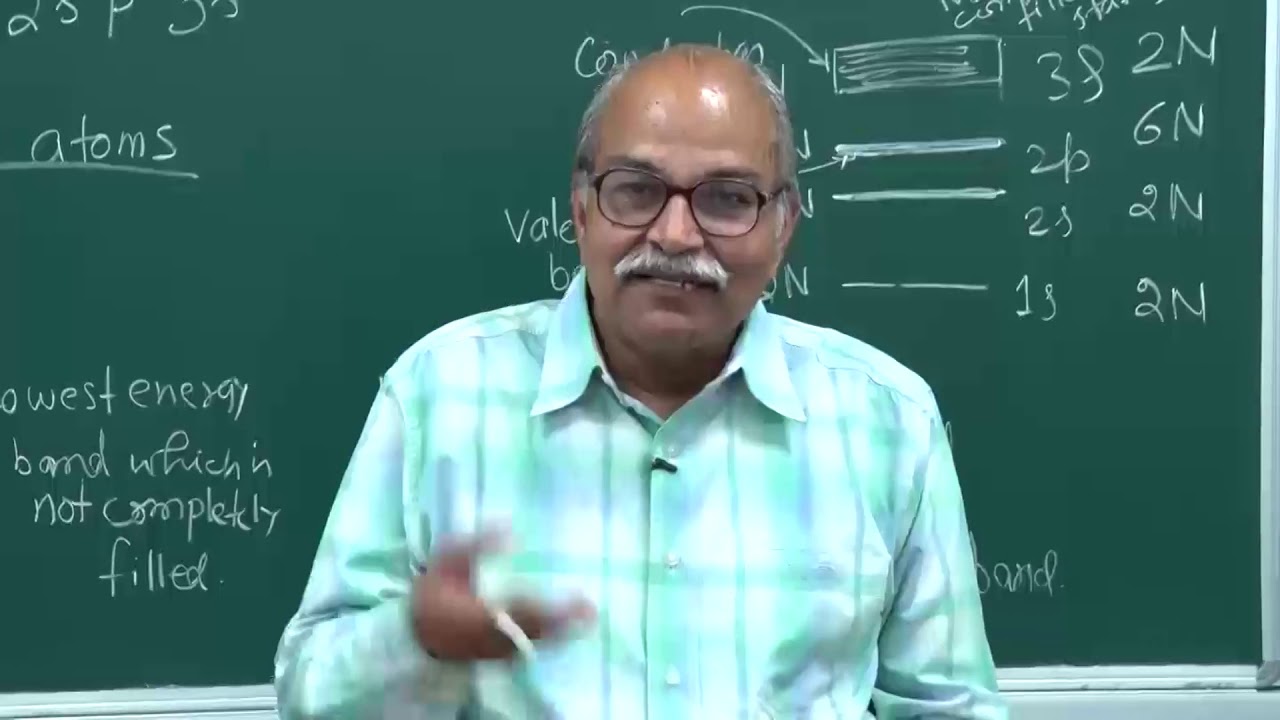
W3-03 Conduction and valence bands #SemiconductorPhysics
Keywords
Summary
187 words
Critical Evaluation
Value of the Information & Strength of the Argument
The lecture provides a solid foundation in band theory, clearly explaining the definitions of valence and conduction bands and their role in determining electrical conductivity. The argumentation is logical and builds step-by-step, using specific elements to illustrate different band structures. The explanation of why some materials are conductors, insulators, or semiconductors is convincing and well-supported by examples. However, the lecture does not provide quantitative calculations or references to experimental data, which would strengthen the argumentation.
Scientific Rigor, Source Quality, Title Accuracy
The lecture is scientifically rigorous in its explanation of band theory, with correct physics and clear definitions. However, it does not cite any external sources or references, relying solely on the instructor’s explanation. The title accurately reflects the content, focusing on conduction and valence bands. The lecture is well-structured and suitable for an introductory course in semiconductor physics.
148 words
Title / Content Match
The title accurately reflects the content, which focuses on conduction and valence bands in semiconductors.
Quality & Reliability
8/10
The lecture provides a clear and accurate explanation of band theory, using sodium, magnesium, and silicon as examples. The physics is correct and well-structured, though it lacks citations and references to external sources.
Key Moments
Markers derived by PSI from the transcript: the creator did not define chapters.
- Introduction to energy bands in solids, using sodium as an example.
- Definition of valence band and conduction band based on filling at low temperature.
- Explanation of why sodium is a conductor due to half-filled 3s band.
- Discussion of magnesium and overlapping bands leading to conductivity.
- Introduction of insulators and semiconductors, with diamond as an example.
- Explanation of thermal excitation and the role of kT in semiconductors.
- Conclusion and preview of silicon as the model semiconductor.
Contribution & Novelties
This lecture provides a clear and accessible introduction to band theory, focusing on the physical meaning of conduction and valence bands. It effectively uses examples of sodium, magnesium, and diamond to illustrate different band structures. The explanation of thermal excitation and the role of kT is particularly useful for understanding semiconductor behavior.
Pour aller plus loin :
- Band theory — Provides a comprehensive overview of band theory, including the formation of bands and the distinction between conductors, insulators, and semiconductors.
- Fermi–Dirac statistics — Essential for understanding the distribution of electrons in energy bands, especially at finite temperatures.
- Silicon — The most important semiconductor material, with details on its electronic properties and applications.
112 words
Radar Profile
The radar profile shows high scores in information quantity, quality, and reliability, with a slightly lower score in technical level, indicating a well-balanced introductory lecture that is both informative and accessible.