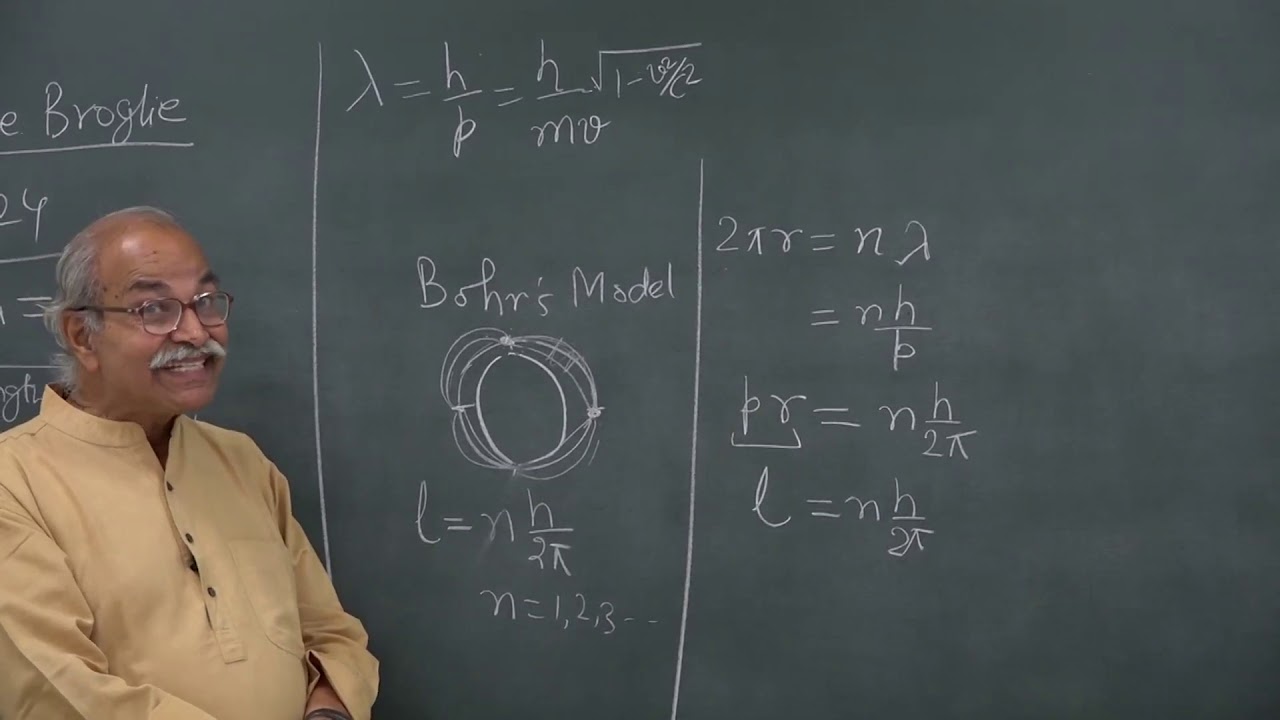
Lec 7 Electron are also waves
Keywords
Summary
183 words
Critical Evaluation
Value of the Information & Strength of the Argument
The lecture provides a solid introduction to the wave nature of electrons, building on the wave-particle duality of light. The argumentation is clear and logical, starting with the de Broglie hypothesis and then showing how it explains the Bohr model’s quantization condition. The demonstration with the vibrating ring is particularly effective in visualizing standing waves and the condition for stable patterns. The discussion of the Davisson-Germer experiment is detailed, including the accidental discovery and the importance of the heat treatment, which adds a historical and practical dimension. The instructor’s explanations are accessible and well-paced, making complex concepts understandable. However, the lecture does not delve into the mathematical derivations in depth, and some steps are glossed over. Overall, the value of the information is high for an introductory audience, and the argumentation is coherent and persuasive.
Scientific Rigor, Source Quality, Title Accuracy
The scientific rigor is high; the content is accurate and aligns with established quantum mechanics. The instructor does not cite specific sources, but the material is standard textbook knowledge. The title accurately reflects the content, focusing on the wave nature of electrons. The lecture includes a live demonstration, which enhances credibility. However, the lack of explicit references to original papers or textbooks may be a minor weakness for viewers seeking further reading. The description mentions relevant hashtags and the instructor’s name, but no external links are provided. Overall, the lecture is reliable and well-structured.
244 words
Title / Content Match
The title accurately reflects the content, which focuses on the wave nature of electrons.
Quality & Reliability
8/10
The lecture is delivered by a knowledgeable instructor (likely H.C. Verma) and presents established quantum mechanics concepts with clear explanations and a live demonstration. The content is accurate and well-structured, though it lacks citations to external sources.
Key Moments
Markers derived by PSI from the transcript: the creator did not define chapters.
- Introduction to wave-particle duality of light
- De Broglie hypothesis: particles have wavelength
- Connection to Bohr model and quantization
- Demonstration of standing waves on a ring
- Explanation of Davisson-Germer experiment setup
- Accidental oxidation and heat treatment of nickel
- Observation of diffraction patterns and confirmation
Contribution & Novelties
The lecture provides a clear and intuitive explanation of the wave nature of electrons, using a physical demonstration to illustrate standing waves. It effectively ties together the de Broglie hypothesis, the Bohr model, and the Davisson-Germer experiment, offering a cohesive narrative. The historical context of the accidental discovery adds depth. For further exploration, consider the following:
- Wave–particle duality — Overview of the concept.
- De Broglie hypothesis — Detailed explanation of matter waves.
- Davisson–Germer experiment — The experiment confirming electron waves.
80 words
Radar Profile
The radar profile shows high scores across all dimensions, indicating a well-balanced and reliable lecture. The strengths are in information quantity and quality, with a slightly lower technical depth, making it suitable for a broad audience.