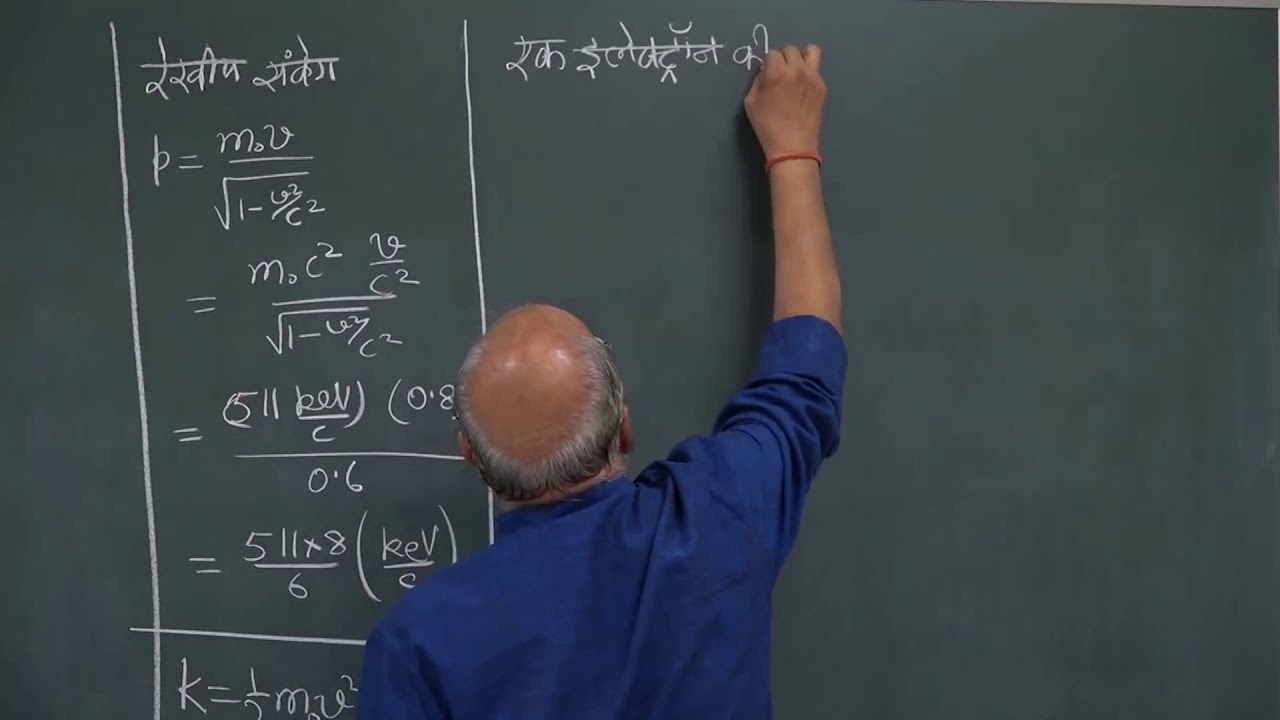
W7-01 Numerical problems in #Dynamics
Keywords
Summary
192 words
Critical Evaluation
Value of the Information & Strength of the Argument
The video provides valuable worked examples that illustrate the application of relativistic formulas to practical problems. The instructor carefully derives each result, showing the algebraic steps and numerical substitutions. The argumentation is sound, based on established physics principles. However, the presentation is somewhat informal, with occasional digressions and unclear phrasing, which may detract from the clarity. The value lies in the concrete numerical examples that help solidify understanding of abstract concepts.
Scientific Rigor, Source Quality, Title Accuracy
The scientific rigor is acceptable for a tutorial, as the formulas used are standard and correctly applied. However, no sources are cited, and the video does not reference any textbooks or papers. The title accurately describes the content, which is a set of numerical problems in dynamics. The lack of citations is a minor weakness, but the content itself is reliable.
147 words
Title / Content Match
The title accurately reflects the content: it is a lecture on numerical problems in dynamics, specifically relativistic dynamics.
Quality & Reliability
7/10
The video is a physics tutorial solving numerical problems in relativistic dynamics. The derivations are standard and correct, but the presentation is informal and lacks citations. The instructor demonstrates the calculations step-by-step, which aids understanding, but the lack of rigorous referencing and occasional unclear explanations reduce the score.
Key Moments
Markers derived by PSI from the transcript: the creator did not define chapters.
- Introduction to the lecture and first problem: electron at 0.8c, find total and kinetic energy.
- Calculation of rest mass energy of electron in joules and electron volts.
- Derivation of total energy and kinetic energy for the electron.
- Calculation of linear momentum for the electron.
- Comparison with non-relativistic kinetic energy formula.
- Second problem: electron with kinetic energy 1.02 MeV, find speed and momentum.
- Derivation of speed from total energy relation.
- Calculation of momentum using energy-momentum relation.
- Third problem: relativistic mass five times rest mass, find speed.
- Discussion on impossibility of reaching speed of light.
- Calculation of energy from mass conversion (1 gram).
- Fourth problem: two particles collide, find rest mass of combined particle.
- Conservation of momentum and energy applied to collision.
- Calculation of combined rest mass and conclusion.
Contribution & Novelties
The video offers a series of worked examples that reinforce the application of relativistic dynamics formulas. It provides a clear demonstration of how to handle problems involving high-speed particles, emphasizing the use of natural units like electron volts. The lecture also clarifies the concept of relativistic mass and its implications for reaching the speed of light.
Pour aller plus loin :
- Special relativity — Foundational theory for the calculations presented.
- Kinetic energy — Relativistic kinetic energy formula.
- Mass–energy equivalence — E=mc^2, central to the mass conversion problem.
87 words
Radar Profile
The radar profile shows balanced scores across all dimensions, with slightly lower technical level due to the tutorial nature. The video is informative and reliable, but not highly technical or original.