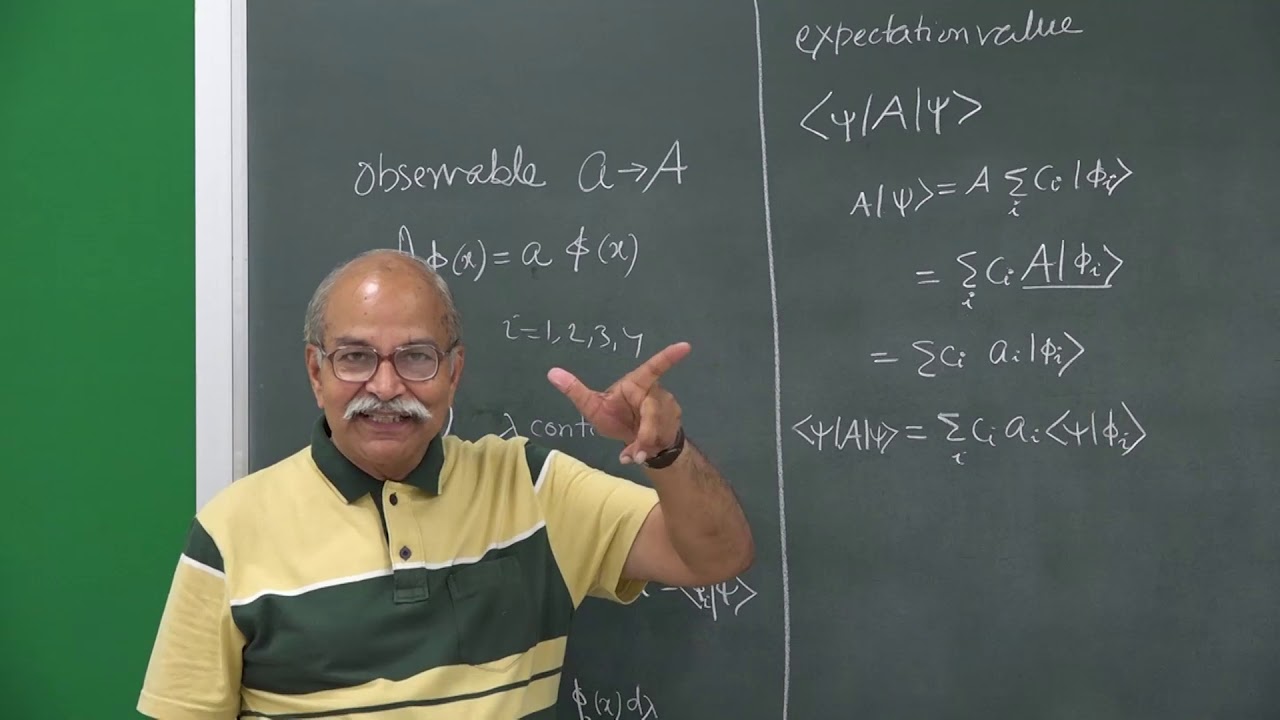
Lec 21 Solving Schrödinger Equation
Keywords
Summary
161 words
Critical Evaluation
Value of the Information & Strength of the Argument
The lecture provides a clear and logical progression from fundamental concepts to the solution of the Schrödinger equation. The argumentation is solid, building on previously established principles of quantum mechanics. The instructor effectively uses analogies, such as comparing the expansion in eigenfunctions to expressing a vector in terms of unit vectors, to make the material accessible. However, the lecture lacks mathematical rigor in some derivations and does not provide concrete examples or applications, which would strengthen the argumentation.
Scientific Rigor, Source Quality, Title Accuracy
The lecture does not cite any external sources, relying solely on the instructor’s explanations. The content is consistent with standard quantum mechanics textbooks, but the lack of references reduces the scientific rigor. The title accurately reflects the content, and the lecture is well-structured. No comments were provided for analysis.
142 words
Title / Content Match
The title accurately reflects the content, which focuses on solving the Schrödinger equation.
Quality & Reliability
7/10
The lecture provides a clear and systematic introduction to solving the Schrödinger equation, but lacks rigorous derivations and references. The content is accurate but presented at an introductory level.
Key Moments
Markers derived by PSI from the transcript: the creator did not define chapters.
- Introduction and review of wave functions and observables
- Expansion of wave functions in orthonormal bases
- Introduction of the Hamiltonian operator and eigenvalue equation
- Derivation of time evolution of expansion coefficients
- Solution of the time-dependent Schrödinger equation using eigenfunctions
- Summary and recipe for solving the Schrödinger equation
Contribution & Novelties
The lecture provides a clear pedagogical approach to solving the Schrödinger equation, emphasizing the use of Hamiltonian eigenfunctions as a basis. It offers a step-by-step recipe that is easy to follow. However, it does not present new research or novel insights, but rather a synthesis of standard quantum mechanics concepts.
Pour aller plus loin :
- Schrödinger equation — Provides a comprehensive overview of the equation and its solutions.
- Hamiltonian (quantum mechanics) — Details the role of the Hamiltonian operator in quantum systems.
- Time-independent perturbation theory — Extends the method to approximate solutions for complex systems.
95 words
Radar Profile
The radar profile shows balanced scores across all dimensions, with slightly higher scores in information quantity and reliability, indicating a solid but not exceptional lecture. The technical level is moderate, suitable for an introductory course.