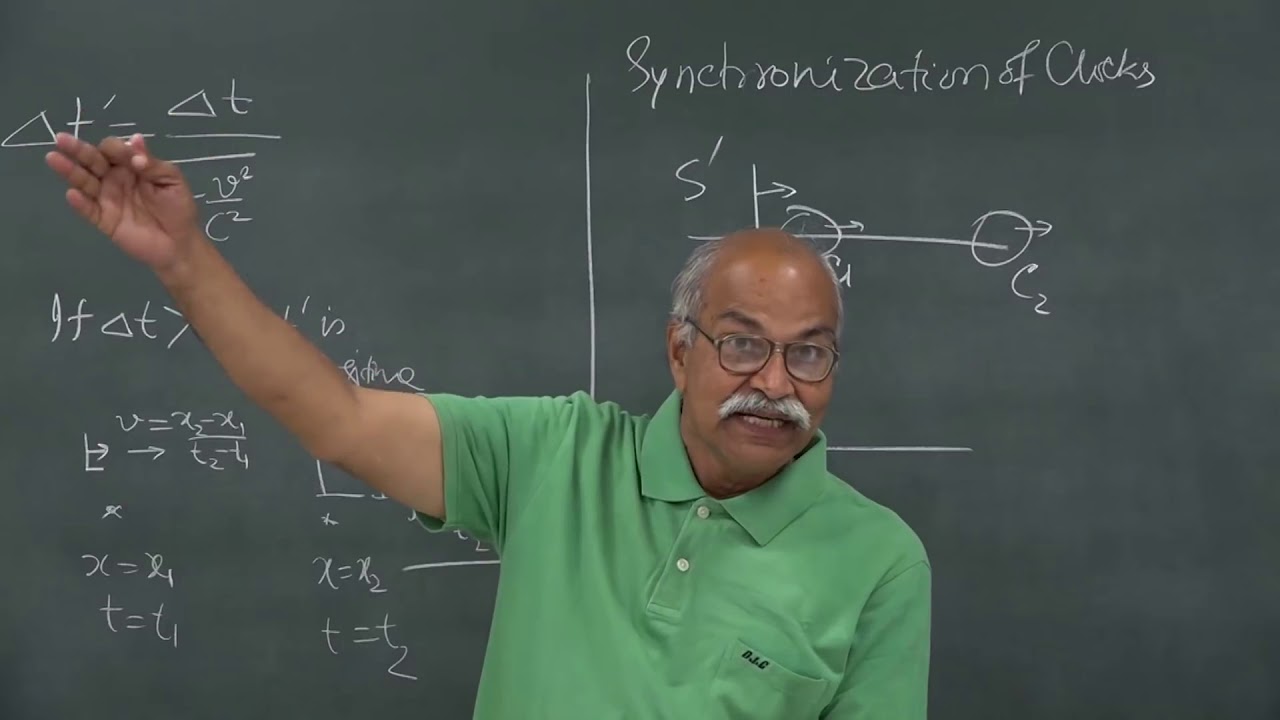
W3-03 Velocity Transformation
Keywords
Summary
164 words
Critical Evaluation
Value of the Information & Strength of the Argument
The lecture provides a clear and rigorous derivation of velocity transformation in special relativity, building on previously established concepts. The argumentation is logical, starting from Lorentz transformations and carefully deriving each component. The explanation of clock synchronization is also valuable, as it clarifies a subtle consequence of relativity. The presentation is didactic, with step-by-step derivations that enhance understanding.
Scientific Rigor, Source Quality, Title Accuracy
The scientific rigor is high: the derivations are mathematically correct and follow standard textbook approaches. However, no external sources are cited, and the lecture does not reference experimental confirmations. The title accurately reflects the content, which is focused on velocity transformation. The lecture is self-contained, assuming prior knowledge of Lorentz transformations and time dilation.
127 words
Title / Content Match
The title accurately reflects the content, which focuses on deriving velocity transformation formulas in special relativity.
Quality & Reliability
8/10
The lecture is a formal derivation of velocity transformation in special relativity, based on Lorentz transformations. The reasoning is clear and mathematically sound, with no apparent errors. However, it lacks citations to external sources and does not discuss experimental verification.
Key Moments
Markers derived by PSI from the transcript: the creator did not define chapters.
- Review of relativity of simultaneity and time dilation; ordering of events at same position is invariant.
- Introduction to clock synchronization; moving clocks are not synchronized.
- Derivation of lack of synchronization: rear clock leads front clock by Lv/c^2.
- Transition to velocity transformation; Galilean vs Lorentz.
- Derivation of ux' using Lorentz transformation.
- Derivation of uy' and uz' components.
- Summary of velocity transformation formulas and inverse transformations.
Contribution & Novelties
The lecture provides a clear and systematic derivation of velocity transformation in special relativity, which is a fundamental topic. It also clarifies the subtlety of clock synchronization, which is often misunderstood. The presentation is suitable for students learning special relativity.
Pour aller plus loin :
- Special relativity - Wikipedia — Provides background and context.
- Lorentz transformation - Wikipedia — Details the mathematical foundation.
- Velocity-addition formula - Wikipedia — Directly related to the topic.
73 words
Radar Profile
The radar profile shows high scores across all dimensions, indicating a well-balanced and reliable lecture. The technical level is high, but the clarity of explanation ensures accessibility for students with prior knowledge of special relativity.