Keywords
Summary
163 words
Critical Evaluation
Value of the Information & Strength of the Argument
The lecture provides valuable worked examples that illustrate the application of relativistic dynamics equations. The argumentation is solid: each step is derived from fundamental principles (energy-momentum four-vector, conservation laws) and calculations are shown in detail. The instructor correctly identifies when non-relativistic approximations are valid and when relativistic treatment is necessary. The final problem elegantly demonstrates the conversion of kinetic energy into rest mass in an inelastic collision, reinforcing the concept of mass-energy equivalence.
Scientific Rigor, Source Quality, Title Accuracy
The scientific rigor is high: the derivations are mathematically correct and follow standard relativistic formalism. However, no external sources are cited, and the lecture does not reference experimental validations or discuss potential limitations of the equations. The title accurately reflects the content, which is a problem-solving session. No comments were provided for analysis.
141 words
Title / Content Match
The title accurately reflects the content: a problem-solving session in physics, specifically relativistic dynamics.
Quality & Reliability
8/10
The lecture is mathematically rigorous, deriving results from fundamental relativistic equations. The explanations are clear and step-by-step, with correct numerical calculations. However, it lacks citations to external sources and does not discuss experimental verification or limitations.
Key Moments
Markers derived by PSI from the transcript: the creator did not define chapters.
- Introduction: solving problems in relativistic dynamics.
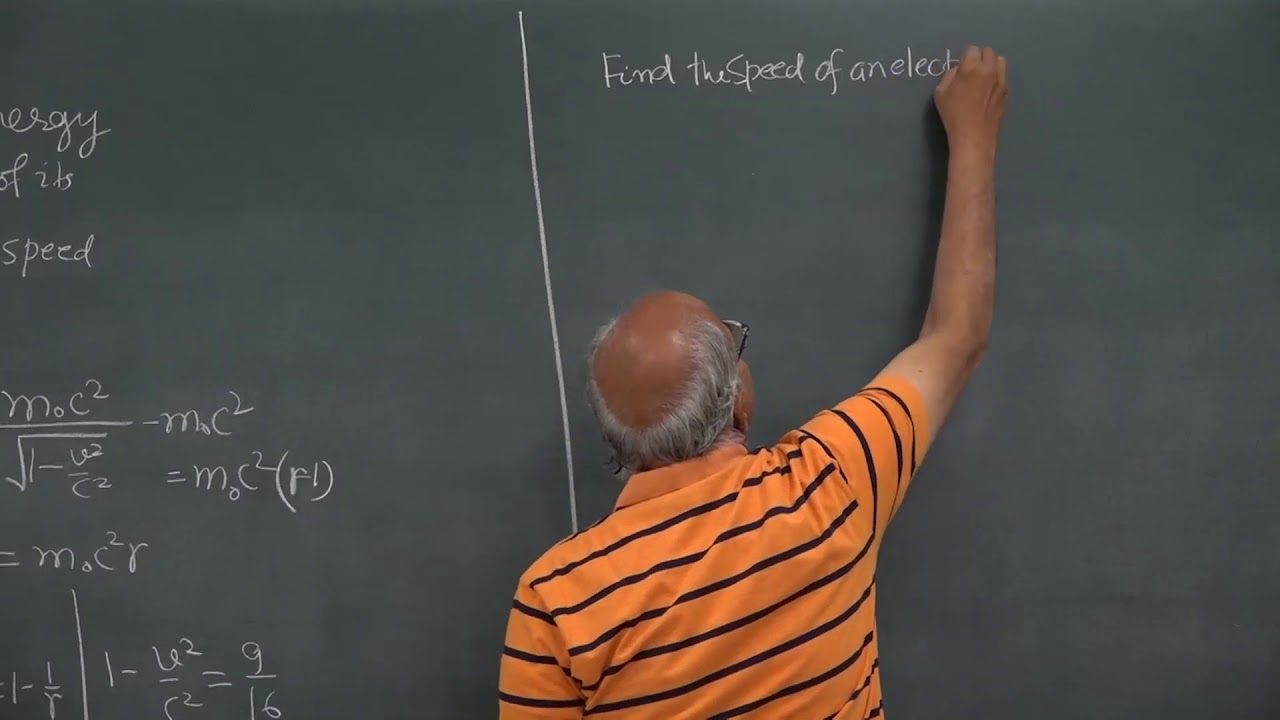
- Problem 1: Kinetic energy is one-fourth of total energy; find speed.
- Solution to Problem 1: v = 0.66c.
- Problem 2: Speed of electron with 100 eV kinetic energy.
- Non-relativistic approximation used; v ≈ 5.9×10^6 m/s.
- Problem 3: Speed of electron with 1 MeV kinetic energy.
- Relativistic calculation; v = 0.94c.
- Problem 4: Perfectly inelastic collision of two particles.
- Conservation of momentum and energy; composite particle at rest.
- Rest mass of composite particle is greater than sum of initial rest masses.
Contribution & Novelties
The lecture provides a clear pedagogical approach to solving relativistic dynamics problems, emphasizing the use of conservation laws and the distinction between relativistic and non-relativistic regimes. It effectively demonstrates the concept of mass-energy equivalence in inelastic collisions.
Pour aller plus loin :
- Special relativity — Foundational theory underlying the calculations.
- Mass–energy equivalence — Central concept illustrated in the final problem.
- Inelastic collision — Classical analogue; relativistic treatment differs in energy conversion.
71 words
Radar Profile
The radar profile shows high scores in quality, technical level, and reliability, with a slightly lower quantity of information due to the focused problem-solving format. This indicates a technically rigorous but narrowly scoped lecture.