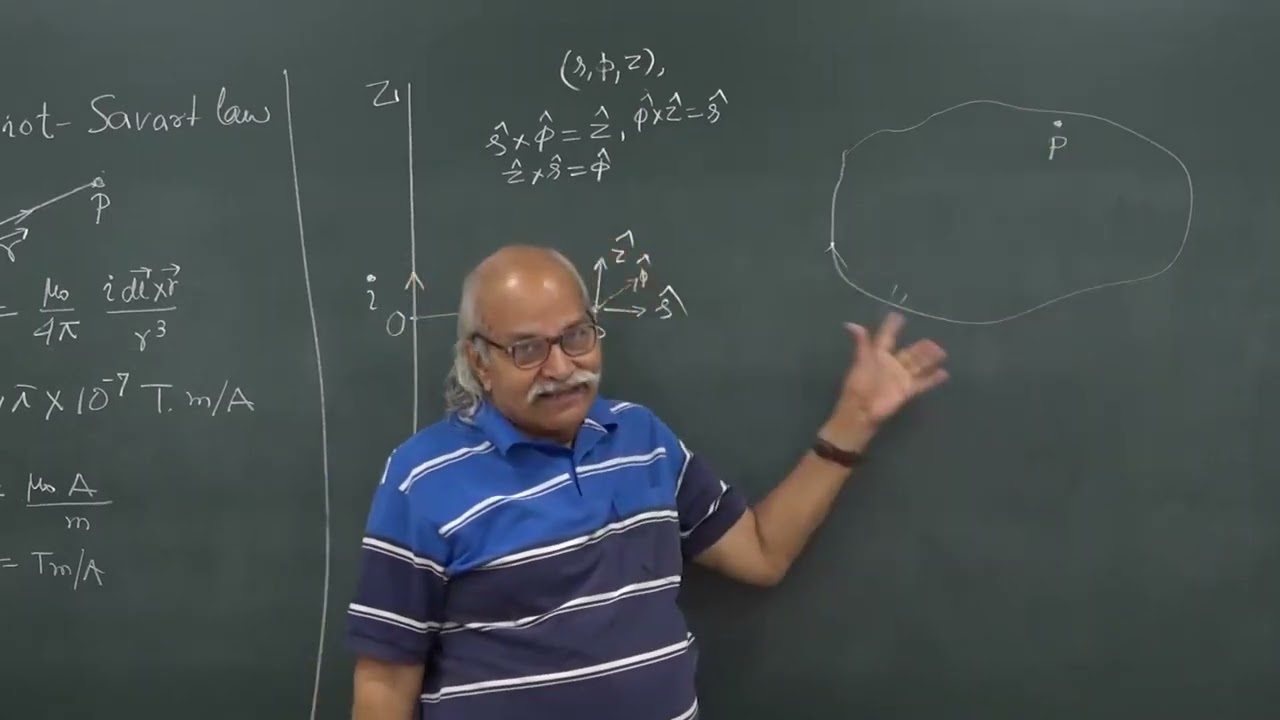
LEC 18 - Magnetic Field Due to a Straight, Long Circular ...
Keywords
Summary
137 words
Critical Evaluation
Value of the Information & Strength of the Argument
The lecture provides a thorough and rigorous derivation of the magnetic field due to a long straight wire, which is a fundamental result in electromagnetism. The argumentation is solid, with each step clearly justified. The use of cylindrical coordinates is well-motivated and explained, making the derivation accessible. The lecturer also connects the result to the right-hand rule, reinforcing the physical intuition. The value lies in the detailed mathematical treatment and the emphasis on coordinate systems, which are essential for solving more complex problems.
Scientific Rigor, Source Quality, Title Accuracy
The lecture is scientifically rigorous, with correct application of the Biot-Savart law and integration techniques. No external sources are cited, but the content is standard and aligns with established physics. The title accurately describes the content, focusing on the magnetic field due to a long straight wire. The presentation is self-contained and does not rely on external references, which is acceptable for a tutorial. The lack of citations is not a significant issue given the foundational nature of the topic.
178 words
Title / Content Match
The title accurately reflects the content, which focuses on deriving the magnetic field due to a long straight wire.
Quality & Reliability
8/10
The lecture provides a rigorous derivation of the magnetic field due to a long straight current-carrying wire using the Biot-Savart law and cylindrical coordinates. The mathematical steps are clear and correct, and the physical interpretation is sound. The presentation is consistent with standard physics textbooks.
Key Moments
Markers derived by PSI from the transcript: the creator did not define chapters.
- Recap of previous topics: magnetic field definition, relativistic origin, and motion of charged particles.
- Introduction to Biot-Savart law and its significance in calculating magnetic fields from current elements.
- Explanation of cylindrical polar coordinates and their unit vectors.
- Setting up the derivation: current element, position vector, and cross product.
- Performing the integration using trigonometric substitution.
- Obtaining the final result B = μ₀I/(2πr) and discussing the direction.
- Discussion on the significance of cylindrical coordinates and the long-wire approximation.
Contribution & Novelties
The lecture provides a clear and detailed derivation of the magnetic field due to a long straight wire using cylindrical coordinates, which is a standard result but presented with pedagogical clarity. The emphasis on coordinate systems and the step-by-step integration is valuable for students. The lecture also reinforces the connection between the Biot-Savart law and the right-hand rule.
Pour aller plus loin :
- Biot–Savart law - Wikipedia — Provides background and applications of the law.
- Cylindrical coordinate system - Wikipedia — Explains the coordinate system used in the derivation.
- Ampère’s circuital law - Wikipedia — An alternative method to derive the magnetic field for symmetric current distributions.
107 words
Radar Profile
The radar profile shows high scores in quality and reliability, with moderate scores in quantity and technical level. This indicates a focused, accurate lecture that provides solid technical content but may not cover a wide range of information.