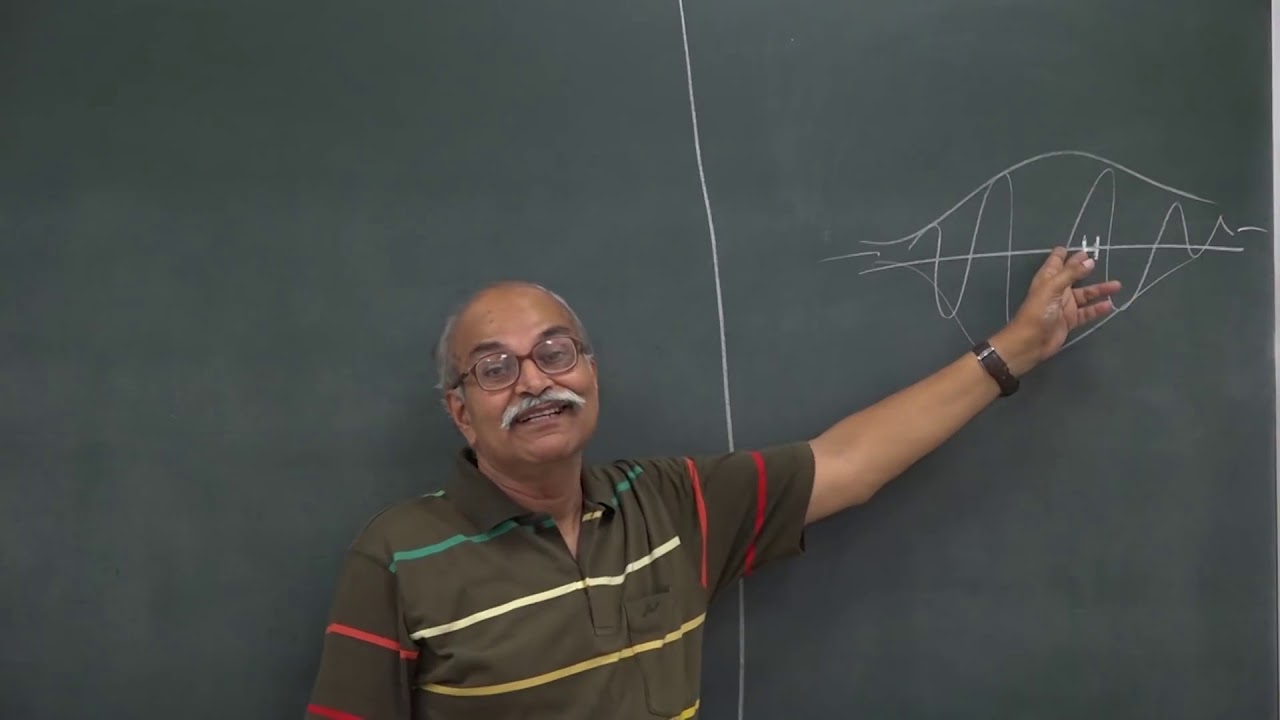
Lec 13 Wave function, observation and measurement
Keywords
Summary
199 words
Critical Evaluation
Value of the Information & Strength of the Argument
The lecture provides a solid conceptual foundation for quantum measurement, clearly explaining the role of wave functions, observables, and eigenstates. The argumentation is logical and builds progressively, using examples to illustrate abstract concepts. The instructor effectively contrasts classical and quantum descriptions, highlighting the probabilistic nature of quantum measurements. The explanation of wave function collapse is particularly clear, with concrete examples for both position and momentum. However, the lecture lacks mathematical rigor in some derivations, and the mixed-language delivery might hinder comprehension for some viewers. Overall, the value lies in its pedagogical clarity and focus on core principles.
Scientific Rigor, Source Quality, Title Accuracy
The lecture is scientifically rigorous in its adherence to standard quantum mechanics formalism, but it does not cite specific sources or references. The title accurately reflects the content, which is a focused discussion on wave functions and measurement. The absence of citations is typical for a lecture, but it limits the ability to verify claims independently. The content aligns with established quantum mechanics textbooks, such as Griffiths or Sakurai, but no explicit references are provided. The lecture’s strength is its pedagogical approach rather than its sourcing.
198 words
Title / Content Match
The title accurately reflects the content, which focuses on wave functions, observation, and measurement in quantum mechanics.
Quality & Reliability
7/10
The lecture is a coherent and pedagogically structured exposition of quantum measurement postulates, consistent with standard textbook treatments. However, it lacks explicit citations to primary sources and is delivered in a mix of Hindi and English, which may affect precision for non-Hindi speakers.
Key Moments
Markers derived by PSI from the transcript: the creator did not define chapters.
- Introduction and recap of wave function concept
- Discussion on observables and pure states
- Example of position eigenstates and delta function
- Probability interpretation and measurement outcomes
- Momentum eigenstates and expansion coefficients
- Introduction to wave function collapse upon measurement
- Illustration of collapse for position and momentum measurements
- Summary and implications of measurement disturbance
Cited Sources
- No explicit sources cited in video description or transcript — The video description contains only hashtags and no references to external sources.
Concurring Sources
- Quantum Mechanics: Concepts and Applications by Nouredine Zettili — Standard textbook covering wave functions, observables, and measurement postulates.
Dissenting Sources
- No discordant sources found — The content aligns with standard quantum mechanics interpretations; no conflicting sources identified.
Contribution & Novelties
The lecture provides a clear and accessible explanation of quantum measurement, emphasizing the concept of wave function collapse and its implications. It effectively bridges the gap between abstract formalism and physical intuition, making it valuable for students. The use of examples for both position and momentum measurements helps solidify understanding.
Pour aller plus loin :
- Quantum superposition — Relevant for understanding mixed states and superpositions.
- Wave function collapse — Directly related to the main topic of measurement.
- Observable — Key concept in quantum mechanics, as discussed in the lecture.
- Born rule — Explains the probability interpretation used in the lecture.
100 words
Radar Profile
The radar profile shows high scores in information quantity and technical level, indicating a content-rich lecture with solid depth. The quality and reliability scores are slightly lower, reflecting the lack of explicit citations and the informal delivery style. Overall, the lecture is well-balanced but could benefit from more rigorous sourcing.
💬 No comments were provided for analysis.