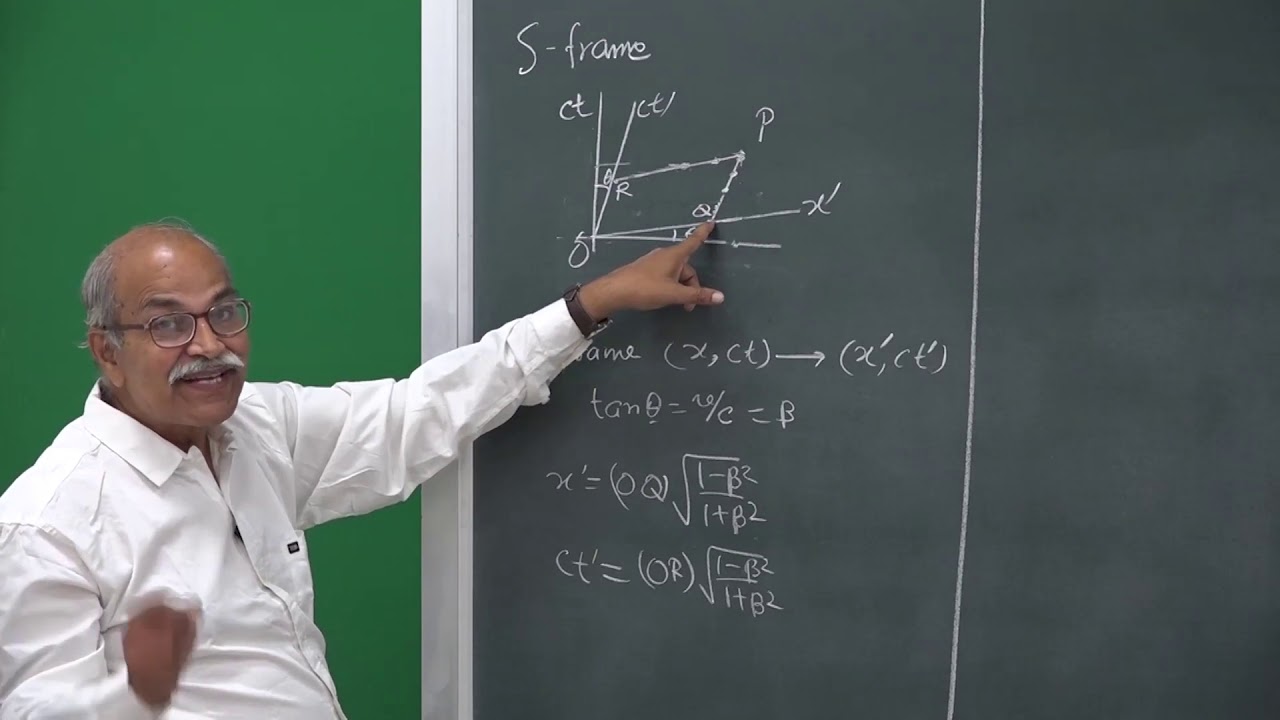
W10-02 Geometry of Time Dilation
Keywords
Summary
157 words
Critical Evaluation
Value of the Information & Strength of the Argument
The lecture provides a clear and rigorous geometric explanation of time dilation, which is valuable for understanding the underlying structure of special relativity. The argumentation is solid, as each step is carefully derived from the geometry of the Minkowski diagram, and the connection to the algebraic Lorentz transformation is made explicit. The instructor also addresses potential misconceptions, such as the impossibility of simultaneity for spacelike-separated events. The use of diagrams enhances comprehension, making the abstract concepts more accessible.
Scientific Rigor, Source Quality, Title Accuracy
The lecture is scientifically rigorous, with correct mathematical derivations and consistent use of standard notation. However, it does not cite any external sources, relying solely on the instructor’s explanation. The title accurately reflects the content, which is focused on the geometric derivation of time dilation. The lecture is self-contained and does not reference any literature, which is acceptable for an educational lecture but limits its value as a research reference.
163 words
Title / Content Match
The title accurately reflects the content, which focuses on the geometric derivation of time dilation using Minkowski diagrams.
Quality & Reliability
8/10
The lecture is mathematically rigorous, deriving time dilation from Minkowski diagrams with clear geometric reasoning. The content is consistent with standard special relativity, but lacks explicit references to external sources.
Key Moments
Markers derived by PSI from the transcript: the creator did not define chapters.
- Introduction to Minkowski diagrams and representation of events.
- Construction of oblique axes for a moving frame S'.
- Reading coordinates in S' using the diagram.
- Explanation of simultaneity in different frames.
- Discussion of timelike and spacelike separations.
- Definition of proper time and its measurement.
- Derivation of the time dilation formula.
- Comparison with Lorentz transformation results.
Contribution & Novelties
The lecture provides a clear geometric derivation of time dilation, which is a standard result but presented in a pedagogical manner. It emphasizes the power of Minkowski diagrams in visualizing relativistic effects. The novelty lies in the step-by-step geometric construction that complements algebraic derivations.
Pour aller plus loin :
- Minkowski spacetime — Overview of the mathematical framework.
- Proper time — Definition and significance.
- Lorentz transformation — Algebraic formulation.
68 words
Radar Profile
The radar profile shows high scores across all dimensions, indicating a well-rounded lecture with strong technical depth, clarity, and reliability. The balance between quantitative and qualitative aspects is good, making it suitable for learners seeking a solid understanding of time dilation.