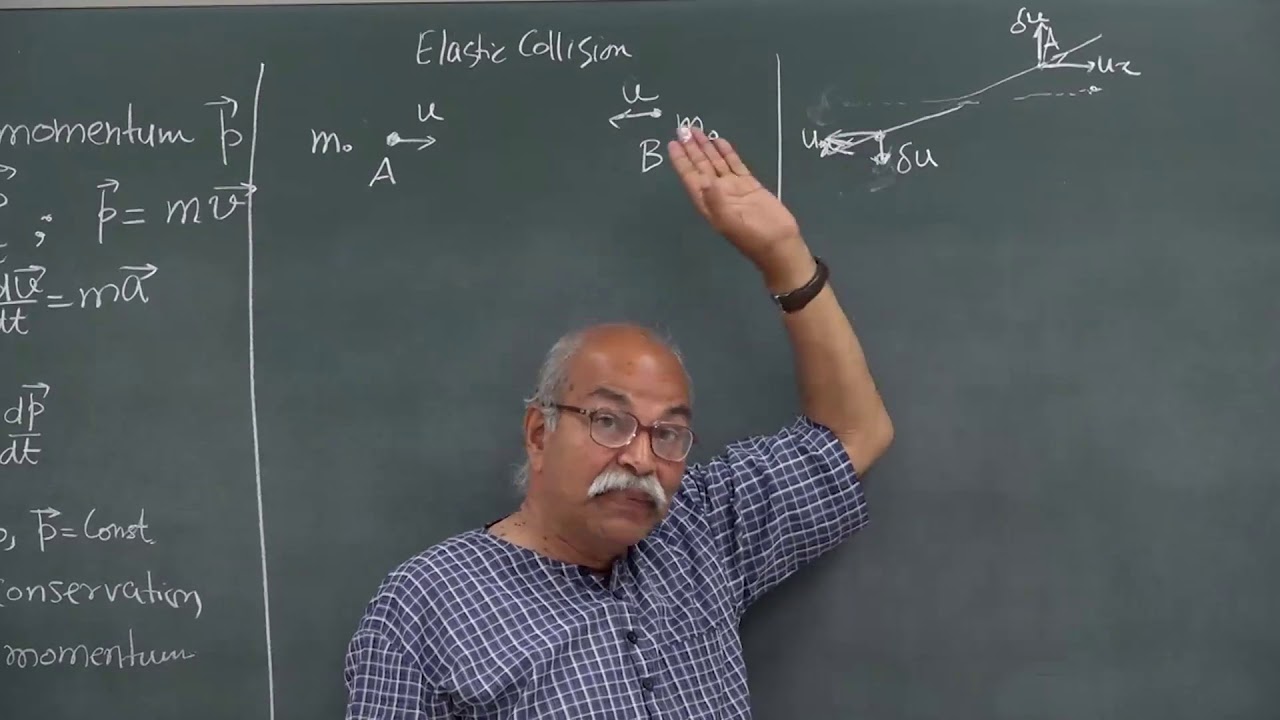
W4-03 P=mv? #Relativity#Physicslectures
Keywords
Summary
177 words
Critical Evaluation
Value of the Information & Strength of the Argument
The lecture provides a clear and rigorous derivation of the need for relativistic momentum. The argumentation is solid: it starts from a fundamental principle (conservation of momentum), constructs a specific example, applies Lorentz transformations, and shows a contradiction with classical momentum. The reasoning is step-by-step and easy to follow, making it valuable for students learning special relativity. The instructor carefully handles approximations and explains each transformation, ensuring the logic is transparent. The value lies in its pedagogical approach, which builds intuition for why classical concepts must be modified at high speeds.
100 words
Title / Content Match
The title 'P=mv?' is a concise and accurate representation of the central question addressed in the lecture, which is whether the classical definition of momentum holds at relativistic speeds.
Quality & Reliability
8/10
The lecture is a well-structured derivation of relativistic momentum from the principle of conservation of linear momentum and Lorentz transformations. The reasoning is clear and mathematically sound, though it lacks explicit references to external sources.
Key Moments
Markers derived by PSI from the transcript: the creator did not define chapters.
- Introduction: recap of Lorentz transformations and spacetime four-vectors.
- Introduction to relativistic dynamics and the need to modify Newton's laws.
- Statement of conservation of linear momentum and definition p=mv.
- Setup of the collision example: two particles of equal mass moving towards each other.
- Analysis of the collision in the lab frame: momentum and kinetic energy conservation.
- Transformation to a moving frame using Lorentz velocity transformations.
- Calculation of velocities in the moving frame before and after collision.
- Computation of momentum components in the moving frame.
- Observation that y-momentum is not conserved, indicating failure of p=mv.
- Conclusion: need to redefine momentum to preserve conservation law.
Contribution & Novelties
The lecture provides a clear pedagogical derivation of relativistic momentum from the conservation principle, using a concrete example that illustrates the failure of classical momentum at high speeds. It effectively bridges the gap between Newtonian mechanics and special relativity.
Pour aller plus loin :
- Special relativity - Wikipedia — Background on the theory.
- Lorentz transformation - Wikipedia — Details on the transformation used.
- Relativistic mechanics - Wikipedia — Further reading on relativistic momentum and energy.
75 words
Radar Profile
The radar profile shows high scores in information quantity, quality, and reliability, with a slightly lower technical level, indicating a lecture that is accessible yet rigorous. The balance suggests a well-rounded educational resource.