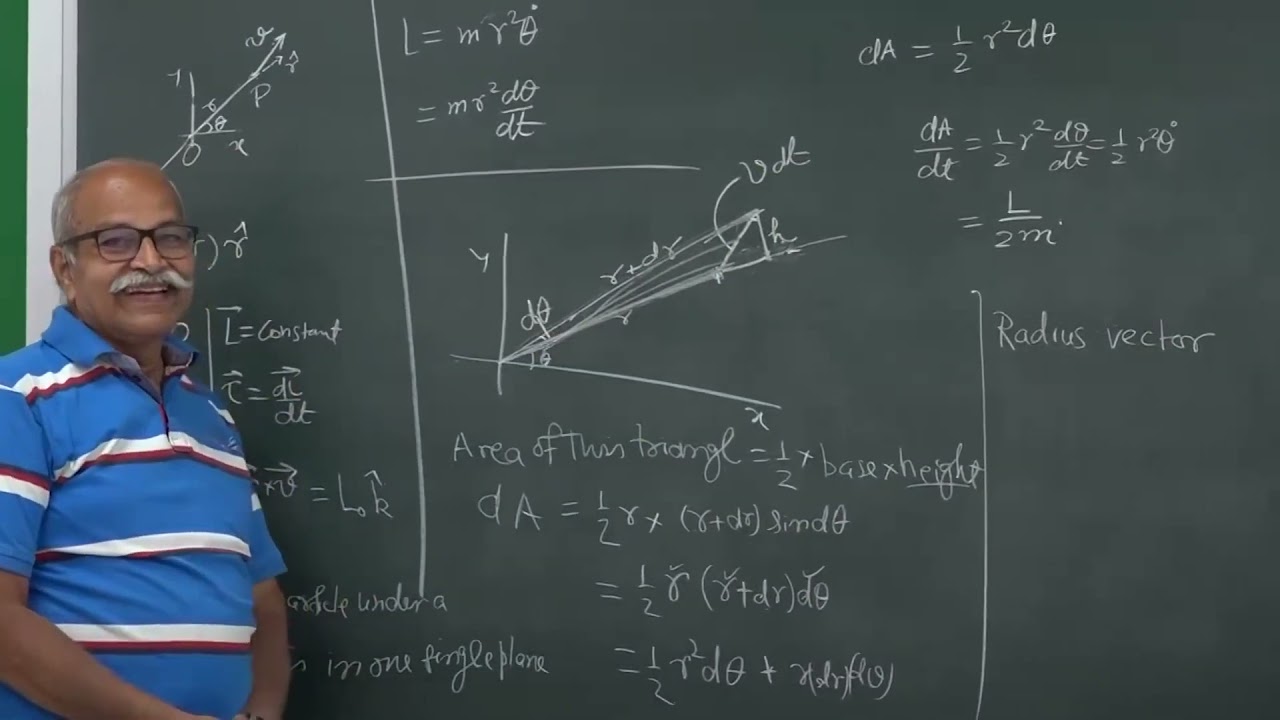
Lecture 6 Central force motion
Keywords
Summary
177 words
Critical Evaluation
Value of the Information & Strength of the Argument
The lecture provides a solid foundation in central force motion, with clear mathematical derivations. The argumentation is logical and step-by-step, making it accessible to students. The value lies in the pedagogical approach, connecting abstract concepts to physical examples like planetary motion. The instructor emphasizes the universality of Kepler’s second law for any central force, which is a key insight. The derivation of the effective potential is particularly valuable, as it simplifies the analysis of orbits.
Scientific Rigor, Source Quality, Title Accuracy
The scientific rigor is high, as the content is standard classical mechanics, accurately presented. However, no external sources are cited, relying solely on the instructor’s expertise. The title is appropriate and matches the content. The lecture is well-structured, but the lack of references may limit its use for further study.
140 words
Title / Content Match
The title accurately reflects the content, which is a lecture on central force motion.
Quality & Reliability
8/10
The lecture is a formal educational presentation by a physics instructor, covering central force motion with mathematical derivations. The content is accurate and aligns with standard classical mechanics. However, it lacks citations to external sources, and the presentation is based on the instructor's expertise.
Key Moments
Markers derived by PSI from the transcript: the creator did not define chapters.
- Introduction to central force motion and definition of central force.
- Derivation that torque is zero and angular momentum is conserved.
- Explanation that motion is confined to a plane.
- Derivation of areal velocity and its constancy, leading to Kepler's second law.
- Discussion of inverse-square force law and its applications.
- Introduction of effective potential and its derivation.
- Sketching the effective potential for inverse-square force and its implications.
Contribution & Novelties
The lecture provides a clear pedagogical derivation of central force motion, emphasizing the conservation of angular momentum and the constancy of areal velocity. It introduces the effective potential as a powerful tool for analyzing orbits. The novelty lies in the step-by-step derivation and the connection to Kepler’s laws.
Pour aller plus loin :
- Kepler’s laws of planetary motion — Relevant for understanding the historical context and applications.
- Central force — Provides a comprehensive overview of central forces and their properties.
- Effective potential — Explains the concept used in the lecture for reducing two-dimensional motion to one-dimensional.
96 words
Radar Profile
The radar profile shows high scores in quantity, quality, and reliability, with a slightly lower technical level, indicating a well-rounded educational lecture that is both informative and accessible.