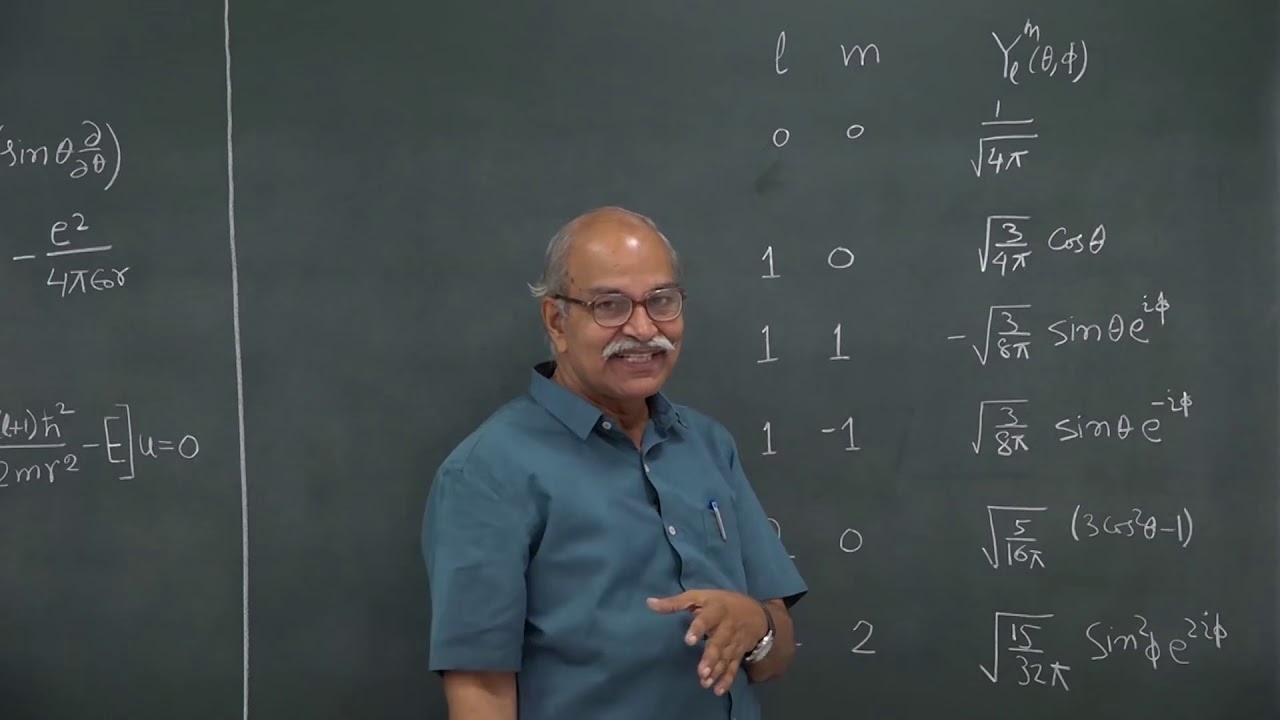
Lec 30 In 3- Dimensions #coursefinished #quantummechanics
Keywords
Summary
213 words
Critical Evaluation
Value of the Information & Strength of the Argument
The lecture provides a solid introduction to quantum mechanics in three dimensions, with clear derivations and explanations. The argumentation is logical, building from the definition of angular momentum operators to the solution of the hydrogen atom. The instructor emphasizes the conceptual differences between classical and quantum descriptions, such as the absence of well-defined orbits and the probabilistic interpretation of wave functions. The value lies in its pedagogical clarity, making complex topics accessible to students.
Scientific Rigor, Source Quality, Title Accuracy
The scientific rigor is high, with accurate mathematical derivations and correct physical interpretations. The lecture does not cite external sources, but it is based on standard quantum mechanics textbooks. The title accurately reflects the content, as it is the final lecture on 3D quantum mechanics. The lecture is well-structured and suitable for an advanced undergraduate or graduate audience.
147 words
Title / Content Match
The title accurately reflects the content: the lecture covers quantum mechanics in three dimensions, concluding the course.
Quality & Reliability
8/10
The lecture is a formal educational presentation by an instructor, likely based on established quantum mechanics curriculum. The content is mathematically rigorous, deriving the Schrödinger equation in spherical coordinates and discussing angular momentum and hydrogen atom solutions. The presentation is clear and accurate, though it lacks citations to external sources.
Key Moments
Markers derived by PSI from the transcript: the creator did not define chapters.
- Introduction to spherical polar coordinates and the need for 3D treatment.
- Definition of orbital angular momentum operator in quantum mechanics.
- Discussion of commutation relations and eigenvalues of L^2 and Lz.
- Introduction to spin angular momentum and its intrinsic nature.
- Setting up the Schrödinger equation for the hydrogen atom.
- Separation of variables and derivation of the radial equation.
- Discussion of quantum numbers and energy levels, comparison with Bohr model.
Contribution & Novelties
This lecture provides a comprehensive introduction to quantum mechanics in three dimensions, specifically focusing on the hydrogen atom. It bridges the gap between the Bohr model and the full quantum mechanical treatment, highlighting the differences in probability distributions and the role of quantum numbers. The lecture is valuable for students transitioning from one-dimensional problems to more realistic three-dimensional systems.
Pour aller plus loin :
- Spherical harmonics — These functions are central to the angular part of the wave function and have wide applications in physics.
- Hydrogen atom — Detailed quantum mechanical treatment of the hydrogen atom, including energy levels and wave functions.
- Angular momentum operator — Comprehensive overview of the operator formalism in quantum mechanics.
115 words
Radar Profile
The radar profile shows high scores across all dimensions, indicating a well-balanced and comprehensive lecture. The strong performance in technical level and information quality suggests it is suitable for an audience with some prior knowledge of quantum mechanics.