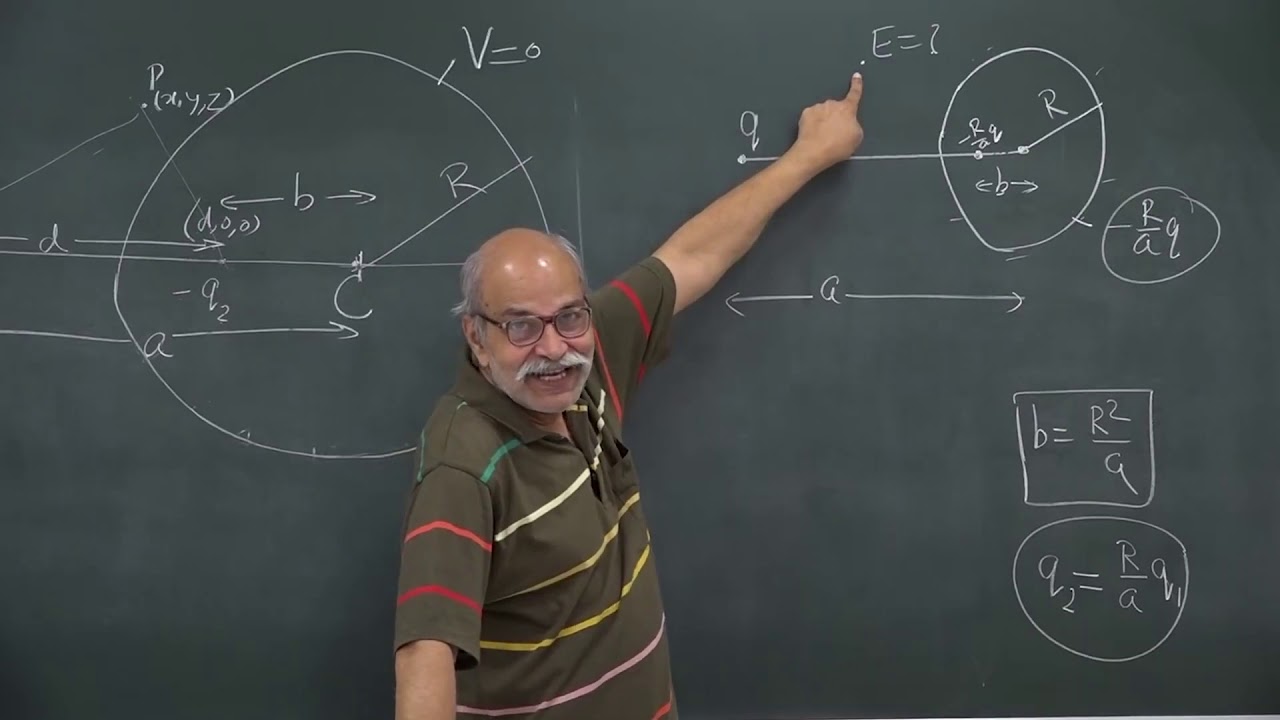
LEC 31 A charge in front of a sphere continued
Keywords
Summary
174 words
Critical Evaluation
Value of the Information & Strength of the Argument
The lecture provides a clear and rigorous derivation of the method of images for a conducting sphere, which is a fundamental technique in electrostatics. The argumentation is solid, building from the uniqueness theorem and the boundary conditions to justify the placement of image charges. The numerical example reinforces the theoretical concepts and demonstrates practical application. The explanation of surface charge distribution is particularly valuable, as it connects the field solution to the physical charges on the conductor.
Scientific Rigor, Source Quality, Title Accuracy
The lecture is scientifically rigorous, with Prof. Verma’s expertise ensuring accuracy. The method of images is correctly applied, and the mathematical steps are transparent. The title accurately reflects the content, which is a continuation of the previous lecture. The description provides a link to the full playlist, which is a reliable source for the course. No external sources are cited within the lecture, but the pedagogical approach is consistent with standard textbooks on electromagnetism.
166 words
Title / Content Match
The title accurately reflects the content, which continues the discussion of a charge in front of a conducting sphere, focusing on the method of images and surface charge distribution.
Quality & Reliability
8/10
The lecture is delivered by a renowned physicist, Prof. H.C. Verma, known for his pedagogical clarity. The content is mathematically rigorous, deriving results from fundamental principles. The method of images is correctly applied, and the numerical example is worked out step-by-step. The lecture is part of a structured course on classical electromagnetism.
Key Moments
Markers derived by PSI from the transcript: the creator did not define chapters.
- Recap of previous lecture: potential surface for two charges, and introduction to the problem of a point charge near a conducting sphere.
- Derivation of the image charge expression for a grounded conducting sphere.
- Explanation of grounding: connecting the sphere to Earth to fix its potential to zero.
- Numerical example: grounded conducting sphere of radius 12 cm with a charge of 4 nC at 18 cm from center.
- Calculation of electric field at a point on the sphere's surface using the method of images.
- Derivation of surface charge density as a function of position on the sphere.
- Discussion of the case of an isolated neutral conducting sphere: total induced charge is zero, but distribution is non-uniform.
- Summary of the method of images for both grounded and isolated spheres, and how to compute fields and surface charges.
Cited Sources
- Classical Electromagnetism-1 (Electrostatics) Playlist — The complete lecture series by Prof. H.C. Verma, providing context and further lectures on electrostatics.
Concurring Sources
- Classical Electromagnetism-1 (Electrostatics) Playlist — The lecture is part of a series, and the playlist provides additional lectures that align with the content.
Contribution & Novelties
This lecture provides a clear and detailed exposition of the method of images for a conducting sphere, including both grounded and isolated cases. The numerical example is particularly instructive, showing step-by-step calculations. The lecture also emphasizes the physical interpretation of induced charges and surface charge density, which is often glossed over in textbooks.
Pour aller plus loin :
- Method of images — Overview of the technique and its applications.
- Uniqueness theorem — Justifies the method of images.
- Conducting sphere in an external field — Related problem and solution.
88 words
Radar Profile
The radar profile shows high scores in quality and reliability, with slightly lower but still strong scores in quantity and technical level. This indicates a lecture that is both informative and rigorous, suitable for advanced students.