W4-02 Jumping to higher band #SemiconductorPhysics
Keywords
Summary
195 words
Critical Evaluation
Value of the Information & Strength of the Argument
The lecture provides a solid foundation in semiconductor physics, clearly explaining the energy band model and the Fermi function. The argumentation is logical and builds step by step, from the band diagram to the concept of intrinsic carriers and the statistical mechanics governing their density. The use of quantitative examples (e.g., carrier densities for Si and Cu) enhances the value of the information. The instructor’s explanation of the Fermi function is particularly clear, including its behavior at 0 K and finite temperatures. The connection between the abstract band diagram and the real crystal structure is well made, helping to solidify understanding. The concluding question about the utility of semiconductors despite their low conductivity is thought-provoking and encourages deeper reflection.
Scientific Rigor, Source Quality, Title Accuracy
The lecture is scientifically rigorous, presenting standard concepts in semiconductor physics without errors. However, it does not cite specific sources or references, relying on established textbook knowledge. The title accurately reflects the content, focusing on the transition of electrons to higher energy bands. The lecture is well-structured and pedagogically sound, but the lack of explicit citations may be a minor limitation for those seeking to verify the information independently.
203 words
Title / Content Match
The title accurately reflects the content, which focuses on the transition of electrons to higher energy bands in semiconductors.
Quality & Reliability
8/10
The lecture is a clear, well-structured educational presentation on semiconductor physics, based on established principles. It uses standard models (energy band diagrams, Fermi function) and provides quantitative examples (carrier densities for Si, Ge, Cu). The content is consistent with textbook knowledge, but it lacks citations to specific sources and is presented as a single instructor's explanation.
Key Moments
Markers derived by PSI from the transcript: the creator did not define chapters.
- Introduction to energy band diagram for silicon, valence and conduction bands, bandgap.
- Definition of intrinsic semiconductor and equilibrium carrier densities.
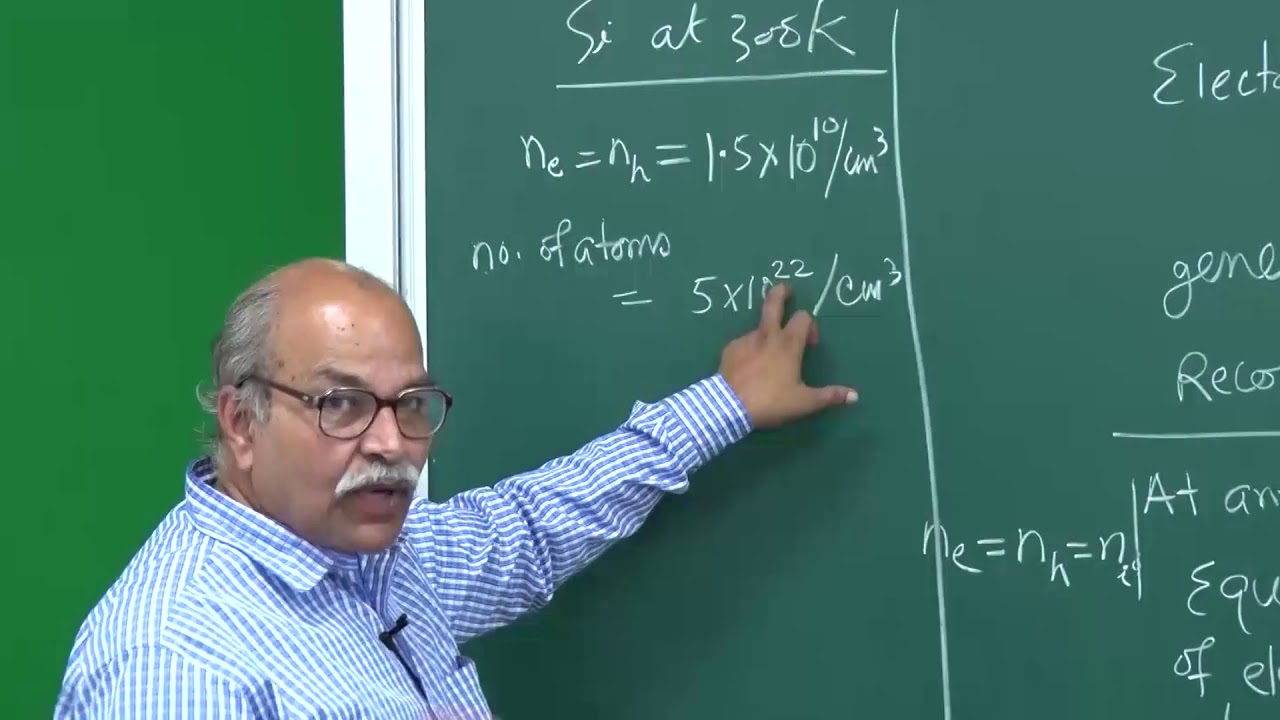
- Comparison of carrier densities in silicon, copper, and insulators.
- Introduction to the Fermi function and its behavior at 0 K and finite temperatures.
- Connection between band diagram and real silicon crystal structure.
- Discussion on why semiconductors are useful despite low conductivity.
Contribution & Novelties
This lecture provides a clear and accessible explanation of intrinsic semiconductors and the Fermi function, making it a valuable educational resource. It bridges the gap between abstract band theory and the physical reality of the crystal lattice, which is often a stumbling block for students. The lecture’s strength lies in its pedagogical approach, using quantitative examples and a step-by-step logical progression.
Pour aller plus loin :
- Fermi–Dirac statistics — The Fermi function is a direct application of Fermi-Dirac statistics, which describes the distribution of fermions over energy states.
- Intrinsic semiconductor — This article provides a comprehensive overview of intrinsic semiconductors, including carrier concentrations and temperature dependence.
- Energy band gap — The concept of bandgap is central to the lecture; this resource explains its significance in semiconductors and insulators.
128 words
Radar Profile
The radar profile shows high scores across all dimensions, indicating a well-balanced and reliable educational content. The lecture is strong in both information quantity and quality, with a solid technical level and high reliability.