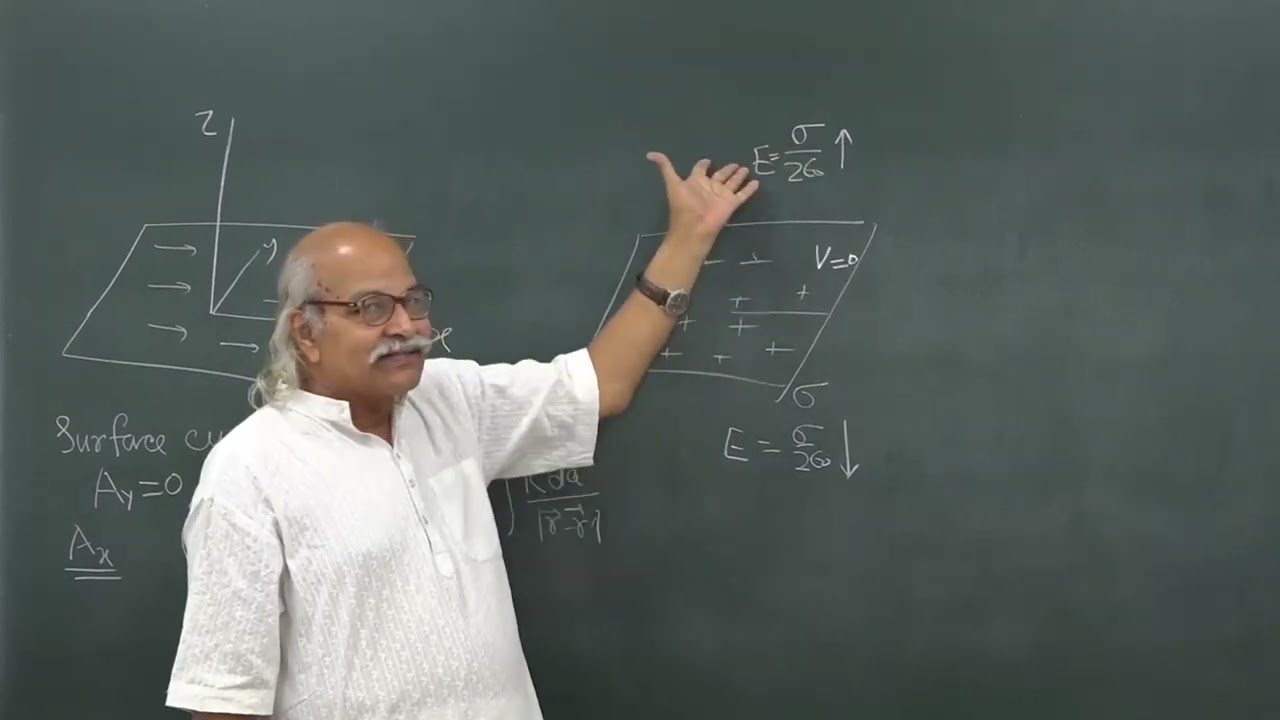
LEC 29 - Vector Potential due to a Plane Surface Current
Keywords
Summary
163 words
Critical Evaluation
Value of the Information & Strength of the Argument
The lecture provides a clear and systematic derivation of the vector potential for a plane surface current, demonstrating the analogy between electrostatics and magnetostatics. The argumentation is solid, building step-by-step from the defining equations to the final result. The method of replacing the current density with a charge density is well-explained and justified. The derivation of the magnetic field from the vector potential via curl is thorough and correct. The introduction of the square loop example sets up a more complex application, but the lecture ends before completing it, which may leave the viewer wanting more.
Scientific Rigor, Source Quality, Title Accuracy
The lecture is scientifically rigorous, relying on established electromagnetic theory. However, no external sources are cited, and the presentation is self-contained. The title accurately describes the content. The lecture does not address potential limitations or alternative methods, but the derivations are correct and consistent with standard textbooks.
158 words
Title / Content Match
The title accurately reflects the content, which focuses on deriving the vector potential for a plane surface current.
Quality & Reliability
7/10
The lecture is a clear, step-by-step derivation of the vector potential for a plane surface current, using established electromagnetic theory. The reasoning is logical and consistent with standard physics, but it lacks citations to external sources and does not address potential limitations or alternative approaches.
Key Moments
Markers derived by PSI from the transcript: the creator did not define chapters.
- Review of vector potential and its relation to magnetic field.
- Analogy between electrostatics and magnetostatics for finding vector potential.
- Introduction of the plane surface current example.
- Derivation of vector potential for the surface current.
- Calculation of magnetic field from vector potential using curl.
- Introduction of the square loop example.
- Outline of the dipole approximation method for the square loop.
Contribution & Novelties
The lecture provides a clear pedagogical demonstration of the analogy between electrostatics and magnetostatics for calculating vector potentials. It shows how to use the known solution for a charged plane to derive the vector potential for a surface current, and then compute the magnetic field. The method is standard but well-presented.
Pour aller plus loin :
- Vector potential — Overview of the magnetic vector potential and its properties.
- Ampère’s circuital law — Fundamental law used to compute magnetic fields from currents.
- Electric dipole moment — Concept used in the upcoming square loop example.
93 words
Radar Profile
The radar profile shows high scores in quantity and quality of information, with a moderate technical level and reliability. This indicates a well-structured lecture that provides substantial content but may not delve into advanced nuances.