Exp 22 - From one to many |Oscillation and Waves
Keywords
Summary
144 words
Critical Evaluation
Value of the Information & Strength of the Argument
The video provides valuable insights into the fundamental concepts of phase and phase difference, which are crucial for understanding wave phenomena. The argumentation is solid, as the instructor derives the mathematical expressions for phase and demonstrates the concepts with physical experiments. The progression from a single oscillator to coupled oscillators and beats is logical and well-structured. The experiments are well-designed and visually illustrate the theoretical points, enhancing the educational value.
Scientific Rigor, Source Quality, Title Accuracy
The scientific rigor is high, as the explanations are mathematically consistent and the experiments are reproducible. However, the video does not cite any external sources, relying solely on the instructor’s expertise. The title accurately reflects the content, which moves from a single oscillator to multiple coupled oscillators and the resulting phenomena. The video is self-contained and does not reference any literature, but the concepts are standard in physics education.
154 words
Title / Content Match
The title 'Exp 22 - From one to many |Oscillation and Waves' accurately reflects the content, which progresses from single oscillator to coupled oscillators and beats.
Quality & Reliability
8/10
The video is a physics lecture demonstrating concepts of phase, phase difference, coupled oscillations, and beats through experiments. The explanations are mathematically rigorous and the experiments are clear. However, it lacks citations to external sources and is based on the instructor's expertise.
Key Moments
Markers derived by PSI from the transcript: the creator did not define chapters.
- Introduction to phase and phase difference in oscillations.
- Demonstration of a pendulum and explanation of phase qualitatively.
- Mathematical representation of phase using theta = theta_0 cos(omega t).
- Demonstration of two pendulums in phase and out of phase, introducing phase difference.
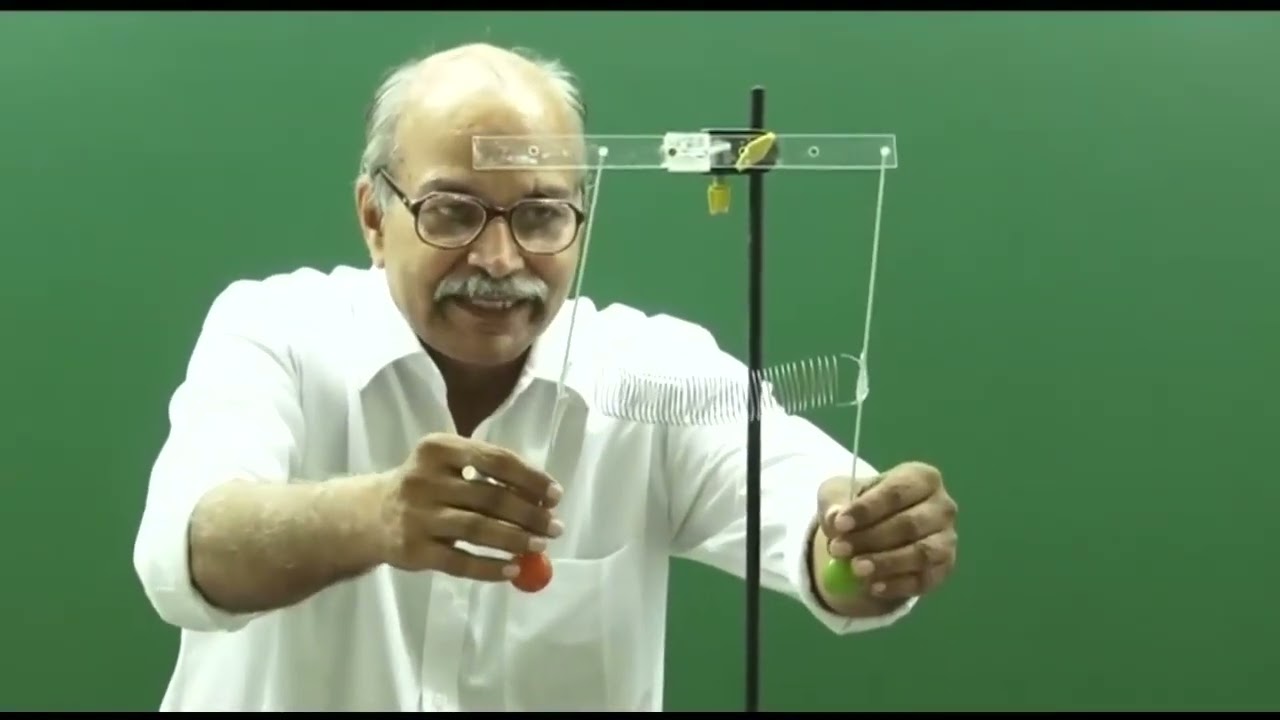
- Introduction of coupled pendulum system with spring, showing two natural frequencies.
- Demonstration of symmetric and antisymmetric modes of vibration.
- Demonstration of beats with coupled pendulums, showing energy transfer.
- Mathematical derivation of beats from superposition of two oscillations.
- Optical experiment demonstrating beats using a bulb and lens.
Contribution & Novelties
The video offers a clear and practical demonstration of phase and phase difference, which are often abstract concepts. It uniquely combines theoretical explanations with physical experiments, making the concepts tangible. The coupled pendulum experiment effectively illustrates normal modes and beats, providing a visual understanding of these phenomena.
Pour aller plus loin :
- Phase (waves) — Wikipedia article on phase in waves.
- Normal mode — Wikipedia article on normal modes.
- Beat (acoustics) — Wikipedia article on beats.
76 words
Radar Profile
The radar profile shows high scores in quantity and quality of information, indicating a content-rich and accurate presentation. The technical level is moderate, suitable for undergraduate physics students. The overall reliability is high, reflecting the soundness of the demonstrations.