Lec 29 Barrier Tunneling
Keywords
Summary
160 words
Critical Evaluation
Value of the Information & Strength of the Argument
The lecture provides valuable insights into quantum tunneling, a phenomenon with profound implications in physics. It effectively explains the mathematical formalism, including the derivation of the transmission coefficient and the WKB approximation. The argumentation is solid, building from fundamental principles to applications. The use of real-world examples like solar fusion, STM, and alpha decay strengthens the practical relevance. However, the presentation lacks rigorous mathematical detail in some steps, and the informal style may detract from the scientific tone.
Scientific Rigor, Source Quality, Title Accuracy
The scientific rigor is moderate: the physics is correct, but the lecture does not cite specific sources or references. The title accurately describes the content. The description provides no additional links or references. The lecture is self-contained, relying on standard quantum mechanics knowledge. The lack of citations is typical for a lecture, but for a rigorous scientific evaluation, it is a limitation.
155 words
Title / Content Match
The title accurately reflects the content, which is a lecture on barrier tunneling in quantum mechanics.
Quality & Reliability
7/10
The lecture provides a solid theoretical foundation of quantum tunneling, deriving key formulas and illustrating with real-world applications. However, the presentation is informal and lacks rigorous citations, and the audio transcription is poor, making it difficult to follow precisely.
Key Moments
Markers derived by PSI from the transcript: the creator did not define chapters.
- Introduction to barrier tunneling and recap of previous lecture.
- Derivation of transmission probability for a rectangular barrier.
- Introduction of WKB approximation for wide barriers.
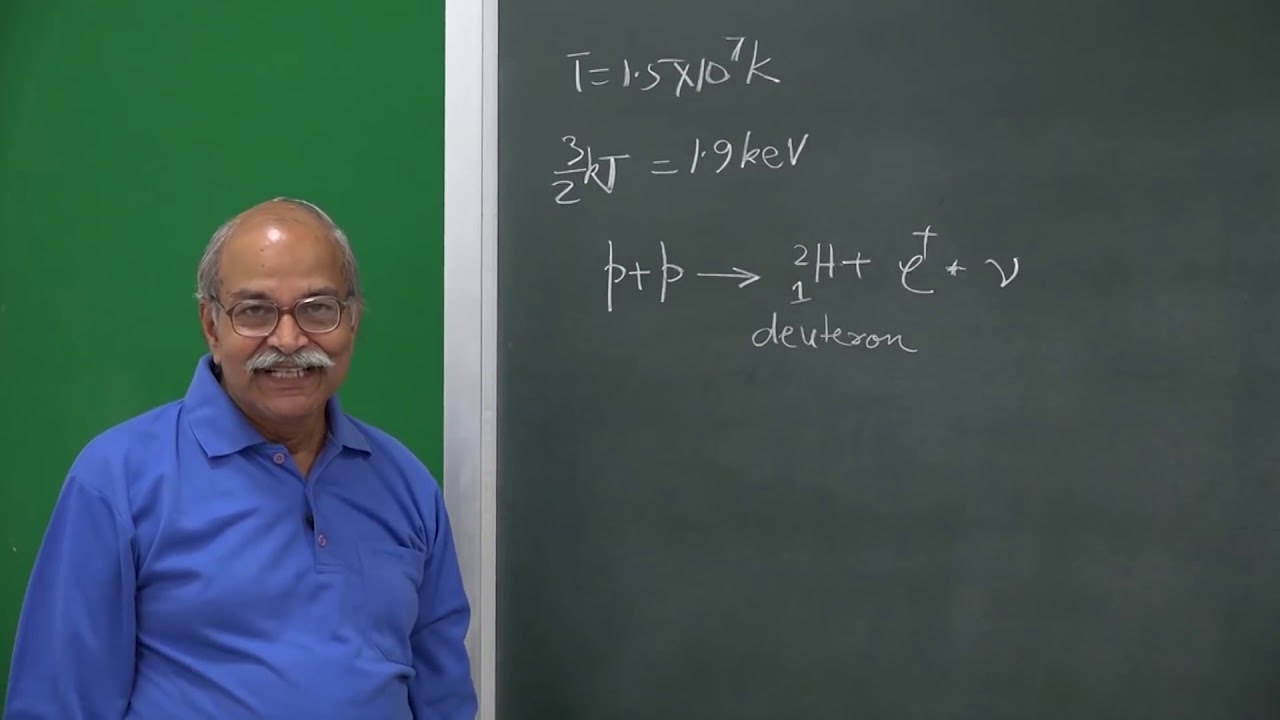
- Application to nuclear fusion in the Sun.
- Explanation of scanning tunneling microscope (STM) and its principle.
- Discussion of alpha decay and its dependence on tunneling probability.
- Summary and conclusion, emphasizing exponential sensitivity.
Contribution & Novelties
The lecture provides a clear and accessible explanation of quantum tunneling, connecting theoretical concepts to key physical phenomena. It effectively demonstrates how tunneling is essential for nuclear fusion in stars, the operation of STMs, and alpha decay. The pedagogical approach, using intuitive explanations and practical examples, makes the topic approachable.
Pour aller plus loin :
- Quantum tunnelling — Comprehensive overview of the phenomenon.
- WKB approximation — Mathematical method used for approximate solutions.
- Scanning tunneling microscope — Detailed description of the instrument and its applications.
- Alpha decay — Explanation of the process and its relation to tunneling.
- Nuclear fusion — Overview of fusion reactions and their role in stars.
108 words
Radar Profile
The radar profile shows high scores in information quantity and technical level, indicating a content-rich lecture. The quality and reliability are slightly lower, reflecting the lack of citations and informal presentation. Overall, the lecture is scientifically sound but could benefit from more rigorous sourcing.