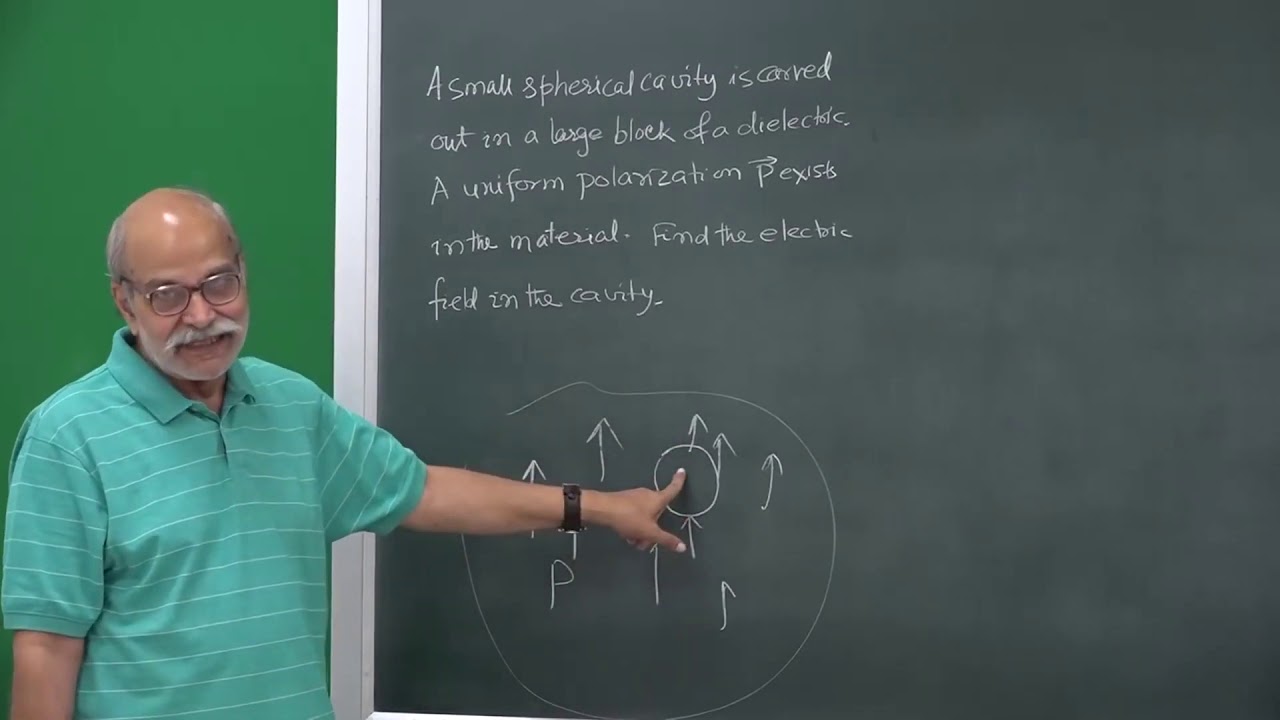
LEC 36 Problem solving with Dielectrics
Keywords
Summary
147 words
Critical Evaluation
Value of the Information & Strength of the Argument
The lecture provides valuable insights into solving electrostatics problems involving dielectrics. The instructor demonstrates a systematic approach: first determining bound charges from the polarization, then computing the electric field using Coulomb’s law or Gauss’s law. The argumentation is solid, with clear physical reasoning and mathematical derivations. The problems are well-chosen to illustrate different aspects of dielectric behavior, such as uniform polarization, non-uniform polarization, and the effect of geometry. The instructor also highlights common pitfalls and offers alternative methods, enhancing the educational value.
Scientific Rigor, Source Quality, Title Accuracy
The scientific rigor is high, as the derivations follow standard electromagnetic theory. The instructor, Prof. H.C. Verma, is a respected physicist and educator, which adds to the credibility. The sources cited are limited to a playlist of related lectures, which is appropriate for a lecture series. The title accurately reflects the content, which is focused on problem-solving with dielectrics. No external sources are referenced, but the lecture is self-contained and mathematically consistent.
169 words
Title / Content Match
The title accurately reflects the content, which focuses on solving problems related to dielectrics and polarization.
Quality & Reliability
8/10
The lecture is delivered by a renowned physicist, Prof. H.C. Verma, known for his pedagogical clarity. The content is mathematically rigorous, with step-by-step derivations and physical reasoning. However, the video is a recording of a live class, with some informal language and potential for minor errors, but overall highly reliable.
Key Moments
Markers derived by PSI from the transcript: the creator did not define chapters.
- Introduction to the lecture and first problem on uniformly polarized dielectric block.
- Calculation of bound surface charges and electric field for the dielectric block.
- Second problem: cubic volume of helium gas, calculation of dipole moment and polarization.
- Third problem: uniformly polarized sphere, finding bound charges and electric field.
- Fourth problem: long thin dielectric slab, derivation of electric field using superposition.
- Fifth problem: polarization field given by a function, calculation of bound charges and total charge.
- Conclusion and summary of the lecture.
Cited Sources
- Classical Electromagnetism-1 (Electrostatics) Playlist — The complete playlist of lectures by Prof. H.C. Verma on electrostatics, which this lecture is part of.
Concurring Sources
- Classical Electromagnetism-1 (Electrostatics) Playlist — The lecture is part of this playlist, which covers related topics in electrostatics.
Contribution & Novelties
This lecture provides a clear, step-by-step methodology for solving dielectric problems, emphasizing the physical interpretation of bound charges. It bridges the gap between theoretical concepts and practical problem-solving, which is valuable for students. The instructor’s approach of deriving electric fields from bound charges using superposition is particularly instructive.
Pour aller plus loin :
- Dielectric polarization — Overview of polarization mechanisms and bound charges.
- Electric displacement field — Related concept used in dielectrics.
- Gauss’s law — Fundamental law used in the derivations.
81 words
Radar Profile
The radar profile shows high scores in information quality and technical level, indicating a rigorous and detailed lecture. The quantity of information is also high, but the global reliability is slightly lower due to the informal nature of the recording. Overall, the lecture is well-balanced and suitable for advanced learners.