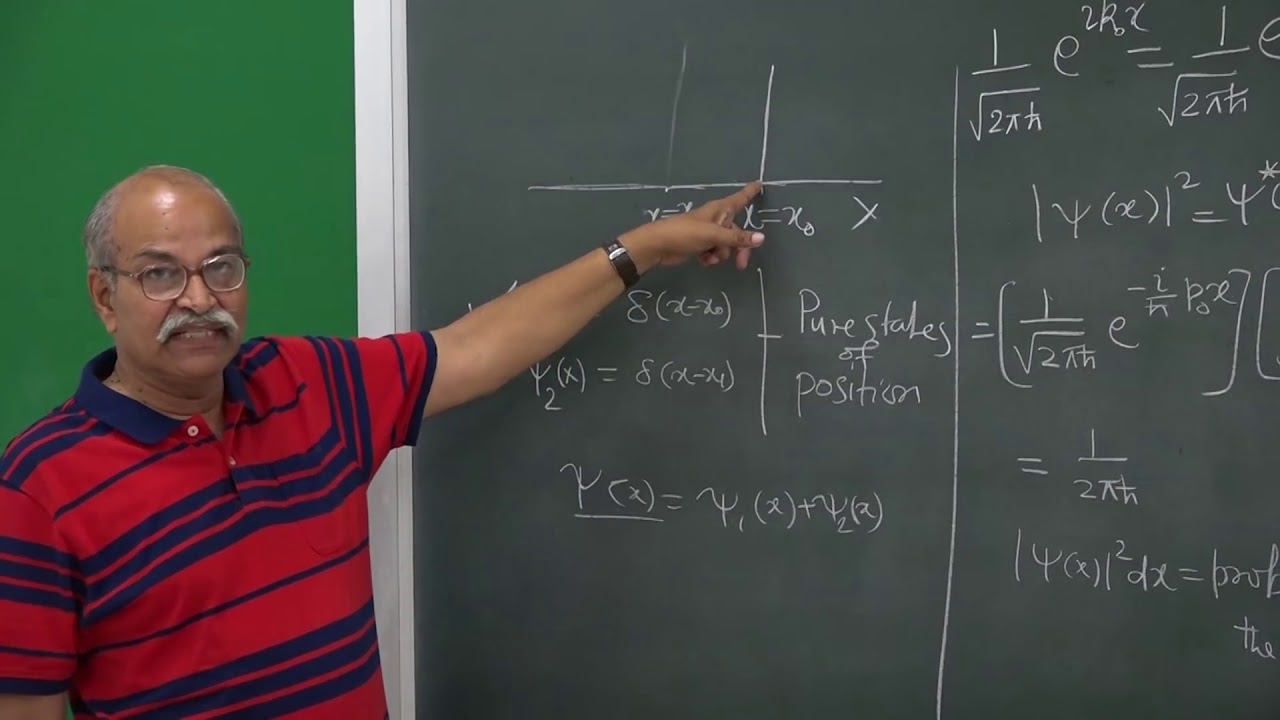
Lec 12 Probabilities from a mix state wave function
Keywords
Summary
145 words
Critical Evaluation
Value of the Information & Strength of the Argument
The lecture provides a solid introduction to the concept of mixed states and the use of Fourier transforms to extract momentum probabilities. The argumentation is logically structured, building from the definition of pure and mixed states to the mathematical formalism. The instructor uses clear examples and emphasizes the physical interpretation of the wave function. However, the presentation is somewhat informal and lacks visual aids, which may hinder comprehension for some viewers. The mathematical derivations are correct and align with standard quantum mechanics textbooks.
Scientific Rigor, Source Quality, Title Accuracy
The lecture does not cite specific sources, but the content is consistent with standard quantum mechanics curriculum. The title accurately describes the topic. The instructor’s explanations are mathematically sound, but the lack of references and the informal style reduce the scientific rigor. The video does not include any citations or links to further reading, which is a limitation for viewers seeking verification.
160 words
Title / Content Match
The title accurately reflects the content, which focuses on deriving probabilities from a mixed state wave function.
Quality & Reliability
7/10
The lecture is a tutorial on quantum mechanics, specifically on mixed states and probability amplitudes. The content is mathematically rigorous and aligns with standard quantum mechanics principles. However, the audio quality is poor and the transcription is garbled, making it difficult to follow. The instructor demonstrates a clear understanding of the subject, but the lack of visual aids and the informal presentation style reduce the overall reliability.
Key Moments
Markers derived by PSI from the transcript: the creator did not define chapters.
- Introduction to pure and mixed states in quantum mechanics.
- Explanation of position eigenfunctions and their role in pure states.
- Discussion on momentum eigenfunctions and their mathematical form.
- Illustration of how a state can be pure for one observable and mixed for another.
- Introduction to the conditions for a physically realistic wave function: continuity, finiteness, and square-integrability.
- Explanation of the Fourier transform as a tool to decompose a wave function into momentum eigenstates.
- Derivation of the formula for the probability amplitude of a given momentum component.
- Example of calculating momentum probabilities for a given wave function.
- Discussion on the interpretation of the probability distribution over momenta.
- Conclusion and summary of the key concepts covered.
Contribution & Novelties
The lecture provides a clear pedagogical explanation of mixed states and the use of Fourier transforms to extract momentum probabilities. It emphasizes the distinction between pure and mixed states, which is a fundamental concept in quantum mechanics. The presentation is accessible to students with a basic understanding of quantum mechanics.
Pour aller plus loin :
- Fourier transform — Essential mathematical tool for decomposing wave functions into momentum components.
- Quantum superposition — The principle underlying mixed states.
- Wave function collapse — Related to the interpretation of probabilities in quantum mechanics.
89 words
Radar Profile
The radar profile shows high scores in quantity of information and technical level, indicating a dense and mathematically rigorous lecture. The quality of information and global reliability are slightly lower, likely due to the informal presentation and lack of citations. Overall, the lecture is informative but could benefit from better structure and references.