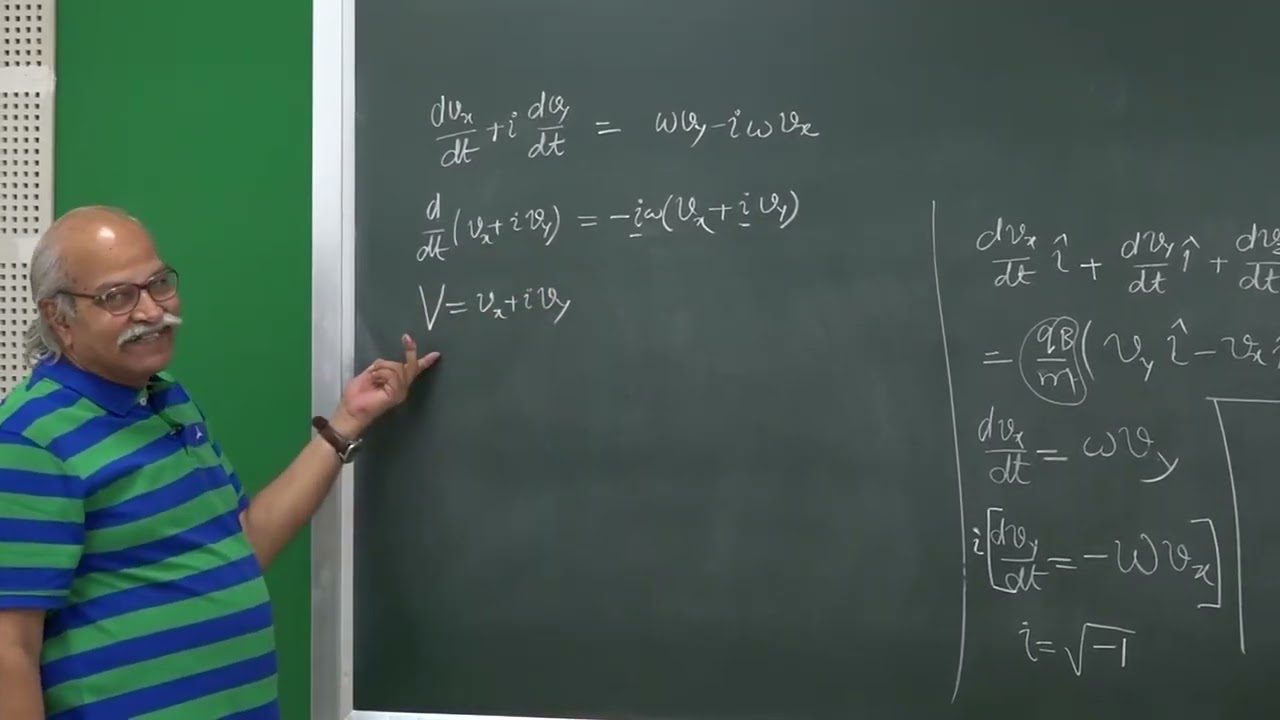
LEC 08 - Motion in Magnetic Field-1
Keywords
Summary
189 words
Critical Evaluation
Value of the Information & Strength of the Argument
The lecture provides a thorough derivation of the motion of a charged particle in a magnetic field, which is a fundamental topic in physics. The value lies in its clear step-by-step approach, from setting up the Lorentz force to solving the differential equations using complex numbers. The argumentation is solid, as each step is justified and the mathematical manipulations are transparent. The use of complex variables is particularly elegant and demonstrates a powerful technique for solving coupled differential equations. The instructor also explains the physical interpretation, noting that the motion is circular with a constant speed. The lecture is self-contained and does not rely on external sources, but the reasoning is internally consistent and correct.
Scientific Rigor, Source Quality, Title Accuracy
The lecture is scientifically rigorous, with no apparent errors in the derivations. The quality of sources is limited, as the instructor does not cite any references, but the content is standard physics that can be found in textbooks. The title accurately reflects the content, which is a lecture on the motion of charged particles in a magnetic field. The lecture is well-structured and the mathematical treatment is precise. However, the lack of citations and the informal nature of a YouTube lecture may reduce its perceived authority. No comments were provided for analysis.
222 words
Title / Content Match
The title accurately reflects the content, which is a lecture on the motion of charged particles in a magnetic field.
Quality & Reliability
8/10
The lecture is mathematically rigorous, deriving the motion of a charged particle in a uniform magnetic field from first principles. The presentation is clear and systematic, with no apparent errors. However, it is a single lecture without external references or citations, and the source is a YouTube channel of unknown authority.
Key Moments
Markers derived by PSI from the transcript: the creator did not define chapters.
- Introduction: uniform and constant magnetic field, coordinate setup.
- Derivation of Lorentz force and acceleration components.
- Introduction of cyclotron frequency omega and equations for vx and vy.
- Complex variable method: define V = vx + i vy and solve first-order ODE.
- Solution for velocity components using Euler's formula.
- Integration to find position as function of time.
- Final expressions for x and y, and discussion of circular motion.
Contribution & Novelties
The lecture provides a clear and elegant derivation of the motion of a charged particle in a uniform magnetic field, using a complex variable method to solve the coupled differential equations. This approach is pedagogically valuable as it simplifies the problem and avoids solving second-order ODEs directly. The lecture also emphasizes the physical interpretation of the results, such as the circular motion and the constancy of the velocity component along the field.
Pour aller plus loin :
- Lorentz force — Fundamental concept underlying the motion of charged particles in electromagnetic fields.
- Cyclotron — Practical application of charged particle motion in magnetic fields.
- Complex numbers in physics — The technique used in the lecture is a common tool in physics for solving differential equations.
123 words
Radar Profile
The radar profile shows high scores in quantity and quality of information, with a moderate technical level. The lecture is mathematically rigorous and provides a comprehensive derivation, but it is a single lecture without external references, which may limit its overall reliability.