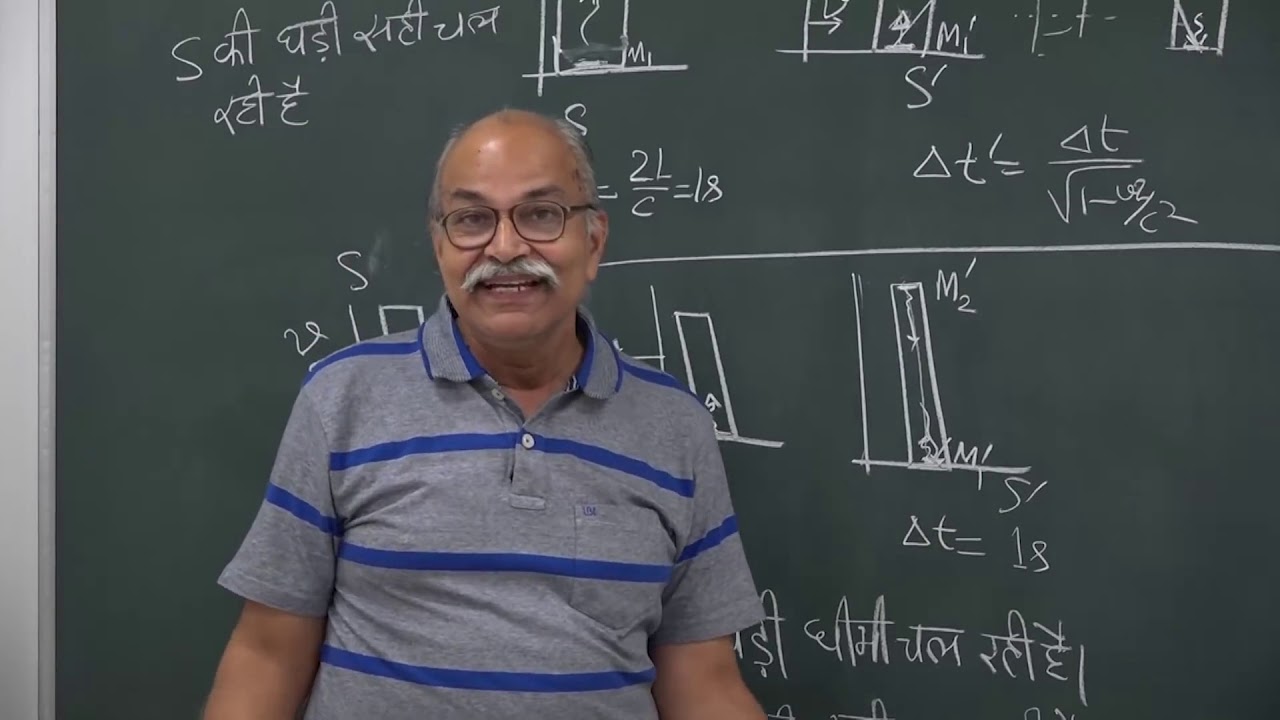
W3-03 Derivation of Time Dilation
Keywords
Summary
189 words
Critical Evaluation
Value of the Information & Strength of the Argument
The video provides a clear and logical derivation of time dilation, starting from the light clock thought experiment and then using the Lorentz transformation to obtain the formula. The argumentation is sound and follows the standard textbook approach. The instructor carefully explains the concept of proper time and distinguishes it from improper time, which is crucial for understanding the derivation. However, the presentation is somewhat repetitive and could be more concise. The value of the information is high for students learning special relativity, as it offers a step-by-step derivation that is easy to follow despite the language issues.
107 words
Title / Content Match
The title accurately reflects the content: a derivation of time dilation.
Quality & Reliability
7/10
The derivation is logically sound and follows standard textbook approach, but the presentation is hampered by poor audio quality and language mixing, reducing clarity. The content is accurate but lacks depth in discussing experimental confirmations.
Key Moments
Markers derived by PSI from the transcript: the creator did not define chapters.
- Introduction and review of light clock from previous lecture.
- Setting up two inertial frames S and S' with identical light clocks.
- Discussion of how each observer sees the other's clock running slow.
- Introduction of proper time interval and its definition.
- Explanation of improper time interval and relation to proper time.
- Derivation of time dilation formula using Lorentz transformation.
- Conclusion and summary of time dilation concept.
Contribution & Novelties
The video offers a clear pedagogical derivation of time dilation, which is a fundamental concept in special relativity. It emphasizes the distinction between proper and improper time intervals, which is crucial for understanding the phenomenon. The use of the light clock thought experiment provides an intuitive basis for the derivation.
Pour aller plus loin :
- Special relativity - Wikipedia — For a broader overview of the theory.
- Time dilation - Wikipedia — Detailed article on time dilation, including experimental confirmations.
- Lorentz transformation - Wikipedia — Mathematical background for the derivation.
90 words
Radar Profile
The radar profile shows moderate scores across all dimensions, indicating a balanced but not exceptional video. The highest score is in technical level, reflecting the mathematical derivation, while the lowest is in quantity of information, as the video is relatively short and focused.