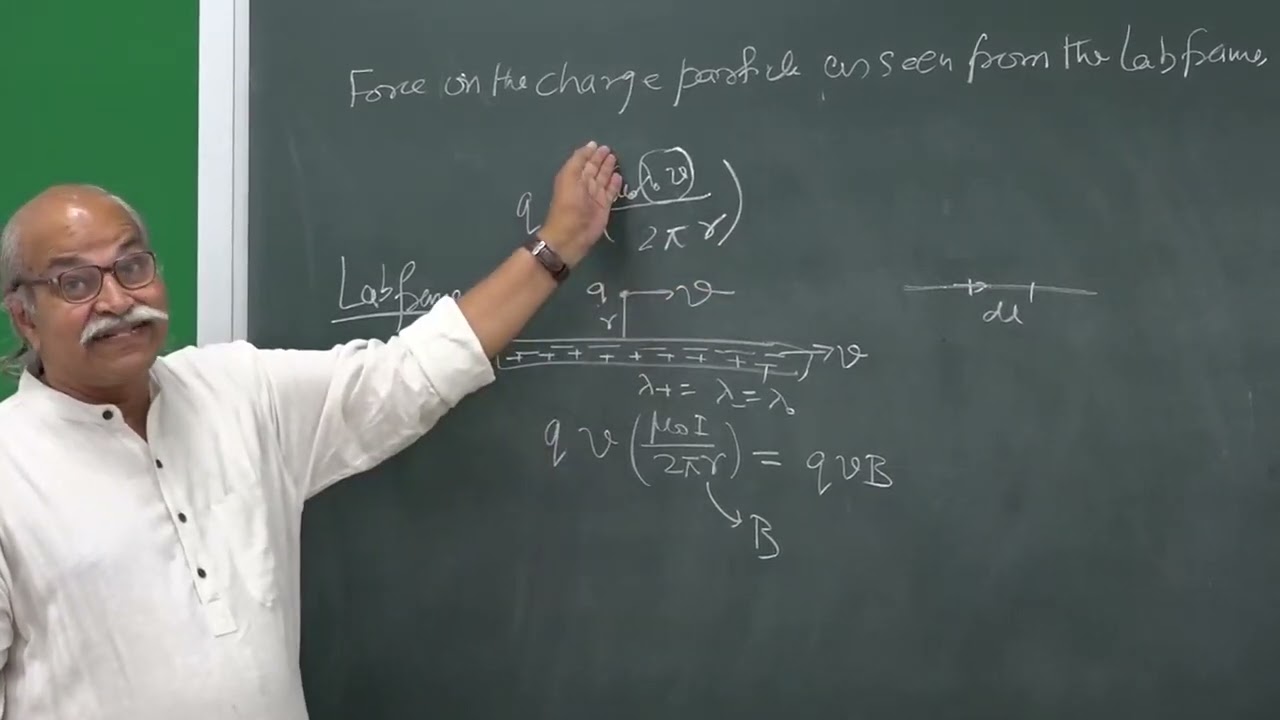
LEC 06 - Properties of Magnetic field
Keywords
Summary
197 words
Critical Evaluation
Value of the Information & Strength of the Argument
The lecture provides a clear and rigorous derivation of the magnetic field from special relativity, offering a deep insight into the nature of magnetism. The argumentation is logical and well-structured, building from a paradox to a resolution. The use of mathematical transformations is accurate and helps solidify the understanding of why magnetic fields exist. The explanation of the Lorentz force and its consequences is also solid, with a clear demonstration that magnetic forces do no work. The lecture is valuable for students seeking a conceptual and mathematical foundation in electromagnetism.
Scientific Rigor, Source Quality, Title Accuracy
The lecture is scientifically rigorous, relying on fundamental principles of special relativity and electromagnetism. The derivation is consistent with standard physics textbooks. The title accurately reflects the content, which focuses on the properties of magnetic fields. No external sources are cited, but the material is well-established physics. The lecture is a pedagogical presentation, not a research contribution, but it is accurate and reliable.
168 words
Title / Content Match
The title accurately reflects the content, which focuses on the properties of magnetic fields, including their origin from relativity and their effects on moving charges.
Quality & Reliability
8/10
The lecture is based on established physics principles (special relativity, electromagnetism) and derives the magnetic field from relativistic charge density transformations. The reasoning is coherent and mathematically sound, though it is a pedagogical presentation rather than a peer-reviewed source.
Key Moments
Markers derived by PSI from the transcript: the creator did not define chapters.
- Introduction to the thought experiment with a current-carrying wire and a moving charge.
- Derivation of net charge density in the trolley frame using length contraction.
- Calculation of electric field and force in the trolley frame.
- Transformation of force to lab frame and identification of magnetic field.
- Introduction of Lorentz force law and its implications.
- Explanation that magnetic forces do no work and cannot change speed.
- Discussion of magnetic field lines and their distinction from force lines.
- Definition of Tesla and examples of magnetic field strengths.
Contribution & Novelties
The lecture provides a unique pedagogical approach by deriving the magnetic field from special relativity, offering a deeper understanding than typical introductions. It emphasizes the relativistic origin of magnetism, which is often not highlighted in introductory courses.
Pour aller plus loin :
- Special relativity — Foundational theory behind the derivation.
- Lorentz force — The force law discussed in the lecture.
- Magnetic field — General overview of magnetic fields.
- Tesla (unit) — Definition and examples of the unit.
77 words
Radar Profile
The radar profile shows high scores in quality and reliability, with moderate scores in quantity and technical level. This indicates a focused, accurate lecture that provides solid foundational knowledge, though it may not cover a wide range of topics or delve into advanced technical details.