LEC 03 - Surface current density
Keywords
Summary
156 words
Critical Evaluation
Value of the Information & Strength of the Argument
The lecture provides a solid conceptual foundation for understanding surface current density, a key concept in electromagnetism. The argumentation is logical and builds on previous knowledge, using a concrete example (rotating charged cylinder) to illustrate volume current density and then extending the analogy to surfaces. The derivation of K = σv is clear and intuitive. The value lies in its pedagogical clarity, making it accessible to students. However, the argumentation is not rigorous in a formal sense; it relies on intuitive explanations rather than mathematical proofs. The instructor also spends time on coordinate systems, which is helpful but somewhat tangential. Overall, the content is valuable for learners but does not offer novel insights beyond standard textbook treatments.
Scientific Rigor, Source Quality, Title Accuracy
The lecture is scientifically sound, following standard definitions and notation from Griffiths’ ‘Introduction to Electrodynamics’. However, no sources are cited explicitly, and the presentation is informal, with some digressions and repetitions. The title accurately reflects the content, which focuses on surface current density. The lecture does not reference any external sources, so the quality of sources cannot be assessed beyond the implicit reliance on established physics. The pedagogical approach is clear, but the lack of citations reduces the scientific rigor. The content is appropriate for an undergraduate physics audience, though the informal style may not suit all learners.
230 words
Title / Content Match
The title accurately reflects the content, which focuses on defining and deriving surface current density.
Quality & Reliability
7/10
The lecture is a clear and systematic tutorial on surface current density, building on volume current density and using standard notation from Griffiths. The reasoning is logical and the examples are illustrative. However, it is a pedagogical exposition without citations or references to original sources, and the presentation is informal with some digressions.
Key Moments
Markers derived by PSI from the transcript: the creator did not define chapters.
- Introduction and review of volume current density
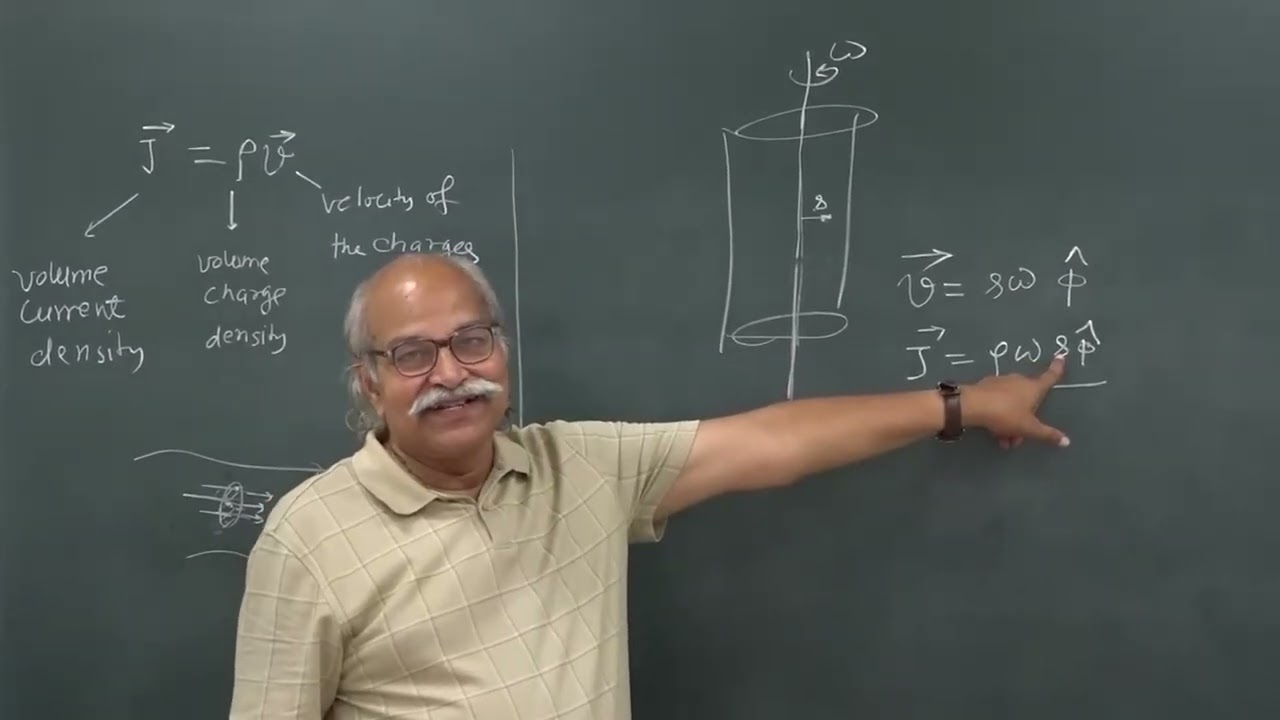
- Example: rotating charged cylinder, deriving J = ρωs φ̂
- Explanation of cylindrical coordinates (s, φ, z) and unit vectors
- Introduction of volume current element J dτ
- Definition of surface current and surface current density K
- Derivation of K = σv using a rectangle of length v dt
- Comparison of volume and surface current elements
- Discussion of linear current density as a preview
Contribution & Novelties
The lecture provides a clear pedagogical introduction to surface current density, building on volume current density and using a concrete example. It emphasizes the distinction between volume and surface currents and introduces the notation K = σv. The main contribution is its didactic value for students, though it does not present new research or novel perspectives.
Pour aller plus loin :
- Surface current density - Wikipedia — Provides a concise definition and context.
- Introduction to Electrodynamics by David J. Griffiths — The standard textbook reference for this topic.
- Maxwell’s equations - Wikipedia — For understanding the role of current densities in electromagnetism.
102 words
Radar Profile
The radar profile shows high scores in information quantity and quality, with moderate technical level and reliability. This indicates a well-structured tutorial that is informative and accurate, but not highly advanced or heavily sourced.