W12-04 Adding numbers #Digital #Electronics #CourseFINISHED #SemiconductorPhysics
Keywords
Summary
164 words
Critical Evaluation
Value of the Information & Strength of the Argument
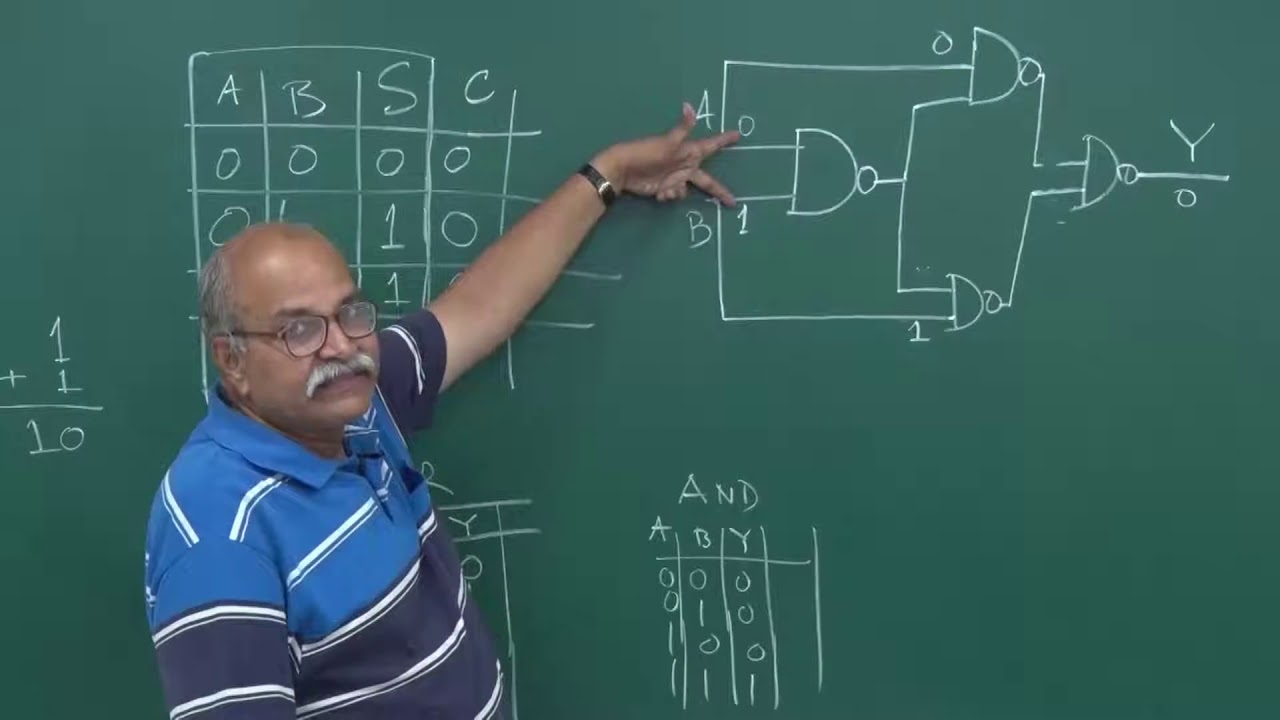
The lecture provides a solid, step-by-step explanation of how to build a half adder using NAND gates. The instructor carefully verifies the XOR gate’s behavior for all input combinations, reinforcing understanding. The argumentation is logical and clear, building from basic gates to more complex circuits. The value lies in its pedagogical approach, making complex digital logic accessible. However, the lecture does not discuss alternative implementations or potential limitations, which could be a drawback for advanced learners.
Scientific Rigor, Source Quality, Title Accuracy
The lecture is scientifically rigorous in its explanation of digital logic, with accurate truth tables and circuit designs. No external sources are cited, which is typical for a tutorial. The title accurately reflects the content, focusing on adding numbers in digital electronics. The lecture is part of a structured course, indicating a coherent curriculum. The absence of references is not a major issue given the foundational nature of the topic.
161 words
Title / Content Match
The title accurately reflects the content: the lecture focuses on adding binary numbers using digital circuits, specifically half adders built from NAND gates.
Quality & Reliability
7/10
The lecture is a clear, step-by-step tutorial on building a half adder using NAND gates, with detailed truth table analysis and circuit verification. The content is accurate and pedagogically sound, though it lacks references to external sources and does not address potential pitfalls or alternative implementations.
Key Moments
Markers derived by PSI from the transcript: the creator did not define chapters.
- Introduction to logic gates and universal gates (NAND, NOR).
- Truth table for binary addition (sum and carry).
- Identification of sum as XOR and carry as AND.
- Construction of XOR gate using four NAND gates.
- Verification of XOR gate for all input combinations.
- Construction of AND gate from NAND gates for carry.
- Combining XOR and AND to form half adder circuit.
- Introduction to full adder and its three inputs.
- Explanation of using two half adders and OR gate for full adder.
- Example of full adder carry calculation and conclusion.
Contribution & Novelties
The lecture provides a clear, step-by-step tutorial on building a half adder using NAND gates, which is a fundamental concept in digital electronics. It reinforces the universality of NAND gates and demonstrates practical circuit design. The approach is pedagogical, making it accessible to beginners.
Pour aller plus loin :
- Half adder — Wikipedia article on adders, including half and full adders.
- XOR gate — Wikipedia article on XOR gates, including implementations.
- NAND logic — Wikipedia article on NAND logic, explaining how NAND gates can be used to build any logic circuit.
91 words
Radar Profile
The radar profile shows high scores in quality of information and technical level, indicating a well-structured and accurate tutorial. The quantity of information is moderate, and the global reliability is solid, reflecting the absence of external sources but the correctness of the content.